
Victron Energy vs Selectronic: The Ultimate Off-Grid Inverter Comparison 2026

Living off-grid in the Australian bush means your inverter is the heart of your home. If it fails, everything stops. You might think all high-end systems are equal, but our latest victron energy vs selectronic off grid inverter comparison for 2026 reveals that the right choice depends on your specific power demands. Selecting between these two giants involves more than just comparing spec sheets. It's about how your system handles a mid-summer heatwave or a week of heavy rain.
We understand that the fear of total power failure is real, particularly when technical support is hundreds of kilometres away. You need a bulletproof system that manages heavy loads without breaking a sweat. This guide will show you which powerhouse fits your property based on reliability, architecture, and long-term support. We will break down the AC versus DC coupling debate, seamless generator integration, and which brand offers the best remote monitoring for your peace of mind.
Table of Contents
Choosing Your Off-Grid Heart: Victron vs Selectronic
When you move away from the grid, your inverter/charger becomes the undisputed brain of your home. It doesn't just convert power; it manages the delicate balance between your solar panels, battery bank, and backup generator. In the context of stand-alone power systems, this component dictates how reliably your lights stay on when a storm hits or when you start a power-hungry appliance. Making a victron energy vs selectronic off grid inverter comparison is the most critical decision you'll face in your off-grid journey. One brand offers a flexible, global ecosystem, while the other provides rugged, Australian-engineered muscle.
The choice between these two powerhouses isn't about which one is "better" in a vacuum. It's about which one matches your lifestyle and technical requirements. Victron Energy brings a modular, tech-forward approach that appeals to those who love data and scalability. Selectronic offers a heavy-duty, industrial-grade solution that has been the backbone of Australian off-grid living for decades. As expert installers, we see how these systems perform "under the hood" every day, and the differences are significant when it comes to long-term reliability and ease of use.
The Victron Philosophy: Modular and Scalable
Victron Energy has built its reputation on a modular "blue box" ecosystem. The beauty of this setup lies in how components like the MultiPlus-II inverter/charger and the Cerbo GX communication hub work together. It's a highly versatile approach. You can start with a modest system for a small weekend cabin and scale it up to a large commercial site without reinventing the wheel. Their software is famously open-source, supported by a massive global community that ensures your system stays modern through constant firmware updates.
The Selectronic Philosophy: Robust Australian Engineering
Selectronic represents the gold standard for heavy-duty off-grid reliability. Their flagship SP PRO series is widely regarded by professionals as "over-engineered" for longevity. While some brands focus on sleek aesthetics, Selectronic prioritises raw performance and high surge capacity. This is vital if your property relies on deep-well pumps, large air conditioning units, or workshop motors that require a massive "kick" of power to start. When you choose Selectronic, you're investing in Australian manufacturing pride and local technical support that understands our harsh climate.
Ultimately, your victron energy vs selectronic off grid inverter comparison should come down to your specific load profile. If you have a complex array of modern electronics and want world-class remote monitoring, Victron is hard to beat. If you're running a working station with heavy machinery and need an inverter that's built like a tank, Selectronic is the traditional choice for a reason. Both brands offer exceptional quality, provided they are designed and installed by professionals who understand the nuances of off-grid engineering.
Technical Architecture: AC Coupling vs DC Coupling
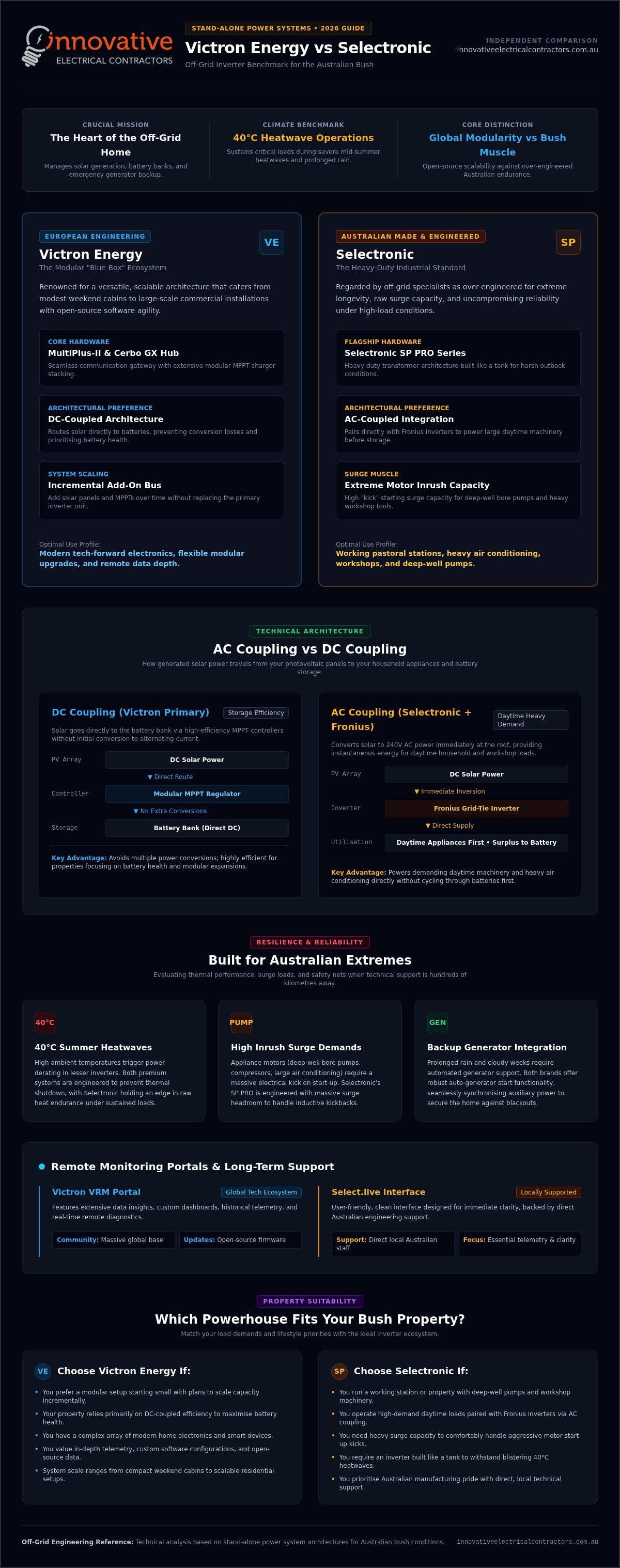
The technical foundation of your off-grid system rests on how your solar energy reaches your batteries and appliances. In any victron energy vs selectronic off grid inverter comparison, the debate between AC and DC coupling is central. DC coupling sends solar power directly to the batteries via a charge controller. AC coupling converts solar power to AC first, allowing it to be used by appliances before it ever reaches the battery. For those new to these concepts, the Energy.gov.au solar PV and battery guide provides a solid baseline for understanding how these configurations impact energy self-sufficiency.
By 2026, the lines between these architectures have blurred. Both brands now offer hybrid solutions that combine the best of both worlds. However, their core engineering still favours specific setups. Victron remains the global leader in DC-coupled efficiency, while Selectronic continues to dominate the AC-coupled space through its sophisticated integration with European grid-tie inverters. Your choice often depends on when you use the most power during the day.
When to Choose a DC-Coupled Victron System
Victron systems are traditionally built around a DC-coupled architecture. This setup is incredibly efficient for charging batteries because it avoids multiple power conversions. It is the ideal choice for smaller systems or properties where battery health and charging efficiency are the primary goals. Adding more solar is simple; you just add another modular MPPT charge controller to the bus. This modularity is a key part of modern electrical services for remote properties, allowing for easy system growth without replacing the main inverter. If your power needs are modest but reliability is paramount, Victron’s DC-heavy approach is hard to beat.
The Power of AC Coupling with Selectronic
Selectronic is the undisputed king of AC coupling in Australia. By using a "Managed AC" link, the Selectronic SP PRO can communicate directly with Fronius inverters. This allows the system to power heavy daytime loads, like air conditioning or workshop machinery, directly from the solar panels. It bypasses the batteries entirely during the day, which reduces wear and tear on your storage bank. This architecture is superior for large residential or commercial sites with high daytime demand. It also simplifies future expansions, as you can often add more AC-coupled solar without rewiring the entire DC switchboard.
Choosing the right architecture requires a deep understanding of your daily habits and load profile. Whether you need the DC efficiency of a Victron setup or the raw AC power of a Selectronic system, professional engineering ensures your investment lasts for decades. If you are unsure which path suits your property, our team can help you design a custom off-grid solution that guarantees power security in any conditions.
Performance in Harsh Australian Conditions
Australia's climate is a brutal testing ground for electronics. In any victron energy vs selectronic off grid inverter comparison, how a unit handles a 45°C afternoon is more important than a glossy brochure. Surge capacity is the ability to provide short-term peak power for motor starting, and it is where these two brands show their true colours. While both are built for longevity, they approach heat and heavy loads with different engineering philosophies.
To address the current 2026 technical landscape, we have outlined the core performance differences below. This data reflects how these units perform under the hood when pushed to their limits in rural environments.
Surge Capacity and Motor Starting
The Selectronic SP PRO series is famous for its 300% surge rating. This means a 5kW inverter can briefly provide 15kW of power to kick-start a stubborn bore pump or a large workshop compressor. For rural properties, this massive headroom prevents the inverter from tripping out when multiple heavy loads start simultaneously. Victron units are incredibly capable, but they generally offer a lower surge ceiling. If your property relies on heavy induction motors, the "over-engineered" Selectronic approach provides a level of peace of mind that is hard to match. It reduces stress on internal components, ensuring the electronics don't cook themselves during high-demand events.
Efficiency and Idle Consumption
Efficiency isn't just about how much power you can pull; it is about how much you lose. Victron is the master of low idle consumption. Their units "waste" very little energy just staying turned on at night. This is vital for winter reliability when every amp-hour in your battery bank is precious. While Selectronic has improved its idle draw in recent models, Victron remains the more efficient choice for systems where solar harvest is limited. However, Selectronic counters this with superior thermal management. In a scorching Australian summer, the SP PRO maintains its output while other inverters might throttle back to protect themselves from overheating. Both brands offer excellent build quality, but your specific environment—whether it is a dusty station or a temperate coastal block—will dictate the best fit.
Monitoring, Support, and the "Australian-Made" Factor
When you're living hundreds of kilometres from the nearest town, being able to monitor and troubleshoot your power system from a smartphone isn't a luxury. It is a necessity. This part of our victron energy vs selectronic off grid inverter comparison looks at the software and support networks that keep your lights on. Victron is widely regarded as having the world's best remote monitoring portal. Selectronic, however, leans on its deep Australian heritage to provide unmatched local technical support when things get tough.
The Victron Remote Management (VRM) portal is a data-lover's dream. It provides granular detail on every aspect of your system, from solar yield to individual battery cell voltages. Selectronic’s Select.live offers a more streamlined experience. It focuses on the essential information a homeowner needs without the complexity of industrial-grade analytics. If a component fails in a remote location, the difference between these two brands often comes down to who is on the other end of the phone and how quickly parts can reach your gate.
Remote Management and Troubleshooting
Victron’s ecosystem allows installers to perform deep-dive diagnostics without stepping foot on your property. By using a GX device, we can adjust inverter settings or update firmware remotely. This capability saves you significant time and travel costs. For the homeowner, the Victron app is fast and intuitive. Monitoring your energy usage becomes as simple as checking the weather. Staying on top of these metrics is also a vital part of solar battery maintenance, as it helps you spot potential issues before they lead to a total power failure.
Warranty and Serviceability
Selectronic holds a significant advantage for those who value Australian-made reliability. Their engineers are based right here, meaning technical support is in your time zone and understands local challenges like extreme heat and dust. Sourcing spare parts for an SP PRO is typically straightforward because the manufacturing happens locally. Victron offers a robust 5-year warranty, which is often extendable to 10 years, supported by a large network of Australian service centres. While Victron is a global company, their commitment to the Australian market ensures you aren't left stranded without support.
Choosing between a global tech leader and a local engineering powerhouse depends on your comfort level with technology. If you want the most advanced remote tools and a massive modular ecosystem, Victron is the frontrunner. If you prefer a system built by Australians for Australian conditions, Selectronic remains the benchmark. To ensure your system is configured for maximum reliability and safety, book a professional off-grid consultation with our team today.
Designing Your Perfect Off-Grid Power System
Choosing between these two powerhouses is the final step in a broader engineering process. While your victron energy vs selectronic off grid inverter comparison helps identify the core hardware, the success of your system depends on how well it is sized for your specific daily habits. A system that works for a retired couple in a coastal cottage won't survive the demands of a working station with three air conditioners and a cold room. Professional system design ensures you aren't just buying parts, but a guaranteed energy solution that handles your peak loads without stress.
One often overlooked element is the backup generator. In an off-grid environment, the generator is your insurance policy for those long periods of rain or heavy winter cloud cover. Victron systems manage this through the Cerbo GX, providing sophisticated start/stop logic based on the battery state of charge. Selectronic SP PRO inverters feature industrial-grade internal relays that can handle complex generator interactions with extreme precision. Integrating these components correctly is what separates a truly reliable home from one that leaves you in the dark when the weather turns.
The Verdict: Which Brand Wins for You?
There are no wrong answers here, only better fits for your lifestyle. If you value a high-tech, modular ecosystem with world-class remote monitoring, Victron Energy is likely your best choice. It is perfect for those who want to see every watt of energy flow on their smartphone and appreciate a scalable "blue box" setup. However, if your property runs heavy induction motors or you feel more comfortable with Australian-made ruggedness and local technical support, Selectronic remains the benchmark. Both brands are Tier 1 options that, when installed correctly, will provide decades of service in our harsh climate.
Partnering with an Expert Installer
Compliance with Australian standards, specifically AS/NZS 5033 and AS/NZS 4777, is non-negotiable for safety and insurance purposes. Off-grid systems are complex, involving high-voltage DC arrays and large battery banks that require precise fault-finding expertise. Innovative Electrical Contractors integrates batteries, solar, and generators into a seamless package designed for total peace of mind. We don't believe in "off-the-shelf" kits because every property has a unique load profile that deserves a custom approach. To get started, consult our off-grid specialists for a custom system design and ensure your power security for years to come.
Secure Your Off-Grid Future Today
Deciding between these two industry giants depends on your property's specific energy profile. Our victron energy vs selectronic off grid inverter comparison highlights that while Victron excels in modular flexibility and world-class data monitoring, Selectronic remains the benchmark for raw Australian-made durability. Whether you need the sophisticated DC efficiency of a Victron setup or the heavy-duty surge capacity of a Selectronic SP PRO, the key is professional engineering. A well-designed system ensures you never have to worry about the lights flicking off during a storm or a heatwave.
At Innovative Electrical Contractors, we specialise in high-end off-grid solutions that integrate solar, batteries, and backup generators into a single, bulletproof ecosystem. Our specialised engineers provide Australia-wide service, ensuring your installation meets the highest safety standards for total peace of mind. Don't leave your power security to chance with a generic kit. Instead, get a professional off-grid system design from Innovative Electrical Contractors to ensure your property is ready for anything the Australian climate throws at it. You deserve a system that works as hard as you do.
Frequently Asked Questions
Is Selectronic still made in Australia in 2026?
Yes, Selectronic remains a proudly Australian-owned and operated manufacturer in 2026. Their engineering and production facilities are located within Australia, which is a major advantage for local homeowners. This local presence means technical support is available in your time zone and spare parts don't have to cross an ocean. It also ensures the hardware is specifically designed to withstand the extreme heat and dust common in rural Australian environments.
Can I use a Victron inverter with a Selectronic battery system?
You can certainly use a Victron inverter with various battery types, including those often paired with Selectronic systems. Victron’s Cerbo GX device communicates with a wide range of managed lithium batteries via CAN-bus protocols. While it is possible to mix components, we generally recommend a unified brand ecosystem where possible. This approach ensures more accurate data reporting and simplifies the troubleshooting process if a fault ever occurs within your stand-alone power system.
Which inverter is better for starting a large air conditioner off-grid?
Selectronic is typically the superior choice for starting heavy induction loads like large air conditioners or bore pumps. The SP PRO series features a massive 300% surge capacity, allowing it to handle the significant "kick" required to start a compressor. While Victron units are highly capable, they generally offer lower peak power ratings. Choosing a Selectronic inverter provides the extra headroom needed to run high-demand appliances without the risk of system trips.
Does Victron or Selectronic have better remote monitoring?
Victron is widely regarded as having the most advanced remote monitoring portal in the world. The Victron Remote Management (VRM) platform provides incredible detail, allowing you to track everything from solar yield to individual battery cell health. This victron energy vs selectronic off grid inverter comparison shows that while Selectronic’s Select.live is user-friendly and effective, it doesn't quite match the granular data and remote configuration capabilities offered by the Victron ecosystem.
What is the warranty difference between Victron and Selectronic?
Victron typically offers a standard 5-year warranty that can be extended to 10 years upon registration or through specific installers. Selectronic provides a robust warranty for their SP PRO series, often reaching 10 years when installed by an accredited professional. Both brands have established Australian service centres, ensuring you aren't left stranded. The main difference lies in Selectronic’s ability to offer factory-level repairs directly from their Australian manufacturing base.
Can I integrate a backup generator with both Victron and Selectronic?
Both brands offer seamless integration with backup generators, which is essential for off-grid reliability. Victron uses the Cerbo GX to automate generator starting based on battery voltage or state of charge. Selectronic inverters include heavy-duty internal relays designed specifically for complex generator control and load shedding. A professional victron energy vs selectronic off grid inverter comparison shows that both ecosystems provide the safety net required during extended periods of low solar harvest.
Which brand is more cost-effective for a standard 3-bedroom off-grid home?
Victron is often considered more cost-effective for standard residential builds due to its modular nature. You can start with exactly what you need and add more components as your budget allows. Selectronic is a premium, heavy-duty investment that prioritises industrial longevity and raw power. The best choice depends on whether you value technical flexibility and data insights or a rugged, "fit and forget" solution designed for the most demanding Australian conditions.
Do I need a specialised electrician to install these systems?
You absolutely need a specialised off-grid electrician to install these complex systems. Off-grid power involves high-voltage DC arrays and sophisticated battery management that standard residential electricians may not be trained for. Installers must be accredited for stand-alone power systems to ensure your installation is safe and compliant. Professional installation is also a mandatory requirement for maintaining your manufacturer warranties and ensuring your property insurance remains valid.

Comments