
Tax incentives for business solar power in Australia: rebates
Tax incentives for business solar power in Australia can include upfront small-scale technology certificate benefits and tax deductions. Eligibility depends on the system, the business and the rules that apply.
It’s natural to look for one clear rebate figure, but support can vary by location and installation. A rebate is different from a tax deduction or a finance option. Understanding which applies can help you assess potential value before planning a system.
This guide explains how federal certificate support works, which state and territory rebates may apply, and what asset write-off and Small Business Energy Incentive rules mean for solar. It also outlines financing options and key eligibility factors to help you make an informed decision for your business, with support from Innovative Electrical Contractors.
Key Takeaways
Differentiate upfront certificate support, rebates, financing and tax deductions: each works differently and has its own eligibility criteria.
Federal small-scale technology certificate support may apply to eligible solar systems under 100 kW, with the value influenced by system size and location.
In Victoria, Solar Victoria's Commercial Solar Rebate covers solar PV systems sized from 30 kW to 200 kW.
Environmental Upgrade Agreements can help spread eligible project repayments over time, which may suit businesses managing larger upgrades.
Asset write-off and energy-efficiency incentive rules depend on the asset, the business and when it was installed or made ready for use.
Table of Contents
What are the benefits of commercial solar panels?
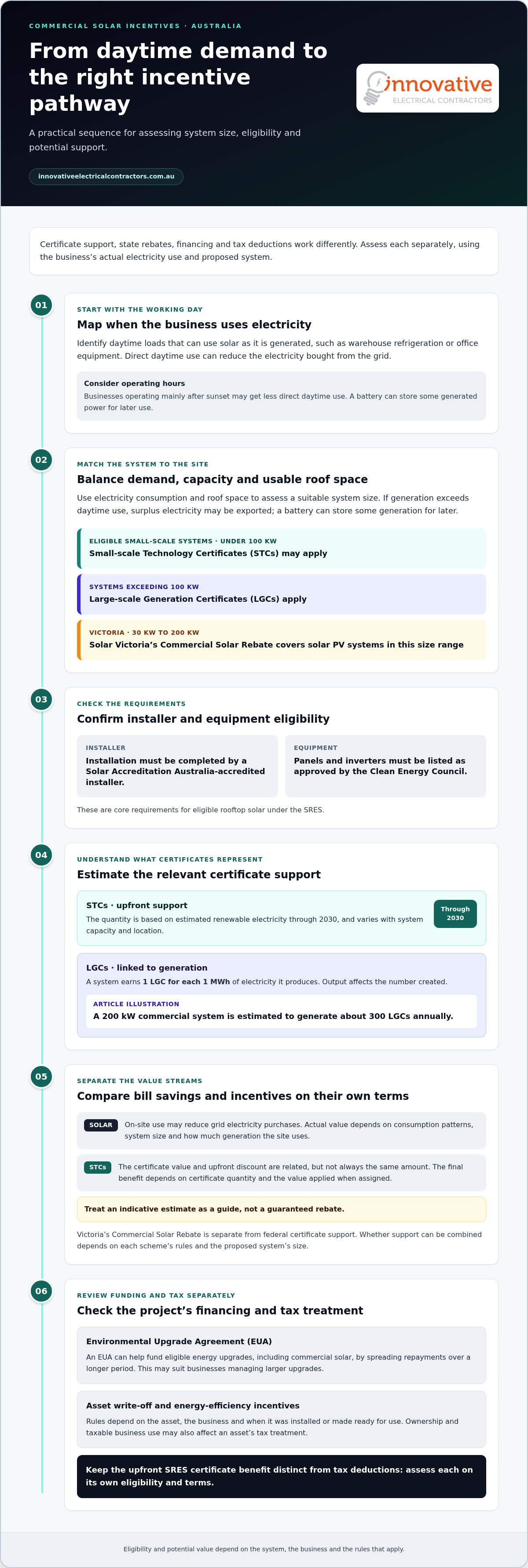
Commercial solar can reduce the electricity a business buys from the grid. The most direct benefit often comes from using generated power during daylight hours. For example, a warehouse running refrigeration or office equipment during the day can use solar as it is produced. This may also reduce exposure to electricity costs over time. Actual value depends on consumption patterns, system size and how much generation the site uses.
Solar incentives can add support, but certificates work differently across system sizes. Eligible rooftop installations can receive Small-scale Technology Certificates (STCs) under Australia’s Small-scale Renewable Energy Scheme (SRES). The certificate calculation uses estimated generation through 2030. To qualify, installation must be completed by a Solar Accreditation Australia-accredited installer, with approved panels and inverters listed by the Clean Energy Council. These requirements make equipment and installer eligibility important.
STCs generally support eligible small-scale systems, while Large-scale Generation Certificates (LGCs) apply to Australian solar installations exceeding 100 kW. Under the Large-scale Renewable Energy Target (LRET), a system earns 1 LGC for each 1 MWh of electricity it produces. The certificates are linked to generation, so output affects the number created. A 200 kW commercial system is estimated to generate about 300 LGCs annually.
Certificate value can influence project economics, but it is indicative rather than a fixed payment for every installation. STC support, by contrast, is an upfront incentive based on eligible generation. Both mechanisms can help with installation costs, but they are not interchangeable. System capacity and eligibility determine which pathway may apply.
In Victoria, Solar Victoria's Commercial Solar Rebate covers solar PV systems sized from 30 kW to 200 kW. This state rebate is separate from federal certificate support. A Victorian business should therefore distinguish the state programme from STCs or LGCs when assessing incentives. Combining available support depends on each scheme’s rules and the proposed system’s size.
Solar can support practical business goals beyond certificates. Using electricity on site can reduce grid purchases, while a battery can store power for later use. A business that operates mainly after sunset may benefit less from direct daytime use, though a system sized around daytime demand can still contribute. Solar may also help a property appeal to prospective tenants or buyers and demonstrate environmental action to customers.
Before comparing incentives, map electricity use across the working day and identify which loads can run during solar generation. Then compare system capacity with the relevant certificate or rebate criteria. Separating expected bill savings from incentive value gives you a clearer picture of the overall commercial case.
Federal SRES support for solar systems under 100 kW
A sale, lease or change in business use can affect an asset’s tax treatment because ownership and taxable use matter. The upfront SRES certificate benefit is separate from tax deductions, so assess each on its own terms.
Under the federal Small-scale Renewable Energy Scheme (SRES), eligible rooftop solar installations can receive Small-scale Technology Certificates (STCs). For eligibility calculations, the system size is capped at 100 kW.
STCs represent the estimated renewable electricity a system will generate through 2030. The number depends on system capacity and location, so two businesses installing the same capacity may receive different certificate quantities. Eligible rooftop solar must be installed by a Solar Accreditation Australia-accredited installer, and panels and inverters must be listed as approved by the Clean Energy Council. These are core eligibility requirements, not optional design choices.
For a practical illustration, the roof space and panel count needed for a system depend on its design. A smaller roof or lower daytime demand may point towards a lower-capacity system. Use the business’s electricity consumption to assess the size that can serve its operations. A system that generates more than the site uses during daylight may export surplus electricity, while a battery can store some generation for later use.
The certificate value and upfront discount are related, but they are not always the same amount. The final benefit depends on the number of certificates and the value applied when they’re assigned. Treat an indicative per-kilowatt estimate as a guide, not a guaranteed rebate.
To compare a proposed system with SRES support, first estimate the site’s daytime demand, then match capacity to usable roof space. Next, assess installer and equipment eligibility, and factor the resulting certificate value into the project’s financial assessment. This keeps the rebate calculation connected to the system the business can actually use. For a clearer view of commercial solar system planning, consider how generation, demand and battery storage fit together.
A sale, lease or change in taxable business use may affect a system’s tax treatment, depending on ownership and how it is used. Assess the SRES certificate benefit separately from tax deductions.
Environmental Upgrade Agreements
Yes. Australian states and territories offer additional commercial energy incentives, although programmes and eligibility vary. Examples include Victoria’s commercial solar rebate, New South Wales’ Energy Saver program and Queensland’s regional Business Energy Savers program.
An Environmental Upgrade Agreement (EUA) can help a business fund energy upgrades, including commercial solar. Rather than relying only on an upfront rebate, an EUA can spread repayments over a longer period. Repayment periods can reach 20 years for Australian commercial solar systems. This structure may suit a business planning panels alongside broader energy-efficiency improvements.
The Sustainable Australia Fund reported funding over A$50 million in commercial solar projects through EUAs last year. That shows how the agreement structure has been used to support commercial projects. It doesn’t make an EUA a rebate or tax credit. Instead, it is a financing option, so a business should assess repayment commitments alongside expected electricity savings and other available incentives.
Victoria’s initiative targets around 57,000 high-energy-use sites, including factories, warehouses and food processors. These businesses may have substantial electricity demand across long operating hours. Solar generation can offset some grid purchases, while a broader upgrade may address energy use elsewhere on site. The right project scope depends on the property and its energy needs.
State programmes can sit alongside financing, but each has its own criteria. Solar Victoria’s Commercial Solar Rebate covers solar PV systems sized from 30 kW to 200 kW. New South Wales’ Energy Saver program offers matched funding of up to 50% of project costs.
These examples aren’t interchangeable. A Victorian business considering a 200 kW system may assess the Solar Victoria rebate, while a regional Queensland business may consider the relevant co-contribution grant. An EUA addresses project financing over time; a rebate or grant reduces eligible project costs under its programme rules. The business’s location and project type shape which options are relevant.
Before comparing an EUA with a rebate, define the upgrade you plan to fund. Separate the solar panels from other proposed measures, estimate how electricity use may change, and compare each measure with the funding programme’s scope. Then assess the repayment period against your business’s operating plans. This helps clarify whether spreading repayments offers an advantage over relying on upfront support alone.
For a business focused on sustainability, the decision is about more than credit or funding. It also means matching the project to the site’s energy profile. A factory with steady daytime demand may use generated solar electricity directly, while a warehouse may need to account for its operating schedule. This context helps frame financing around practical use.
Business solar asset write-off eligibility
An asset write-off is a tax deduction, not an upfront rebate or certificate discount. It affects how eligible business expenditure is treated for tax purposes. For commercial solar, the asset’s cost, installation timing, business use and entity eligibility all matter. A clean energy investment may include solar panels, storage and monitoring equipment, but tax rules may treat each asset differently. Large-scale Generation Certificates are separate from deductions and do not determine write-off eligibility.
The instant asset write-off limit was A$20,000 for assets first installed between 1 July 2023 and 30 June 2026. That period has ended, so the limit should not be treated as an ongoing entitlement for installations made after 30 June 2026. Eligibility also depends on the relevant small business rules and whether the asset is used for the business. A solar system’s capacity alone does not establish that it qualifies.
The Small Business Energy Incentive was a separate, time-limited bonus deduction. It provided a bonus deduction of 20% of eligible expenditure incurred from 1 July 2023 to 30 June 2024, with eligible expenditure capped at A$100,000 per entity. The maximum bonus deduction was A$20,000 per entity. Businesses with aggregated annual turnover of less than A$50 million could qualify, subject to the other rules.
Solar panels whose sole or predominant purpose is generating electricity cannot receive the Small Business Energy Incentive bonus deduction. Eligible expenditure may instead involve energy storage, time-shifting or monitoring assets, or improvements that increase another asset’s energy efficiency. A depreciating asset must also be deductible under other tax provisions. For an improvement to an existing asset, the expenditure had to be incurred within the incentive period.
Timing and use were central to the incentive. A depreciating asset had to be used, or installed ready for use, for a taxable purpose during the eligible period. Assets capable of using fossil fuels were excluded unless fossil fuel use was merely incidental. GST-registered businesses calculated the bonus deduction on eligible expenditure net of GST claimed as an input tax credit. These conditions distinguish a qualifying clean energy upgrade from a general renewable energy purchase.
Turnover thresholds also differed across measures. Businesses with aggregated annual turnover of less than A$10 million could have been eligible to claim both the instant asset write-off and the energy incentive in the 2023-24 income year, if they met the other criteria. That threshold should not be confused with the A$50 million limit for accessing the energy incentive. For a business assessing a solar investment, separate the system’s tax treatment from any certificate or rebate value, then match each claim to its relevant date, asset and business-use rules.
What are the latest federal tax rules and end dates for business solar incentives?
Federal support for business solar includes certificate incentives and tax measures, but their timelines differ. The Small-scale Renewable Energy Scheme (SRES) is being phased out until 2030. For businesses, that makes installation timing relevant: certificate eligibility and value may change as the scheme approaches its end date. Tax deductions have separate rules and shouldn’t be treated as another name for a solar rebate.
A key change concerns mid-scale solar PV. According to the Australian Government, intended SRES changes for mid-scale installations apply to systems installed from 1 October 2026, subject to regulations being in place. This date matters for businesses planning installations around the scheme’s system-size categories. The certificate pathway depends on the system and applicable rules, so don’t assume every commercial installation receives the same support.
Tax incentive dates require similar care. The Small Business Energy Incentive covered eligible expenditure incurred from 1 July 2023 to 30 June 2024. It provided a 20% bonus deduction, with eligible expenditure capped at A$100,000 per entity and a maximum bonus deduction of A$20,000 per entity. Those dates are in the past, so this bonus deduction isn’t an ongoing incentive for new expenditure.
The instant asset write-off limit was A$20,000 for assets first installed between 1 July 2023 and 30 June 2026. That eligibility period has also ended. Earlier announcements can cause confusion: the Australian Government increased the threshold from A$30,000 to A$150,000 in 2020 as part of a pandemic-era stimulus package. That historical measure doesn’t establish the current threshold for a new solar installation.
Accelerated depreciation is another historical measure to distinguish from current rules. The cited 2020 stimulus package described an additional deduction of 50% of an asset’s cost in its year of purchase. It shouldn’t be assumed to apply to an installation made now. For any proposed investment, separate the installation date, the asset type and the business’s taxable use before assessing a deduction.
These timelines show why certificate support and tax treatment need separate assessment. STCs are linked to eligible solar generation, while deductions depend on the tax rules applying to the asset and business. A battery, monitoring equipment and solar panels may receive different treatment. Record the relevant installation and expenditure dates, then assess each component against the applicable incentive period and eligibility criteria.
For a project planned around federal incentive dates, discuss commercial solar planning and how system design fits the site’s energy use.
Innovative Electrical Contractors: Commercial Electrical
Innovative Electrical Contractors provides Commercial Electrical and Solar & Battery services for businesses considering a solar project. If you’re assessing solar generation, battery storage or off-grid power, these services can support the electrical work involved.
Start by outlining how your premises uses electricity and what you want the system to achieve. This gives the project a practical basis, whether you’re planning a grid-connected upgrade or considering off-grid solar, battery and generator solutions. Tax treatment is separate from system design, so consider both as your plans develop.
To discuss a commercial electrical or solar project, contact Innovative Electrical Contractors.
Turn your solar plans into a practical next step
A sound decision on tax incentives for business solar power in Australia starts with a project plan that connects financial priorities to the way your premises operates. Set out your energy goals, the equipment you’re considering and suitable timing for your business. This gives your accountant clearer information to assess tax treatment and keeps system design grounded in your operational needs.
Innovative Electrical Contractors provides Commercial Electrical and Electrical Services, alongside off-grid solar, battery and generator solutions. These services can support businesses planning a grid-connected upgrade, a standalone power setup or broader electrical work as part of a site project. Tax advice and electrical planning address different parts of the decision, so keep both in view as your plans take shape.
For a practical discussion about your business’s electrical or solar project, contact Innovative Electrical Contractors. A clear starting point can help you move ahead with confidence and make a considered choice for your premises.
Frequently Asked Questions
What is the rebate?
“Rebate” can also refer to support delivered through certificates or a state programme, rather than one universal payment. The amount a business receives depends on the incentive pathway, location and installation. Treat a rebate as one part of the project’s financial assessment, not a guaranteed cash payment.
What is the aim of this incentive?
The incentive aims to encourage businesses to invest in renewable energy and reduce reliance on grid electricity. In practice, solar can reduce grid purchases when generation matches operating hours. Incentives can also improve the upfront economics of eligible equipment. For example, a workshop using machinery during daylight may use more of its solar generation directly than a site with peak demand overnight.
Why solar power for your business?
Solar can help a business generate electricity for its own operations using its roof or site. The business case is strongest when daytime demand aligns with panel output, such as refrigeration, office equipment or production machinery running during daylight. A battery can store some generation for later use. Solar may also support sustainability goals, but system design should start with the business’s actual electricity-use pattern.
What Australian tax incentives are available for businesses installing solar power in 2026?
Tax incentives for business solar power in Australia in 2026 may include SRES certificates for eligible rooftop systems and state-based commercial rebates, depending on system size and location. Small businesses may also access a federal battery incentive for batteries with nominal capacity from 5 to 100 kWh. The A$20,000 instant asset write-off period ended for assets first installed after 30 June 2026. Check the relevant asset and timing rules before forecasting support.
Can businesses claim an instant asset write-off or accelerated depreciation for commercial solar systems?
The A$20,000 instant asset write-off applied to eligible assets first installed between 1 July 2023 and 30 June 2026, so that period has ended for new installations. The earlier 50% accelerated depreciation deduction was part of a 2020 stimulus package, not a current general solar rebate. Commercial solar assets may still be depreciated under ordinary tax rules, depending on business use and tax treatment.
What are the eligibility rules and asset thresholds for business solar tax deductions in Australia?
Businesses assessing tax incentives for business solar power in Australia need to consider turnover, asset type, taxable use and installation timing. The former instant write-off threshold was A$20,000 for eligible assets first installed by 30 June 2026. The Small Business Energy Incentive applied to eligible expenditure in 2023-24, with an aggregated turnover limit below A$50 million. Solar panels whose main purpose is generating electricity were excluded from that bonus deduction.
How does the small-scale technology certificate (STC) scheme reduce the cost of business solar?
Under the SRES, eligible rooftop solar systems can generate STCs based on estimated electricity generation through 2030. The certificates can be assigned to reduce the upfront system cost, rather than requiring the business to wait for future electricity savings. Eligibility involves the system, approved panels and inverters, and an accredited installer. The STC calculation uses a system-size cap of 100 kW, so additional capacity doesn’t increase that calculation.
Can large commercial solar systems receive large-scale generation certificates (LGCs) in Australia?
Yes. Australian solar installations exceeding 100 kW can be eligible to create LGCs under the Large-scale Renewable Energy Target. Certificates relate to electricity produced, so generation records matter to the number earned. For example, a 200 kW system is estimated to generate about 300 LGCs annually. LGCs are distinct from STCs, and system capacity and generation determine which certificate scheme is relevant.
Comments