
The Ultimate Guide to Modern Home Electrical Systems in Australia

What if your home’s electrical system could do more than keep the lights on? Modern home electrical systems connect the switchboard, circuits and outlets with technologies such as solar, battery storage and smart controls. But rising power bills and ageing wiring can leave homeowners unsure where to start, or whether new energy equipment will work safely with what’s already in place.
Those concerns are understandable. A safe, efficient home depends on components that work together and are maintained before problems arise. This guide explains the parts of a modern electrical system and how to plan upgrades. You’ll learn how to assess older wiring and switchboards, check solar and battery compatibility, improve energy efficiency and follow practical maintenance steps. We’ll also cover how professional installation supports safety and helps you plan for future needs, from changing household energy use to new technology. The aim is to give you a clear path towards a system that’s reliable today and ready for what comes next.
Table of Contents
The Anatomy of Modern Australian Home Electrical Systems
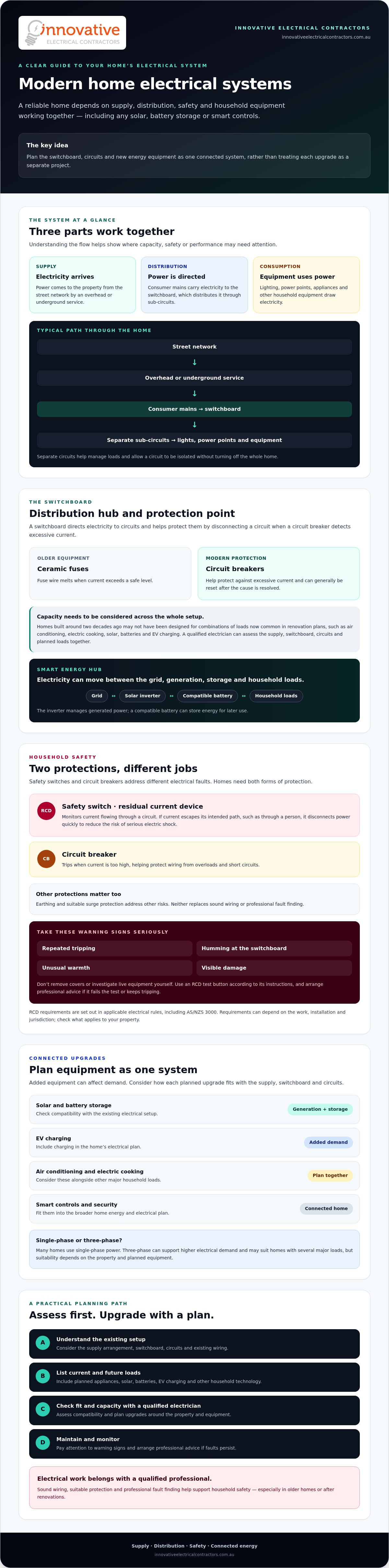
A home’s electrical setup is more than wires running to power points. It’s a connected network with three parts: supply, which brings electricity to the property; distribution, which routes it through the home; and consumption, where appliances, lighting and other equipment use it. Understanding these parts makes it easier to plan upgrades and identify where added demand could affect safety or performance.
In many Australian properties, electricity reaches the home from the street network through an overhead or underground service. The point of attachment is where an overhead service connects to the building. Consumer mains then carry electricity to the switchboard. Details vary with the property and supply arrangement. For a foundational overview of home electrical wiring, see the general principles behind residential circuits and connections.
Homes built around two decades ago may not have been designed for the combination of electrical loads now common in renovation plans, such as air conditioning, electric cooking, solar, batteries and EV charging. The answer isn’t simply to add more equipment. The supply, switchboard and circuits need to be considered together, with capacity and future needs assessed by a qualified electrician.
From Mains to Power Points: How Electricity Flows
After reaching the switchboard, power travels through separate sub-circuits to areas or types of use, such as lighting, general power points and higher-demand equipment. This organisation helps manage loads and makes it possible to isolate a circuit without turning off the whole home.
Many homes use single-phase power. Three-phase power can support higher electrical demand and may suit homes with several major loads, but suitability depends on the property and the equipment planned. Learn more about three phase power and discuss your requirements with an electrician.
The Central Nervous System: Your Switchboard
A switchboard is the distribution hub that directs electricity to circuits. It also helps protect them by disconnecting a circuit when a circuit breaker detects excessive current. It’s the central point for controlling and protecting the home’s electrical supply.
Older switchboards may use ceramic fuses, which rely on fuse wire that melts when current exceeds a safe level. Modern circuit breakers perform a similar overcurrent-protection role and can generally be reset after the cause is resolved. A switchboard assessment can establish whether the existing equipment suits the home’s current and planned loads.
With solar and battery storage, electricity doesn’t flow only from the grid to appliances. A solar inverter manages generated power, while a compatible battery can store energy for later use. This makes the home a Smart Energy Hub, where electricity may flow between the grid, generation, storage and household loads. Planning these connections as one system helps avoid treating each upgrade as an isolated project.
Essential Safety Components: Protecting Your Household
Good electrical safety relies on several protections working together. In modern home electrical systems, safety switches, circuit breakers, earthing and suitable surge protection each address different risks. None is a substitute for sound wiring or professional fault finding, especially in older homes or after renovations.
RCDs and Circuit Breakers: The Frontline of Defence
A residual current device (RCD), often called a safety switch, monitors the current flowing through a circuit. If it detects current escaping the intended path, such as through a person, it disconnects power quickly to reduce the risk of serious electric shock. A circuit breaker has a different job: it trips when current is too high, helping protect wiring from overloads and short circuits. Homes need both forms of protection because they respond to different electrical faults.
RCD requirements are set out in applicable electrical rules, including AS/NZS 3000. Requirements can depend on the work, installation and jurisdiction. The NSW Government’s overview of the Australian Wiring Rules is a useful reference. Check the requirements that apply to your property. Don’t assume an older home has the same protection as a new installation.
Repeated tripping can signal a fault. Humming, unusual warmth or visible damage around a switchboard should also be taken seriously. Don’t remove covers or investigate live equipment yourself. Use an RCD’s test button according to its instructions, and arrange professional advice if a device fails the test or keeps tripping.
Earthing Systems and Electrical Bonding
Earthing provides a path for fault current to travel safely towards the ground, helping protective devices disconnect power. Electrical bonding connects relevant conductive parts so dangerous voltage differences are less likely to develop. These protections are largely out of sight, but fundamental to safe operation.
Renovations can leave problems if wiring has been altered without properly checking the existing earthing and bonding arrangements. A qualified electrician should verify them as part of new-home electrical work and when assessing older installations. This isn’t a visual check homeowners can reliably complete themselves.
Surge protection can help reduce the risk of damage to sensitive electronics from some voltage spikes, including those associated with grid disturbances or nearby lightning. It isn’t a guarantee against all surges, so an electrician can advise whether protection suits your switchboard and equipment.
Ageing insulation, damaged cables or poorly completed alterations can create faults that aren’t obvious until a device trips or a burning smell appears. Professional fault finding can help locate underlying issues before they become more serious. If you’re concerned about switchboard safety or hidden wiring faults, explore professional electrical services for an assessment.
Renewable Integration: Solar, Batteries, and EV Charging
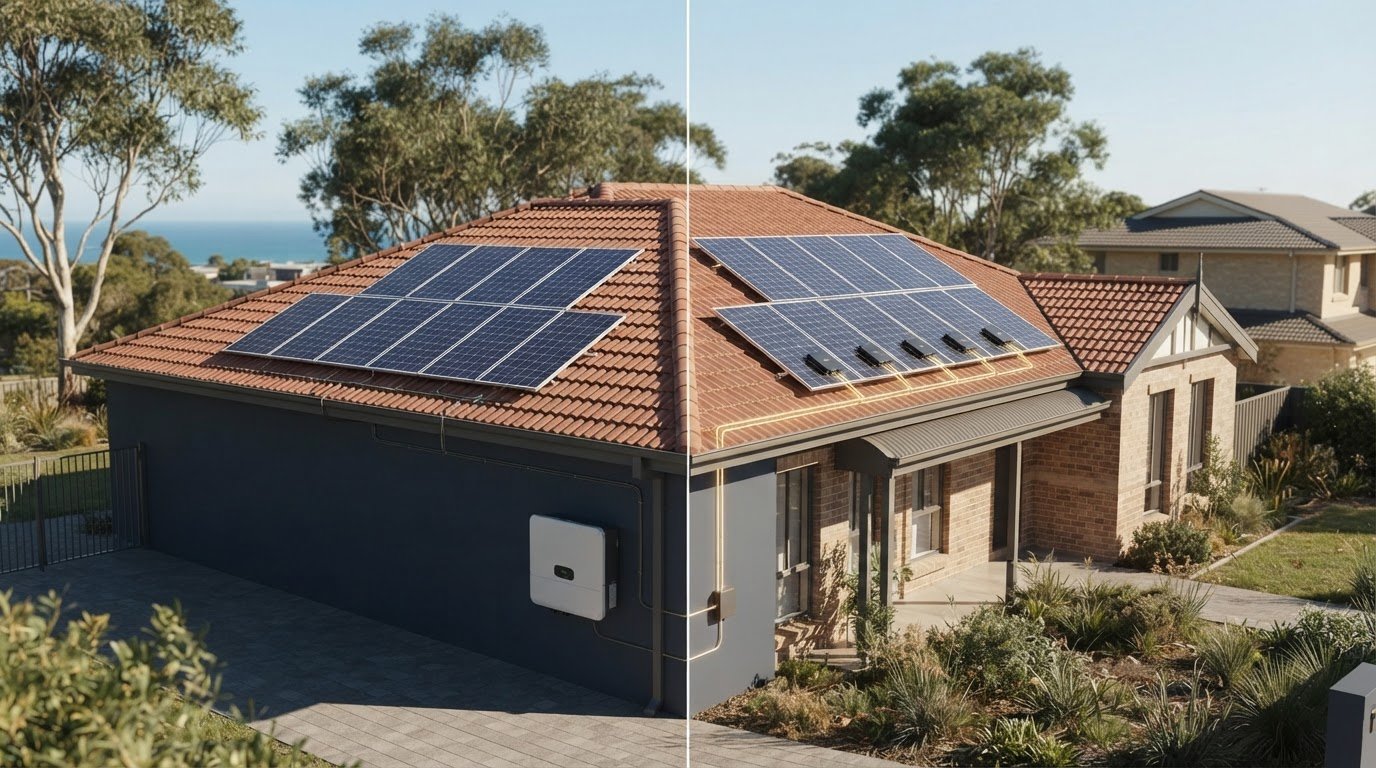
Solar panels change a home’s role in the energy network. Instead of relying solely on electricity from the grid, the household can generate power, use it as it’s produced and, with a suitable system, store some for later. Modern home electrical systems can therefore become active energy hubs, where generation, storage, household demand and grid supply need to work together.
A hybrid inverter helps manage these flows. Depending on the system design, it converts solar electricity for household use, coordinates battery charging and discharging, and manages the connection with the grid. Compatibility matters: the inverter, battery and existing electrical installation need to be assessed as a complete system, not chosen in isolation.
Maximising Self-Consumption with Battery Storage
Solar generation is often strongest during the day, while household demand can rise in the evening. A battery can store surplus daytime energy for later use, helping the household rely less on grid electricity at those times. The value depends on factors such as generation, usage patterns, system design and electricity plan.
Grid-connected solar works alongside the electricity network. An off-grid system is designed to supply a property without relying on that connection, so its generation, storage and backup arrangements need careful planning around household demand. A battery also doesn’t automatically provide power during a grid outage. Backup operation depends on the system’s design and configuration.
Like other electrical equipment, a battery needs care to support reliable operation over time. Follow the manufacturer’s instructions and arrange checks if the system displays a fault or isn’t behaving as expected. This solar battery maintenance guide explains what to consider to help protect your investment.
EV Ready Homes: Future-Proofing Your Garage
An EV can charge from a standard household outlet, sometimes described as Level 1 charging, or through a dedicated wall-mounted charger, often called Level 2. A dedicated unit may better suit regular charging, but the right option depends on the vehicle, charging needs and the home’s electrical capacity.
Before installation, an electrician should assess the switchboard, available capacity, cabling route and other major loads. A switchboard upgrade or three-phase supply may be required in some homes, but isn’t a given. Planning first helps avoid overloading existing circuits and identifies any work needed to support the charger safely.
Smart charging can coordinate charging times with solar generation when compatible equipment and system settings allow. This can increase the share of solar power used to charge the vehicle and reduce electricity drawn from the grid. It isn’t automatically “free” fuel: results depend on the system, household use and any electricity costs involved. Professional planning can bring solar, battery storage and EV charging together as one practical home energy plan.
Smart Home Infrastructure and Climate Control
Air conditioning, security cameras and connected controls all add to a home’s electrical demand. Planning them as part of one system helps avoid overloaded circuits and patchy connectivity, and makes future upgrades easier. During a new build or renovation, consider which devices you want, where they’ll be installed, how they’ll be powered and how they’ll communicate.
Efficient Climate Control: Air Conditioning Services
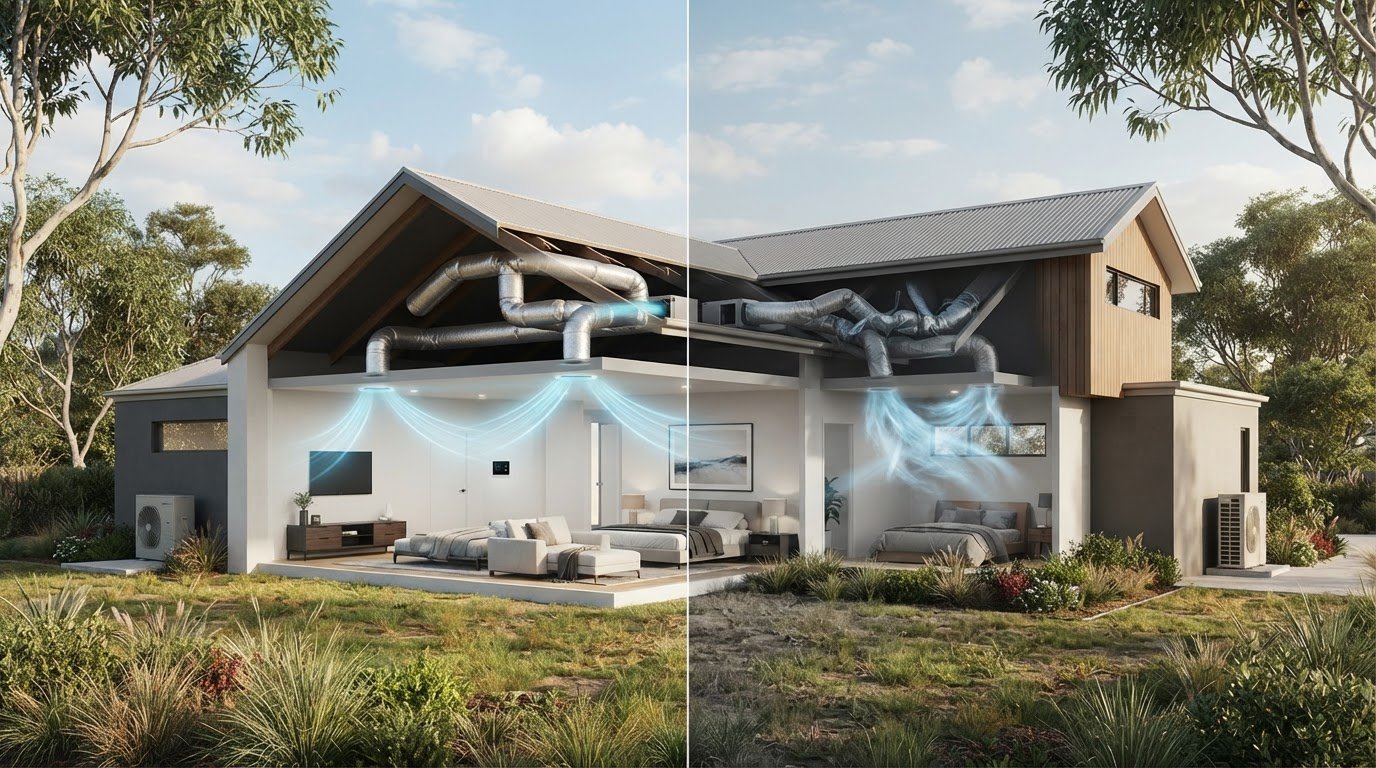
Reverse-cycle air conditioning can provide both heating and cooling, and can be an efficient option compared with electric resistance heating. Results depend on choosing equipment suited to the space and using it appropriately. Multi-head split systems and ducted air conditioning can place different demands on the electrical installation, so check the system’s specifications and the home’s existing capacity before installation.
Filters and equipment need care to operate as intended. Follow the manufacturer’s maintenance guidance and arrange servicing with an appropriate professional. Dirty filters or neglected components can restrict airflow and make the system work harder, using more energy to maintain comfort.
Security and Automation Integration
CCTV and access control are part of the home’s electrical and communications setup. Power over Ethernet (PoE) can deliver power and network connectivity through one cable to compatible cameras, while wireless cameras typically rely on a separate power source and Wi-Fi connection. A wired connection can offer more consistent network performance for fixed devices, though the best approach depends on the layout and equipment.
Smart lighting can help reduce unnecessary use by switching lights off when rooms are empty or scheduling them around household routines. More advanced automation can also shift or temporarily limit selected loads, but it must be configured to suit the home and its electrical capacity. For security equipment, check whether the cameras, recorder, network equipment and access controls have backup power. A battery backup may keep some components running during an outage, but duration and coverage depend on the system.
Hardwired data cabling can provide a stable connection for devices such as access points, televisions or network recorders. Wi-Fi offers flexibility, but walls, distance and interference can affect signal strength. A mix of wired connections for key equipment and Wi-Fi for mobile devices is often a practical design choice.
Compatible energy monitors and apps can show household electricity use, sometimes close to real time. Reviewing patterns can help you identify when air conditioning or other large loads are using power, then adjust schedules or settings. For a connected plan that considers air conditioning and smart security together, discuss your home electrical requirements with Innovative Electrical Contractors.
Planning and Maintaining Your Home Electrical System
Good planning starts before you select equipment. For a new build or major renovation, work through five practical steps: list current and future electrical needs; map lighting, power points and major loads; plan for solar, batteries, air conditioning and EV charging; check the proposed supply and switchboard capacity with an electrician; then coordinate installation and testing with the building programme. This new home electrical and energy planning guide expands on the process.
Electrical work isn’t a safe DIY project. Australian state and territory rules generally require electrical work to be carried out by a licensed electrician, with limited exceptions that vary by location. Incorrect connections can cause electric shock, fire or damage that remains hidden behind walls. For major work, choose a contractor with the appropriate licence for your location and experience relevant to the job. Ask for a clear written scope and confirmation of the testing and compliance documents that apply.
When to Call a Professional Electrician
Don’t ignore flickering lights, switches that feel warm, repeated tripping or a burning smell. Stop using affected equipment and seek professional help. Don’t open the switchboard or investigate live wiring yourself. Before buying an older property, arrange an electrical assessment to understand the installation’s condition and likely upgrades. Larger residential developments also need coordinated switchboard capacity planning. The principles behind a commercial switchboard upgrade can offer useful context, but residential requirements must be assessed for the specific property.
Your Annual Electrical Safety Checklist
Use a regular household check to spot visible issues, but don’t treat it as a substitute for professional inspection. Follow each device manufacturer’s directions, and ask an electrician to investigate anything that fails or appears damaged.
Test RCDs using their push-button test, following the instructions on the device. If one doesn’t trip or reset as expected, arrange an assessment.
Look for cracked covers, corrosion or other visible wear on outdoor lights and weatherproof power points. Don’t use damaged fittings.
Check smoke alarm expiry information and battery condition, then follow the manufacturer’s testing and replacement guidance.
Keep a record of faults, electrical work and changes to household equipment. It helps identify recurring issues and supports future planning.
A regular check can help you stay alert to changes, but there’s no single inspection interval that suits every property. Age, renovation history, added loads and recurring faults all matter. A qualified electrician can recommend a suitable maintenance approach for your home electrical systems. For help planning electrical upgrades or maintenance, talk with an electrical services provider.
Build a Safer, More Energy-Ready Home
A well-planned electrical system brings safety, comfort and energy use into one clear picture. Make sure your switchboard and circuits can support the equipment you use now, while allowing you to plan future upgrades. Solar, batteries, air conditioning and smart technology work best when considered together, rather than added without checking how they’ll affect the whole home.
Regular checks and professional fault finding can help identify issues before they become more serious. For electrical work, qualified installation matters. It supports safe operation and helps ensure equipment is installed according to its requirements.
Whether you’re building, upgrading or planning renewable energy, an experienced electrical contractor can help you weigh up the options for your property. Innovative Electrical Contractors provides electrical services, including solar and battery installations. Get a professional assessment of your home electrical system to discuss your needs and next steps.
With a considered plan, your home electrical systems can be ready for today’s demands and better prepared for what comes next. A safer, more efficient home starts with an informed decision.
Frequently Asked Questions
What are the main components of a home electrical system in Australia?
A home electrical system has three main parts: supply, distribution and consumption. Electricity enters the property through the service connection and consumer mains, then reaches the switchboard. From there, circuits distribute power to lights, power points and equipment. The system also includes safety devices such as circuit breakers and RCDs. In modern home electrical systems, solar panels, batteries, EV chargers and connected devices may also form part of the overall setup.
How much does a switchboard upgrade cost for a standard home?
There’s no single cost for a switchboard upgrade, as the work depends on the existing installation and the changes required. The electrician may need to consider the switchboard’s condition, available capacity, safety devices, wiring and planned additions such as solar, batteries or an EV charger. Ask for an itemised quote based on an assessment of your property, and check what testing and documentation are included.
Can I install my own power points or light switches?
No. Installing or replacing power points and light switches involves electrical work that must be handled in line with the rules in your state or territory. In general, homeowners should use an appropriately licensed electrician rather than attempting this work themselves. DIY electrical work can expose you to electric shock or create faults that increase fire risk. If a fitting is damaged or not working, leave it alone and arrange professional help.
Does a solar battery require a special electrical setup?
Yes. A battery needs to be compatible with the solar system and inverter, and the property’s switchboard and wiring must suit the installation. Backup power during a grid outage also depends on system design and configuration, so don’t assume every battery will keep the home running when the grid is down. Have a qualified installer assess your existing equipment, household energy needs and intended battery operation before choosing a system.
What is the difference between a circuit breaker and a safety switch?
A circuit breaker protects wiring by disconnecting power when it detects excessive current, such as from an overload or short circuit. A safety switch, also called an RCD, monitors the flow of electricity and trips when it detects current leaking from the circuit, helping reduce electric shock risk. They protect against different hazards, so one doesn’t replace the other. If either device trips repeatedly or fails its test, arrange an electrician’s assessment.
How often should I have my home electrical system inspected?
There isn’t one inspection interval that suits every home. The right timing depends on factors such as the installation’s age, renovation history, electrical faults and new equipment added to the property. Arrange an assessment if you notice warning signs, buy an older home or plan major electrical work. You can also test RCDs using the device’s instructions and look for visible damage, but these checks don’t replace professional inspection.
Why do my lights flicker when the air conditioner turns on?
Lights may briefly dim when an air conditioner starts because the unit draws extra current as it begins operating. A brief, occasional change may have a different cause from persistent or worsening flickering, which can point to a circuit, connection or supply issue. If lights flicker often, other appliances are affected, or you notice warmth, buzzing or a burning smell, stop using affected equipment and contact a qualified electrician for fault finding.
Is 3-phase power necessary for a modern home with solar and an EV?
No. Three-phase power isn’t automatically necessary for a home with solar and an EV. Suitability depends on the property’s supply, switchboard capacity, solar and inverter design, EV charger requirements and other major electrical loads. A qualified electrician can assess how these components will work together and whether an upgrade is needed. Plan the system as a whole, rather than assuming three-phase supply is required or that existing capacity will be sufficient.

Comments