
Strata Approval for Commercial Solar in Apartment Buildings
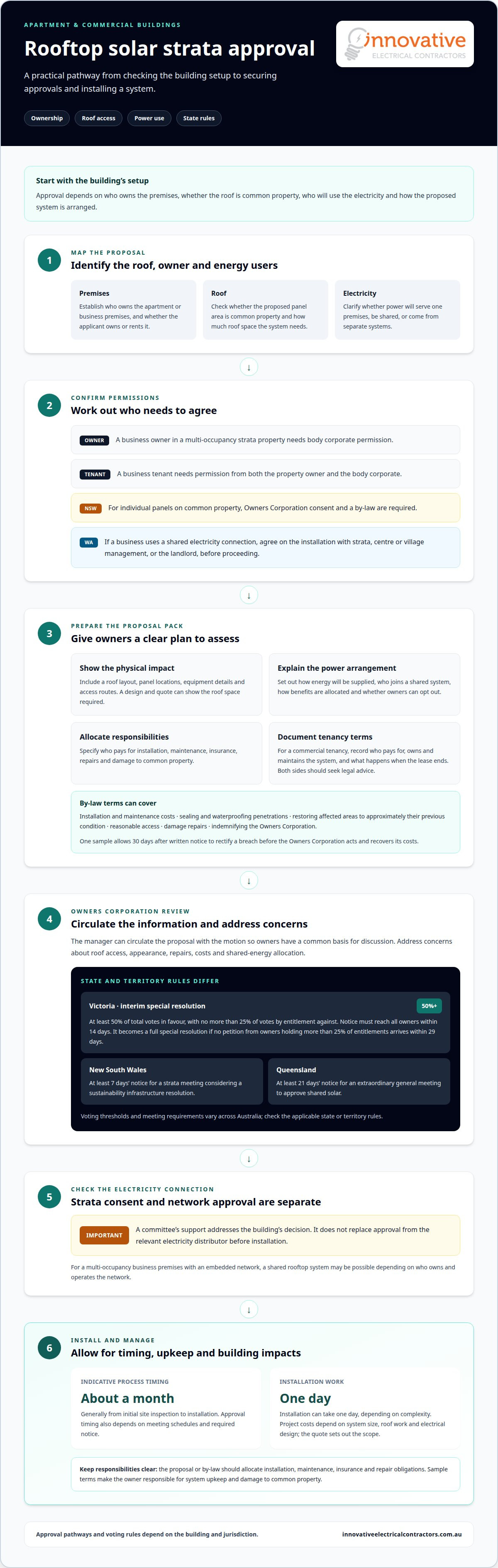
Apartment buildings in Australia can install rooftop solar, but approval must be secured before installation. The strata approval process for commercial solar installation depends on who owns the premises, whether the roof is common property and how the electricity will be used. A business owner in a multi-occupancy strata property needs body corporate permission, while a tenant needs permission from both the property owner and the body corporate.
It’s understandable to ask who gets a say when a solar system uses shared space or supplies power to multiple parts of a building. Solar panels on a shared roof may require approval under the building’s strata arrangements before installation. Approval routes and voting requirements vary between states, so first establish how the proposal fits the building’s ownership and strata arrangements.
This guide explains when apartment buildings can install solar, how shared electricity can work, and what strata committees consider when reviewing a proposal. It also covers how common-property rules affect the decision and how commercial electrical and solar expertise can help put an approved plan into practice.
Table of Contents
Can you install solar panels on an apartment building in Australia?
Yes. Apartment buildings can install solar, but panels on common-property roofs need strata approval. The approval route depends on ownership, the proposed system and how residents will use its energy.
Individual systems on common property
An individual system uses shared roof space to supply electricity to one apartment or business. Installing panels on shared roof space may require approval from the owners or strata community. A professional solar design and quote from specialists such as GES ENERGY can show how much roof space the system needs before owners consider the proposal. This helps the community compare an individual system with other possible uses of the rooftop.
Permissions for rented and strata properties
Permission depends on whether the applicant owns or rents the premises. A business owner in a multi-occupancy strata property needs body corporate permission for rooftop solar. A business tenant needs permission from both the property owner and body corporate. For a commercial tenancy, record agreed terms in the tenancy agreement, including who pays for, owns and maintains the system, and what happens when the lease ends. Both sides should seek legal advice.
By-laws for solar panels
A solar by-law sets responsibilities for installing and keeping a system on common property. Sample terms can require the owner to pay installation and maintenance costs, seal and waterproof penetrations, and restore affected areas to approximately their previous condition. They can also cover reasonable access through common property, damage repairs and indemnifying the Owners Corporation. In one sample, an owner has 30 days after written notice to rectify a breach before the Owners Corporation can act and recover its costs.
Government support may also help multi-unit properties fund shared rooftop solar. Grants may help fund shared rooftop solar for apartment buildings, but eligibility and funding terms vary. Applications have a 4 December 2026 deadline unless funds run out earlier. Check how a program’s eligibility and funding arrangements fit the building’s proposal.
How do strata committees approve solar installations?
A strata approval process for commercial solar installation starts with a clear proposal for owners and the manager. The committee considers the system’s impact on the building and how residents will use its energy.
Owners corporation decisions and participation
An owners corporation decision records whether the scheme supports the proposal and how owners participate. In Victoria, the Owners Corporation Act 2006 was amended in 2021. An interim special resolution needs at least 50% of total votes in favour, with no more than 25% of votes by entitlement against. Notice must reach all owners within 14 days. It becomes a full special resolution if no petition from owners holding more than 25% of entitlements arrives within 29 days. For shared renewable energy, explain who joins, how benefits are allocated and whether owners can opt out.
Approval applications and supporting plans
An application is the proposal pack owners review before deciding. Clear plans show the installation’s impact and should include a roof layout, panel locations, equipment details, access routes and how the system will supply energy. Explain whether owners will share power or have separate systems, and set out proposed responsibilities for maintenance and repairs. The manager can circulate these materials with the motion so members have a common basis for discussion.
Approval timing, costs and responsibilities
From initial site inspection to installation, the process generally takes about a month. Installation can take one day, depending on complexity. Approval timing also depends on meeting schedules and required notice. Project costs depend on system size, roof work and electrical design, with the quote setting out the scope—whether budgeting for an individual 6.6kw solar panel installation or a larger shared setup. The proposal or by-law should allocate installation, maintenance, insurance and repair responsibilities. Sample terms make the owner responsible for system upkeep and damage to common property.
Objections, risks and dispute resolution
Owners may object over roof access, appearance, repairs, costs or shared-energy allocation. Address each concern in the proposal and state who carries each responsibility. In Laws v The Owners, Strata Plan 97230 [2022] NSWCATCD 131, NCAT found refusal of a solar by-law unreasonable and made the orders sought. This shows a disputed decision can reach NCAT. A strata approval process for commercial solar installation is clearer when plans and responsibilities support the motion.
Strata approval for solar installations
Approval depends on the state or territory, the building’s ownership arrangements and the proposed solar setup. Treat strata consent and electricity-network approval as separate parts of the project. A committee’s support addresses the building’s decision; it does not replace approval from the relevant electricity distributor before installation.
In Western Australia, a business using a shared electricity connection must agree on its solar installation with strata, centre or village management, or its landlord, before proceeding. This makes the connection arrangement important to establish early. A shared rooftop system may be possible for a multi-occupancy business premises with an embedded network, depending on who owns and operates that network.
Meeting rules also vary by state. In New South Wales, a strata meeting considering a sustainability infrastructure resolution requires at least seven days’ notice. In Queensland, an extraordinary general meeting to approve shared solar requires at least 21 days’ notice. The meeting quorum for that decision is 25% of eligible voters. These requirements shape when residents can consider and vote on a project.
Before the committee considers the proposal, define what the system will supply. A project serving common areas differs from one intended to distribute electricity among apartments. If residents expect shared power, explain the supply arrangement and how the system will connect to the building. For an individual apartment, clarify the proposed use of roof space and how the installation relates to common property.
Then align the strata proposal with the electricity connection. Identify distributor approval as a separate requirement, and include the planned inverter and system capacity in the technical information. Present one coherent project: who will use the energy, which shared areas are affected and what approvals apply. This gives the owners corporation a clear basis for considering the proposal while keeping building consent distinct from network approval.
Obtain strata consent for the proposed system and any use of common property, and treat approval from the relevant electricity distributor as a separate requirement before installation. Include the planned inverter and system capacity in the technical information submitted for consideration.
Does installing solar on common property require a special or unanimous resolution?
There isn’t one national voting threshold for strata solar. The required resolution depends on the state or territory and the decision put to owners. For common-property solar, the proposal may involve separate decisions about approving the installation and setting out responsibilities for its use.
For the relevant strata sustainability upgrade resolution, NSW has reduced the voting threshold to 50%. A new by-law for solar on common property generally requires a special resolution, which needs a 75% vote in most cases. These thresholds apply to different decisions, so don’t treat approval of the upgrade as automatically passing the by-law. The motion should make clear what owners are being asked to approve.
Queensland uses a different test for shared solar. A special resolution requires at least two-thirds of votes cast in favour. It fails the stated threshold if votes against exceed 25% of the total number of lots. That means the count of votes cast and the number of lots both matter when assessing the outcome.
These examples show why you should not assume unanimity, or apply one state’s threshold across Australia. Identify the jurisdiction, the approval required and whether the system affects common property or requires a new by-law. Then frame each motion separately and attach the solar plans and responsibilities, so owners can see precisely what each vote covers.
For an NSW proposal, distinguish the sustainability-upgrade vote from the by-law vote before the meeting. For a Queensland proposal, explain how votes cast and total lots affect the special-resolution test. Clear wording helps the owners corporation record the correct decision. Once the required approval is in place, discuss a solar and battery installation as the practical next step.
Innovative Electrical Contractors: Commercial Electrical
Innovative Electrical Contractors provides commercial electrical work and solar and battery installations for businesses planning an approved strata project. Once owners have agreed on the proposal, the company’s electrical services can support the next practical stage: carrying the approved design through to an installation suited to the building and its shared-energy needs.
Bring the agreed plans and project requirements into the discussion. The system’s intended use, access to common property and any battery requirements help shape the technical work. For buildings considering off-grid solar, batteries and generators, the electrical design needs to reflect the intended setup.
Contact Innovative Electrical Contractors to discuss the electrical and solar requirements for your strata project.
Turn approval into a workable project
Strata approval is a starting point, not the finished solar project. The next step is to carry the agreed scope into electrical planning, keeping the building’s access arrangements, energy use and installation requirements aligned. A well-organised strata approval process for commercial solar installation helps owners move from a committee decision to a practical plan, with responsibilities clear before work begins.
Innovative Electrical Contractors can support that next stage through Commercial Electrical, Electrical Services, and off-grid solar, batteries and generators. Bring the approved proposal and building requirements to discuss how the electrical work can suit the project’s intended use.
Contact Innovative Electrical Contractors to discuss the next steps for your strata solar project. With a clear plan and the right approvals in place, your building can move forward with confidence.
Frequently Asked Questions
Are there some building types where solar installation just isn’t possible?
A proposed solar system may not suit every building, but the building type alone does not determine feasibility. Roof condition, available space, shading, access and the electrical connection all affect the design. A preliminary site inspection can help identify constraints, such as limited roof area or equipment placement. If rooftop panels aren’t practical, the project may need a different arrangement or may not proceed.
How does a strata property switch to solar?
A strata property first decides what the system should power: common facilities, individual apartments or a shared supply. The owners corporation then considers a proposal that fits the building’s roof, electrical setup and ownership arrangements. For shared electricity in a multi-occupancy business property, an embedded network may be relevant. Its suitability depends on who owns and operates the network, as well as the building’s metering arrangements.
How does solar work for strata apartments?
Solar panels generate electricity that can power building services or be supplied to apartments through an agreed arrangement. A system for common loads, such as shared facilities, differs from one intended to benefit individual households. In a larger residential block, an embedded network may distribute shared solar energy. The design needs to match the building’s meters and define how residents access the electricity.
What strata approvals are required for commercial solar installation in Australia?
The approvals depend on who owns the premises and whether the installation uses common property. A business owner in a multi-occupancy strata property needs body corporate permission; a tenant needs permission from both the landlord and body corporate. Installing panels on a shared roof may require agreement from those responsible for the property. Solar systems also need approval from the electricity distributor for the relevant state or territory before installation.
What voting thresholds apply to strata solar proposals in each Australian state and territory?
There’s no single national threshold. NSW’s relevant sustainability upgrade resolution has a 50% threshold, while a new common-property solar by-law generally needs a special resolution requiring 75% in most cases. Queensland shared solar requires two-thirds of votes cast in favour, with votes against not exceeding 25% of total lots. Victoria has interim special-resolution rules. In SA, ACT, WA, NT and Tasmania, apply the relevant scheme’s legislation and resolution type.
What steps should an owner or owners corporation follow to get strata approval for commercial solar?
Start by identifying who owns the premises, whether the roof is common property and what the system will supply. Arrange a solar design and quote to show the proposed use of the roof, then present the plans and responsibilities to the owners corporation. Identify the required resolution and any by-law, and secure the electricity distributor’s approval before installation. Tenants should also obtain the property owner’s permission and record agreed solar terms in the tenancy agreement.
Comments