
ROI of Upgrading to LED Lighting in Warehouses: A 2026 Guide

What if your warehouse’s biggest LED savings come from its longest-running areas, not a one-for-one fixture swap? The ROI of upgrading to LED lighting in warehouses depends on how your site operates. Energy savings can look compelling on paper, but your electricity use, operating hours, existing lights and maintenance demands determine whether the investment stacks up.
Before committing, build your estimate from your own electricity data and operating patterns. Include the project scope and the condition of the existing lighting, as these can significantly affect the result. There’s no single savings figure that applies to every warehouse.
This guide explains how to assess project costs, potential savings and payback. You’ll learn what information to gather, how lamp retrofits compare with full fitting replacement, and how to plan installation around warehouse operations while maintaining visibility and safe working conditions. A considered electrical plan helps you compare options against your warehouse’s actual requirements.
Table of Contents
Warehouse LED lighting ROI: what determines whether an upgrade is worthwhile?
Start by comparing the full project investment with realistic annual operating savings. The ROI of upgrading to LED lighting in warehouses depends on more than the cost of replacement fittings. Operating hours, the condition of existing lights, required light levels, electricity tariffs and installation scope all influence the result.
Warehouse LED ROI is the financial return from an upgrade over a defined period, based on the project investment and the benefits it can reasonably deliver. Keep energy savings, maintenance savings and operational impacts separate in your calculations. This makes each assumption easier to review and helps you avoid relying on a broad savings claim that may not reflect your facility.
Which warehouse conditions have the biggest effect on LED upgrade returns?
Start by documenting how the site runs. Record daily and annual lighting hours, shift patterns and seasonal changes. Areas where lights run for longer periods may offer more opportunity to reduce electricity use. Note existing lamp types, fitting condition, failure history and the effort required to access fittings for maintenance.
Next, map ceiling height, racking layout and task areas. The lighting plan needs to suit the work and provide appropriate visibility in aisles, picking zones and other active areas. The Light-emitting diode (LED) produces light differently from traditional lamps, but the technology alone doesn’t determine the outcome. Fitting choice, placement and light distribution all need to suit the warehouse.
Which benefits belong in the business case?
Estimate electricity savings from the measured lighting load and expected operating hours, using consistent units for the existing and proposed systems. Apply your actual electricity tariff to the estimated change in energy use. Check the bill structure too: lower lighting consumption may not reduce every charge on the bill.
Maintenance savings can strengthen the case when they’re supported by records. Compare current call-outs, replacement lamps and other materials, as well as access equipment or labour needed to reach high fittings, with the expected needs of the proposed system. Don’t count a saving if there’s no reliable record or clear basis for the estimate.
Assess productivity, safety and reduced disruption separately. Improved visibility may support work quality or safer movement, and careful scheduling may limit interruptions. Treat these as benefits that need evidence, not guaranteed financial returns. A commercial electrical assessment can connect the figures to actual warehouse conditions, giving decision-makers a practical basis for comparing project scope and expected results.
How to calculate the ROI of warehouse LED lighting
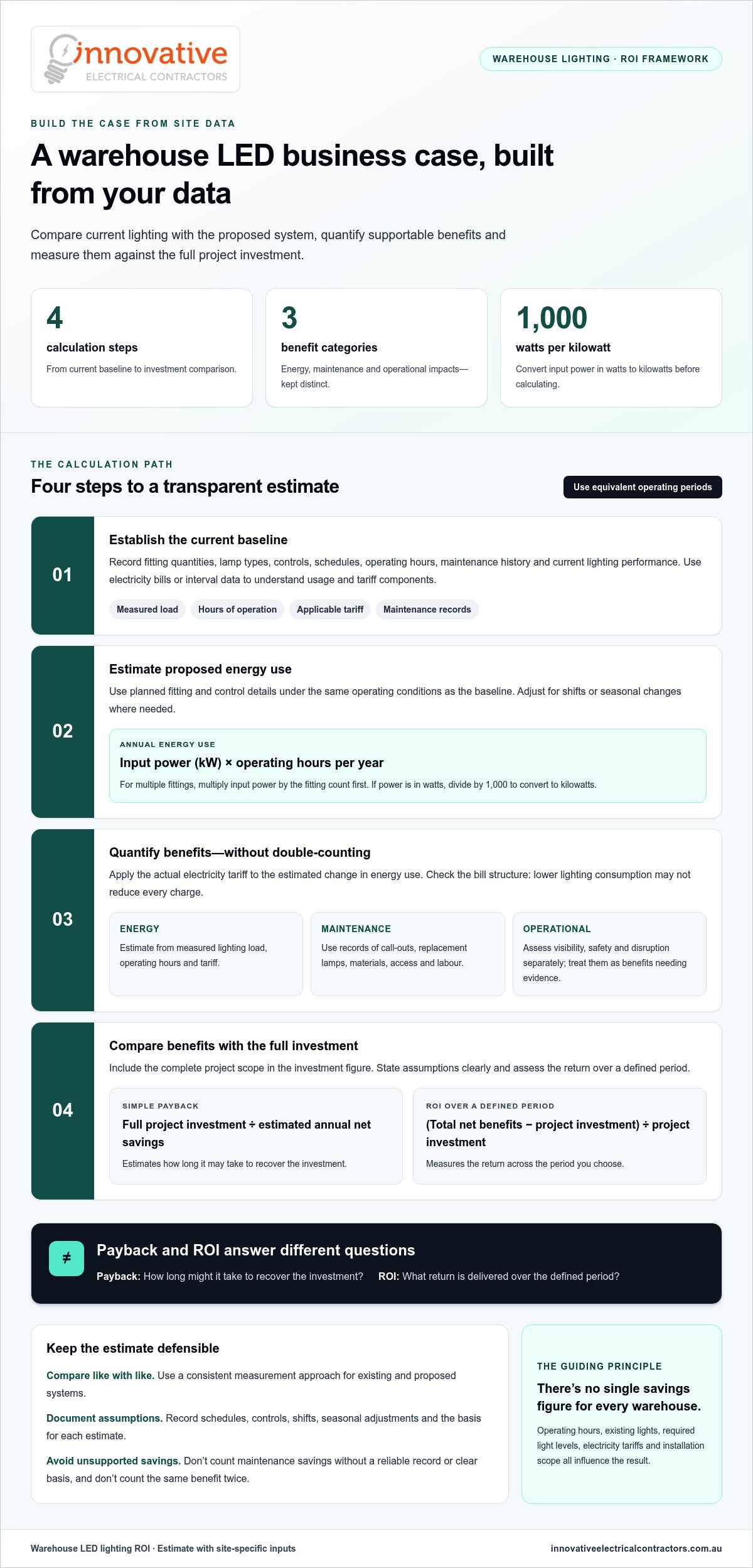
A useful estimate follows four steps: establish the current baseline, estimate the proposed system’s energy use, quantify benefits, then compare them with the full project investment. This gives you a transparent way to assess the ROI of upgrading to LED lighting in warehouses without relying on generic savings claims.
What information should a warehouse lighting baseline include?
Inventory fitting quantities, lamp types, controls and operating schedules. Add maintenance records, including replacement frequency, materials and access requirements. Electricity bills or interval data can help you understand usage patterns and relevant tariff components. Record current lighting performance too, including areas where visibility is inadequate. This ensures the estimate accounts for the required outcome, rather than simply reducing the electrical load.
For each group of lights, calculate annual energy use consistently:
Annual energy use (kWh) = input power (kW) × operating hours per year.
For multiple fittings, multiply the input power by the fitting count before applying operating hours. If input power is recorded in watts, divide by 1,000 to convert it to kilowatts. Use the same measurement approach for the existing and proposed systems, and record assumptions about schedules and controls.
How should savings and payback assumptions be tested?
Compare equivalent operating periods, adjusting for shifts or seasonal changes where needed. Then work through the estimate:
Establish the baseline: Calculate current annual lighting energy use and costs from measured load, operating hours and the applicable electricity tariff.
Estimate proposed use: Use the planned fitting and control details to calculate expected annual energy consumption under the same operating conditions.
Quantify benefits: Separate estimated energy savings from maintenance savings and operational benefits. Use maintenance records where available, and don’t count the same benefit twice.
Compare investment: Include the full project scope in the investment figure, then calculate simple payback and ROI over a defined period.
Simple payback = full project investment ÷ estimated annual net savings. Net savings should include only the annual benefits in your business case, with assumptions clearly stated. For ROI over a defined period, compare the total net benefits during that period with the project investment, then express the difference as a proportion of the investment. Payback estimates how long it may take to recover the investment; ROI measures the return over the period you choose.
Test the estimate using conservative, expected and optimistic scenarios. For example, vary operating hours or the maintenance savings assumption while keeping the calculation method consistent. These are planning scenarios, not promised outcomes. A project-specific commercial electrical assessment can connect the estimate to your warehouse’s requirements. To discuss a warehouse electrical upgrade, begin with the information gathered for your baseline.
LED warehouse upgrade options: compare retrofit, replacement and controls
The right approach depends on what your warehouse needs, not simply the fitting price. A lower upfront investment only makes sense if the existing equipment can support the required lighting performance and the expected site-specific benefits justify the work. Compare retrofit kits, complete fitting replacement and controls as project options rather than assuming one approach will always deliver the strongest return.
When might a retrofit suit an existing warehouse lighting layout?
A retrofit is worth assessing if existing fittings are in sound condition and compatible with the proposed components. Check whether the current layout provides suitable light across aisles, racking and task areas, and whether ongoing maintenance needs remain acceptable. Consider ceiling height, access equipment and activity below each work zone. Racking and active operations can affect how and when installation work can be carried out.
When is full fitting replacement or lighting control worth assessing?
Consider full replacement if fittings are unreliable, poorly matched to warehouse tasks or unable to deliver the required light distribution. Controls may suit areas with changing occupancy or useful daylight, but their value depends on actual zone use and correct commissioning. A design should account for the whole site, including relevant Australian lighting standards and state or territory electrical requirements.
For the ROI of upgrading to LED lighting in warehouses, compare each option’s full scope with its expected performance and operating benefits. A tailored commercial electrical plan can align the fitting choice, controls and installation sequence with your warehouse’s needs. This supports an investment decision based on practical site conditions, rather than blanket assumptions about retrofit savings or control technology.
Plan a warehouse LED upgrade and verify its real-world performance
A well-planned installation helps protect warehouse operations and gives you a reliable way to check whether the upgrade performs as intended. Treat the work as a sequence: audit the site, finalise the lighting design, organise installation by work zone, then document and verify the results.
What should happen before installation begins?
Map fittings, circuits, work areas, access constraints and operating schedules. Note where racking, equipment or active work could affect access to lights, and identify how each zone can remain safe and functional during installation. Set project requirements in advance, including the lighting performance needed for each task, proposed control settings, maintenance access and commissioning checks.
Agree on work sequencing and site access with the people responsible for warehouse operations. A staged approach may allow work to progress area by area, but the sequence should suit the site rather than follow a fixed template. The scope may also involve electrical planning beyond the fittings themselves. Innovative Electrical Contractors’ commercial electrical services cover electrical work planned around a property’s requirements.
How can a business check the upgrade delivered expected results?
Keep a clear record of what was installed and how it was set up. Commissioning information should capture equipment details, control settings, measured lighting in relevant work areas and any adjustments made. This gives facilities teams a useful reference and helps them check whether the finished system matches the design intent.
Compare post-upgrade energy use with the baseline under comparable conditions. Account for operating hours and changes in shifts, activity or other relevant site conditions. If the lights run fewer hours during the comparison period, for example, lower consumption alone won’t show how much of the change came from the upgrade. Use the same measurement units and note any differences that could affect the comparison.
Audit: Record the existing layout, operating patterns and site constraints.
Design: Set lighting and control requirements for each area, with applicable Australian standards and site requirements in view.
Install: Coordinate work zones, access and safety arrangements with warehouse operations.
Verify: Document commissioning results and compare energy data with the baseline.
If actual results differ from the forecast, investigate before revising the ROI model. Check operating hours, control settings, installed equipment and measurement conditions. A careful review can show whether the difference reflects an assumption that needs updating or an adjustment to the system. To plan a site-specific project, discuss your warehouse electrical upgrade with our team.
Build a warehouse lighting business case with an electrical project partner
Approve an upgrade when documented assumptions show that the investment makes sense for your warehouse. A decision-ready proposal should connect the lighting design to site operating conditions, project scope and expected benefits. The ROI of upgrading to LED lighting in warehouses isn’t a universal figure. It depends on what’s installed, how the facility runs and what the project involves.
What should a decision-ready warehouse LED proposal show?
Look for a clear scope that identifies fitting quantities, the approach for each area and any proposed controls. The estimate should state operating-hour assumptions, expected energy use and the basis for maintenance savings. It should also show the full project investment alongside conservative, expected and optimistic savings scenarios. These are estimates to support a decision, not guaranteed outcomes.
A practical proposal also sets out how the work will be delivered and checked. It should identify commissioning tasks, coordination with warehouse operations and the plan for measuring performance after installation. This gives your team a way to compare actual results with the original assumptions and update the business case if site conditions change.
How can electrical planning support a confident upgrade decision?
Lighting choices need to suit the building as well as the work taking place in it. Ceiling height, racking, task areas, existing electrical infrastructure and operating schedules can all shape the design and installation plan. Commercial and industrial electrical planning brings these details together, helping align the selected solution with warehouse requirements from initial scope through installation and verification.
Innovative Electrical Contractors provides commercial electrical work with each site’s requirements in view. Our commercial and industrial electrical services can support a planned warehouse lighting upgrade, from assessing the electrical scope to coordinating installation. A considered plan also helps the warehouse team understand the work sequence and what information will be used to check performance afterwards.
Before a project discussion, assemble available electricity bills or interval data, fitting and maintenance records, operating schedules, and notes on areas with lighting issues. These details give the electrical project conversation a practical starting point and help shape a proposal around your facility.
Ready to take the next step? Discuss a warehouse electrical project with Innovative Electrical Contractors and explore an upgrade plan tailored to your site.
Make your next warehouse lighting decision with confidence
A sound LED business case starts with your warehouse, not a generic savings promise. Use actual operating hours, electricity data, maintenance records and lighting requirements to compare the full project scope with realistic annual benefits. Then choose between retrofit, replacement and controls based on site conditions, and verify performance after installation.
The ROI of upgrading to LED lighting in warehouses is most useful when its assumptions are clear, measurable and suited to how your facility operates. A considered plan also helps coordinate installation with warehouse activity and maintain the lighting your teams need.
Innovative Electrical Contractors provides commercial and industrial electrical work for businesses across Australia. Bring together your site information and project priorities, then discuss a warehouse electrical project with a team that can tailor the planning to your requirements.
With the right information and practical electrical planning, you can make your next decision with confidence.
Frequently Asked Questions
How do you calculate the ROI of upgrading warehouse lighting to LED?
Use site data rather than a generic savings claim. Record the existing lighting load, operating hours, electricity tariffs and maintenance costs, then estimate the proposed system’s energy use and full project investment. Simple payback is project investment divided by estimated annual net savings. Payback shows how long recovery may take; ROI measures financial return relative to investment over a defined period. State assumptions and separate benefit types to avoid double-counting.
How long does it take for warehouse LED lighting to pay for itself?
There’s no universal payback period for a warehouse LED upgrade. The timeframe depends on existing fittings, operating hours, electricity tariffs, maintenance needs, controls and installation scope. Model conservative and expected scenarios using your site information, then compare estimated annual net savings with the project investment. Treat the result as an estimate, not a guarantee. A project assessment using actual warehouse data can help estimate a timeframe for your facility.
Can LED lighting reduce a warehouse’s electricity bill?
LEDs may reduce lighting energy use when they replace less efficient equipment, but the impact on the bill varies with operating hours, installed load, tariffs and control settings. Separate lighting consumption from total site energy use, as other equipment and operational changes also affect the bill. Compare baseline data with the proposed design under similar operating conditions. This gives you a site-based estimate instead of relying on a fixed percentage saving.
Is it worth upgrading warehouse lights to LED?
It can be worthwhile if the site’s energy, maintenance or lighting performance benefits support the full project investment. Consider operating schedules, fitting condition, light distribution, access requirements and potential disruption. Compare suitable options using clearly stated assumptions, including a scenario where savings are lower than forecast. If the business case remains sound under that more cautious estimate, you’ll have a stronger basis for deciding whether to proceed.
What costs should be included in a warehouse LED upgrade ROI calculation?
Include the full project scope, such as fittings, controls, electrical work, access equipment, installation and commissioning where applicable. Estimate energy and maintenance changes separately, using site records and the proposed design. Costs and scope vary with the warehouse layout and existing electrical infrastructure, so generic price ranges may not reflect your project. Use project-specific estimates and state whether operational downtime or other disruption-related impacts are included.
Do warehouse LED lights need occupancy sensors to deliver a good ROI?
No. Occupancy sensors may help in areas used intermittently, but they aren’t automatically beneficial throughout a warehouse. Their value depends on zone use, control design, commissioning and operating patterns. Assess potential controls area by area, then compare their additional project investment with the extra savings the site model supports. A sensor strategy should suit how each space is used rather than apply one setting across the whole facility.
How can I check whether an LED warehouse upgrade has delivered the expected savings?
Record the pre-upgrade energy baseline, operating hours, installed equipment and estimate assumptions. After commissioning, compare energy data across comparable periods, accounting for changes in shifts, occupancy or production activity. Check control settings and lighting performance alongside consumption, as lower energy use alone doesn’t confirm the system meets operational needs. Update the ROI calculation with measured results, then investigate material differences from the forecast before changing your assumptions.
Comments