
How to Achieve Energy Independence for Your Home in Australia

What if relying less on the grid didn’t mean disconnecting from it altogether? If you’re researching “achieving energy independence for my home australia”, think of independence as a series of practical steps, not an all-or-nothing switch. Solar can generate power during the day, but how much it covers depends on when and how your household uses electricity.
It’s understandable to be unsure whether solar is enough, what a battery can do, or when an off-grid system makes sense. A suitable setup starts with your household’s energy use, not simply the biggest system available.
This guide explains the difference between reducing grid reliance and going off-grid, and compares solar, battery storage and generator options. You’ll learn what information helps shape a plan, including daily usage patterns, essential loads and future needs. With a clear view of the choices, you can identify a sensible next step, whether that’s adding solar and storage or planning a more independent power system.
Table of Contents
What achieving energy independence for your home in Australia really means
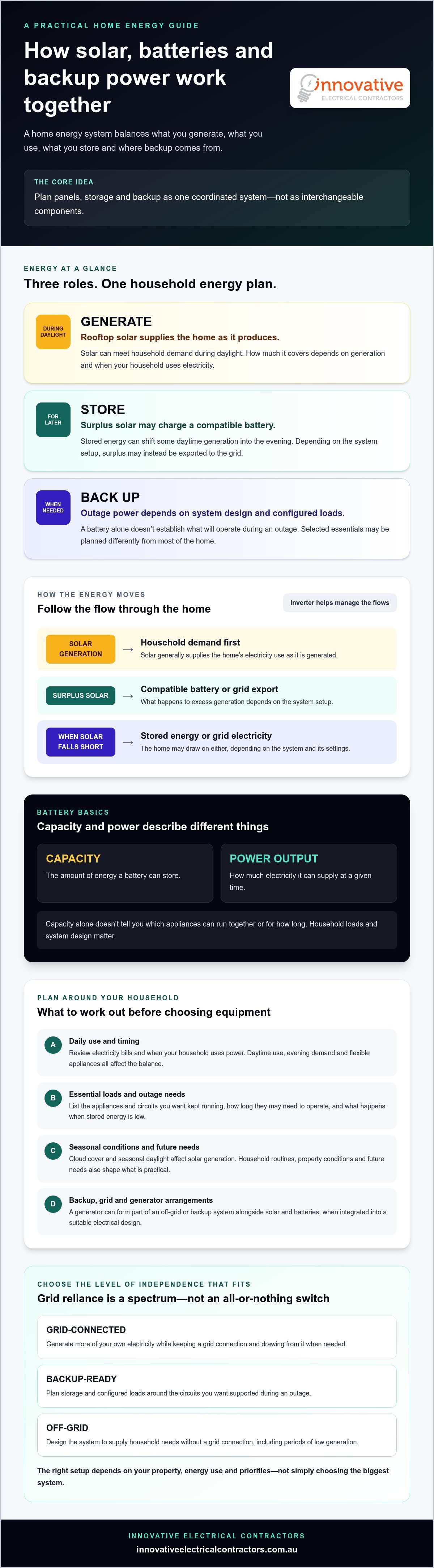
Energy independence doesn’t have to mean cutting every connection to the electricity grid. It can mean generating more of your own electricity, storing some for later and relying less on grid power. If you’re exploring “achieving energy independence for my home australia”, first decide what you want to change: daytime grid use, evening imports, outage resilience or the connection itself.
Energy independence is a spectrum of choices, from using more self-generated power while remaining grid-connected to designing a home to operate without a grid connection. These outcomes call for different equipment and planning. The right point on the spectrum depends on your property, energy use and priorities, not a universal target.
What does energy independence look like in an Australian home?
With rooftop solar, your home can use electricity as it’s generated during daylight hours. If generation exceeds household demand, surplus power may be stored in a compatible battery for later use or exported, depending on the system setup. Stored solar can shift some daytime generation into the evening, when panels aren’t producing.
The balance changes throughout the day and year. Cloud cover and seasonal daylight affect solar generation, while household routines determine when electricity is needed. Running flexible appliances during sunny periods can make more direct use of available generation. A home with high evening demand may draw more from storage or the grid after dark. Australia’s mix of solar and other renewables is outlined in Renewable energy in Australia, but each home’s results depend on its conditions and system design.
Is going completely off-grid the right goal?
Reducing grid reliance means using more of your own generated or stored electricity while keeping a grid connection. Going off-grid is a more substantial design choice: the system must be planned to supply household needs without that connection. It needs to account for periods when generation is low, as well as the appliances and routines that shape demand.
One household may be comfortable drawing from the grid when solar and stored energy aren’t enough, while another may prioritise operating independently. Neither choice is automatically better. Consider whether the intended level of independence suits your household in ordinary conditions and during periods of weaker generation.
System design matters more than simply aiming for the largest setup. Household demand, seasonal conditions and the role of backup supply all affect what’s practical. Clarifying your goal gives the next planning steps direction, whether you want to cut grid imports or explore a fully off-grid arrangement.
How solar, batteries and backup power work together
A home energy system manages electricity as it’s generated, used, stored and, where applicable, exported. Solar power generally supplies household demand first. If the panels produce more than the home is using, the surplus can charge a compatible battery or be sent to the grid. If generation can’t meet demand, the home may draw on stored energy or grid electricity, depending on the system and its settings.
An inverter helps manage these energy flows. It converts the electricity produced by solar panels into a form household appliances can use, and coordinates how generation, household use and battery operation interact. Panels, storage and backup need to be planned as parts of a system, not treated as interchangeable components. For broader Australian energy information, the Australian Government's Department of Climate Change, Energy, the Environment and Water provides national context on energy and environmental matters.
What does a home battery add to rooftop solar?
A battery can store some surplus solar generation for use later, such as after sunset. Two measures help describe its role: capacity is the amount of energy it can store, while power output is how much electricity it can supply at a given time. Capacity alone doesn’t tell you which appliances can run together or for how long. Those details depend on household loads and system design. Include battery care and monitoring in your planning, and follow appropriate solar battery maintenance guidance.
When do a generator and grid connection matter?
Storing solar energy and providing power during a grid outage are related, but they aren’t automatically the same capability. Backup depends on the system’s design and which loads are configured to receive power. A setup intended to keep selected essentials available may be planned differently from one expected to supply most of a home. Backup power depends on system design and configured loads; a battery alone doesn’t establish what will operate during an outage.
List the appliances and circuits you’d want to keep running, then consider how long they may need to operate and what happens when stored energy is low. A generator can form part of an off-grid or backup system alongside solar and batteries, but it needs to be integrated into a suitable electrical design. Grid connection, protection and operating arrangements also need to suit the project. This matters when planning a coordinated solar and battery installation around your household’s priorities.
For anyone researching “achieving energy independence for my home australia”, the practical question isn’t simply how much a battery stores. It’s how generation, storage, backup and household demand work together, including when solar output is limited. That’s what turns a list of components into a considered energy plan.
Grid-connected, backup-ready or off-grid: compare your options
The right setup depends on what you want your home to do. Are you aiming to generate more of your own electricity, keep selected circuits operating during an outage, or plan for life without a grid connection? A battery can support some of these goals, but adding one alone doesn’t guarantee complete energy independence. Its role depends on how the system is designed and configured.
Which system suits lower bills, outage resilience or disconnection?
Grid-connected solar may suit households focused on generating electricity while retaining grid supply. Solar with battery backup may suit those prioritising stored energy and defined essential loads during outages. Off-grid systems are for households planning to operate without a grid connection, with generation and backup arrangements designed around that goal. These are different pathways, not a simple ranking from basic to best.
What trade-offs should homeowners understand?
Keeping a grid connection means the home can draw on grid supply when its own generation or storage doesn’t meet demand. An off-grid design instead needs to account for low-generation periods and how electricity use will be managed. Battery care, generator operation and monitoring are ongoing considerations, so include these practical tasks in the plan. If your home is still being designed, planning electrical and energy systems for new homes can bring those choices into the broader project early.
Connection and operating arrangements are also part of the design. The Australian Energy Market Commission provides information on Australia’s energy rules and markets, while a household system still needs to suit its circumstances. For achieving energy independence for my home australia, start with the outcome you want, then match the system pathway to your priorities. Discuss a tailored solar, battery or off-grid installation as part of that planning.
How to plan an energy-independent home step by step
A useful plan begins with your household, not a shopping list of equipment. Before considering solar, batteries or backup, get clear on what you want to achieve and how electricity is used at home. This turns “achieving energy independence for my home australia” into a practical planning exercise based on actual demand rather than assumptions.
Choose your main goal. Decide whether you want to reduce grid imports, keep selected household loads available during an outage, or plan to operate without a grid connection. You can have more than one priority, but identify which matters most. That will guide the rest of the brief.
Review bills and available usage data. Look beyond the total amount used. Note when demand rises, such as during the day, evening or overnight, and compare bills across different seasons where possible. If your retailer provides time-based usage information, use it to see whether your household’s peak demand aligns with solar generation.
List the main electricity loads. Record high-use appliances and when they normally run. Include daytime loads, overnight use and equipment that runs regularly, such as heating or cooling. Add planned changes too, including an electric vehicle, new appliances, a growing household or a renovation that could alter electricity use.
Separate essentials from flexible use. If outage support is a priority, write down which appliances or circuits you’d want available and which could remain off. This defines the backup requirement more clearly than saying you want to “run the whole house”. Think about how long essential loads may need to operate, not just which ones matter.
Record what’s already in place. Note existing solar and battery equipment, if any, and gather relevant system information. Include the condition of the electrical infrastructure, such as the switchboard, in the wider plan. If you’re building or renovating, record the project stage and any electrical work being planned.
Check property and connection considerations. Before settling on a system, account for current connection requirements and network conditions that apply to your property. These can affect how a grid-connected setup is planned. Treat this as part of project design rather than assuming the same arrangements suit every home.
Turn the findings into a system brief. Bring your goal, usage patterns, existing solar, major loads and backup priorities together. A concise brief helps coordinate electrical, solar and battery planning around your household rather than choosing equipment in isolation.
For broader context on electrical planning, modern electrical services for Australian properties can connect household energy goals with the electrical work around them. Innovative Electrical Contractors coordinates electrical, solar and battery installations, as well as off-grid systems incorporating solar, batteries and generators. Discuss a tailored solar and battery installation based on your household brief.
Plan your home energy system with a coordinated installation
A well-planned system starts with the household brief, then brings electrical work, solar generation and storage together around it. That avoids treating panels, a battery and backup as separate decisions. The aim isn’t to promise a particular level of independence. It’s to shape a practical design around your property, electricity use and priorities.
Innovative Electrical Contractors provides solar and battery installations, electrical services and off-grid systems incorporating solar, batteries and generators. Off-grid capability is one pathway, not a default requirement. A grid-connected home seeking to reduce imports has different needs from a household planning to operate without a grid connection. The system configuration should reflect that difference.
What happens during a tailored system plan?
Your energy patterns, existing infrastructure and resilience goals help shape the design. A household focused on using more of its own solar generation may have different priorities from one that wants selected loads supported during an outage. Existing solar, major appliances and the condition of the electrical setup all help put those goals into context.
Electrical work is part of that picture. If a switchboard upgrade or other electrical work is needed, it can be considered alongside the solar and battery plan. For an off-grid system, the design may also include a generator where the project calls for one. The right arrangement depends on the property and the chosen independence goal, so one standard configuration won’t suit every home.
A component’s presence doesn’t, by itself, define what the whole home can do. A battery, for instance, needs to be considered alongside household demand and the system’s intended operation. Planning the electrical and energy components together helps keep decisions aligned with the brief.
What should your next step be?
Bring useful details together before planning a tailored system. A clear starting brief keeps the focus on the choices that matter for your home, rather than on equipment alone.
Recent electricity bills and any available usage information.
Details of existing solar, battery or other energy equipment.
A list of essential loads you’d want available during an outage.
Your main priority: reduced grid reliance, backup power or off-grid operation.
Relevant plans for a new home, renovation or changes to household demand.
These details connect your goal to the property’s existing electrical setup and expected energy use. If you’re researching “achieving energy independence for my home australia”, a tailored discussion can turn that broad aim into a considered next step, without assuming full disconnection is necessary.
Make your next energy decision count
Your home’s energy needs can change. New appliances, a renovation or a shift in household routines may alter how much power you use and when you need it. Review your energy plan as those needs evolve, rather than treating independence as a one-time decision with a fixed endpoint.
If you’re considering achieving energy independence for my home australia, start by choosing the change that matters most now. That might mean relying less on grid electricity, planning for essential power during an outage or exploring life without a grid connection. A clear priority keeps decisions focused and gives future upgrades a purpose.
There’s no need to solve every part of the plan at once. Begin with a system suited to your home and goals, then consider how it can support your needs over time. Innovative Electrical Contractors can help shape a tailored approach that connects your household priorities with the right electrical and energy work.
Discuss a tailored home energy system and take a confident next step towards a home that better reflects your energy goals.
Frequently Asked Questions
Can solar panels alone make my home energy independent?
Solar panels can reduce grid electricity use while they’re generating, but they don’t necessarily cover demand at other times. A home may export surplus power during a sunny afternoon, then draw electricity from the grid in the evening. Without storage, that exported energy isn’t available for later household use. Review your usage alongside solar generation to understand how much grid reliance may remain.
Will a home battery keep my whole house running during a blackout?
Not automatically. Backup depends on how the battery and inverter are configured, which circuits are connected and what’s running at the time. To plan practically, identify essentials such as refrigeration, lighting or communications, then distinguish them from high-demand appliances you could leave off. A backup plan should clearly describe the loads it’s designed to support, rather than assume every circuit will stay on.
How much energy independence can a typical Australian home achieve?
There’s no single figure that applies to every home. If you’re researching “achieving energy independence for my home australia”, use your own electricity records to set a meaningful target, such as lowering grid imports or supporting essential loads during outages. Solar output, household demand, storage and seasonal conditions all affect the result. Compare actual usage over time against your chosen goal rather than relying on a generic estimate.
Is an off-grid solar and battery system suitable for every home?
No. An off-grid system needs to be designed around the home’s demand, including times when solar generation is low. Consider how your household would manage electricity use during those periods and whether a generator should form part of the system. If you’re comfortable retaining a grid connection, you can still aim to use more self-generated electricity. The right pathway depends on your priorities and the practical demands of the property.
What happens if my solar battery is empty during an outage?
If the battery has no usable stored energy, backup may be limited or unavailable, depending on the system and any other supply included in its design. A battery stores electricity; it doesn’t generate it. Solar output can also vary, so panels shouldn’t be assumed to meet demand at every point during an outage. A sound system plan accounts for low storage, including whether loads need to be reduced or a generator used.
Do I need to replace my existing solar system to add a battery?
Not necessarily. Whether a battery can be integrated depends on the existing solar configuration, inverter and proposed battery arrangement. Before planning an addition, gather your system documentation and note any changes made since installation. The existing equipment and electrical setup need to be considered together when planning compatibility and any required electrical work. Avoid choosing a battery on capacity alone, as the approach must also suit the equipment already at your property.
Can I stay connected to the grid and still improve energy independence?
Yes. You can remain grid-connected and still aim to use more of your own generated electricity. Adjusting when flexible appliances run may help align their use with solar generation, while storage can support later use if included in the system. The suitable arrangement depends on your household’s energy habits, backup priorities and property connection conditions. Set your goal first, then plan around the level of independence you want.
Comments