
Presenting an Energy Savings Proposal to Management: A Practical Guide

What if the strongest energy-saving idea isn’t the one management approves? The difference often comes down to how clearly the proposal connects site data to business priorities. When presenting an energy savings proposal to management, the challenge is real: savings are difficult to prove before changes are made, capital budgets compete with other priorities, and technical details can obscure operational value.
A credible case doesn’t rely on bold promises. It starts with a clear energy-use baseline, states the assumptions behind each estimate and explains how results will be measured after implementation. From there, practical options can be compared by expected impact, cost considerations, disruption and fit with the site’s needs.
This guide shows you how to build an evidence-based case and present it in language decision-makers can act on. You’ll learn how to frame measures such as electrical upgrades, solar and battery systems, or air-conditioning improvements as options, not guaranteed savings, and recommend a clear next step, from approval to investigate further through to a staged project plan.
Table of Contents
Why an energy-savings proposal needs a clear business case
Before management considers equipment or upgrades, make the decision clear. Are you seeking approval to fund a defined change, permission to investigate an opportunity, or support to prioritise it against other work? A proposal with a specific request gives decision-makers a practical way to respond, even when more evidence is needed before committing to implementation.
An energy-savings proposal is an evidence-based decision document that links a possible intervention to expected outcomes, supporting information and the action being requested. It places energy use within wider energy management, which connects resource use and cost control with business operations. The case should also consider relevant site priorities, such as reliable operations, occupant comfort and the organisation’s stated objectives.
Start with the management decision, not the technology
Write for the people who will approve funding, set priorities or authorise further investigation. Start with the operational issue in plain language. For example, a work area may be uncomfortable during operating hours, or energy use may be difficult to explain from available records. Then state what you want management to decide. Avoid leading with a technical solution before showing why the issue matters to the site.
Keep the opening summary easy to scan. State the decision request, the main reason for considering action and the evidence available. This order keeps the discussion focused on business needs rather than allowing equipment details to take over.
Connect energy performance to business priorities
Energy use can affect more than the utility bill. Depending on the site, a proposed change may also need to account for operational reliability, comfort, maintenance demands or disruption during installation. Explain which priorities are relevant and how the proposal supports them. Don’t assume the organisation has a particular sustainability target or budget requirement unless that has been established.
Use a short, fact-dense summary to link the evidence to the decision. For instance: “The available site records indicate a potential opportunity to review the air-conditioning controls; approval is requested to investigate operating patterns and assess options.” This describes a case for further work without claiming a result the evidence can’t yet establish.
Be precise about confidence. A preliminary opportunity is a reason to investigate, not a verified savings forecast. Label estimates as estimates, identify their assumptions and explain what information is still needed. A forecast becomes more credible when it’s grounded in relevant site evidence and its measurement approach is clear. This distinction helps management weigh the opportunity without mistaking projected outcomes for guaranteed results.
Build a credible energy baseline before estimating savings
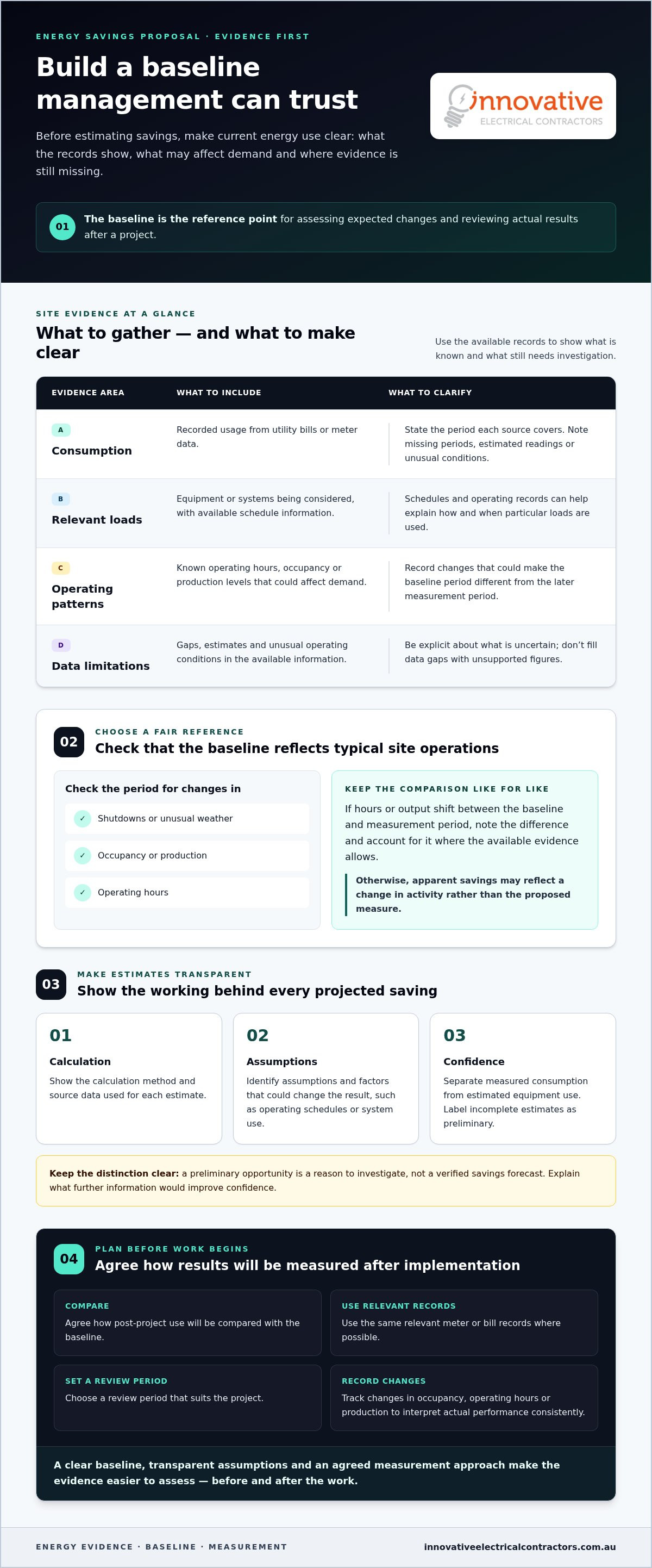
A savings estimate is only as useful as the picture of current energy use behind it. Establish a baseline before comparing options, and make clear which records support it. The baseline gives management a reference point for assessing expected changes and, later, reviewing actual results.
Gather and organise the site energy evidence
Collect the records available for the site, such as utility bills, meter or interval data, equipment schedules and operating-hour information. State the period each source covers and note gaps, estimates or unusual conditions. A bill may show total site consumption, for example, while equipment schedules and operating records can help explain how and when particular loads are used.
A concise summary helps readers see what is known and what still needs investigation. Include details such as:
Consumption: recorded usage and the bills or meter data it comes from.
Relevant loads: equipment or systems being considered, with available schedule information.
Operating patterns: known hours, occupancy or production levels that could affect demand.
Data limitations: missing periods, estimated readings or unusual operating conditions.
Choose a baseline period that reflects typical site operations, then check whether it includes shutdowns, unusual weather, changed occupancy or production changes. Compare like with like. If operating hours or output shift between the baseline and the measurement period, note the difference and account for it where the available evidence allows. Otherwise, apparent savings may reflect a change in activity rather than the proposed measure.
Estimate savings transparently and set a measurement plan
For every projected saving, show the calculation method, source data and assumptions. Separate measured consumption from estimated equipment use, and identify factors that could change the result, such as operating schedules or how a system is used. Don’t fill data gaps with unsupported figures. If the evidence is incomplete, present the estimate as preliminary and explain what further information would improve confidence.
Agree how post-project use will be compared with the baseline before work begins. Use the same relevant meter or bill records where possible, set a review period that suits the project, and record changes in occupancy, hours or production. This gives the team a consistent way to interpret actual performance. For broader context on the financial case, the Institute for Market Transformation discusses the business case for energy efficiency, including avoided costs and asset value.
When presenting an energy savings proposal to management, use clear language such as: “Projected savings are estimates based on the stated site data and assumptions; verified savings can only be reported after post-project consumption is measured against the agreed baseline.” As the proposal moves towards implementation, commercial electrical and energy solutions can be considered in light of the site evidence and operating needs.
Compare energy-saving options on value, delivery and risk
A shortlist is easier to assess than a catalogue of technologies. Select options that address the site’s identified energy use, then compare them against the same practical criteria: expected benefit, evidence confidence, delivery needs, disruption, maintenance and any project-specific capital or operating costs. This makes trade-offs visible without implying that one measure suits every building.
Compare measures that fit the site
Depending on the equipment already in place and how the site operates, options might include lighting controls, efficient lighting, air-conditioning improvements, or solar and battery systems. Suitability depends on factors such as existing system condition, operating schedules, site requirements and available evidence. For broader electrical context, see this guide to modern electrical services.
Use a simple comparison table to show what each option could address and what needs further assessment. Keep costs and savings project-specific, and label estimates and assumptions rather than presenting them as confirmed results.
Make trade-offs, dependencies and uncertainty visible
A strong proposal shows more than the forecast benefit. Explain what could affect delivery, including work sequencing, operational disruption, maintenance responsibilities and the condition of existing equipment. Note dependencies such as electrical capacity or further site investigation. Include expected useful life only where it’s supported by reliable information for the proposed equipment.
Rank the shortlist against the organisation’s priorities, not a universal rule. A controls upgrade may suit a site with changing occupancy, while air-conditioning improvements may warrant review where comfort and system operation are key concerns. Solar or storage may merit investigation where site conditions and energy-use patterns support it. State what is known, what remains uncertain and what evidence would resolve that uncertainty. A tailored comparison gives decision-makers a sound basis to approve an option, request further investigation or set priorities for a later stage.
Shape the proposal around management questions and approval concerns
Management needs to see what decision is required, why it matters and what happens next. Organise the proposal so readers can move from the request to the supporting detail without having to interpret a technical report. A practical sequence is:
Decision: what you’re asking management to approve, investigate or prioritise.
Evidence: the site information and assumptions behind the opportunity.
Options: the alternatives considered and why you favour a particular pathway.
Risks and delivery: likely disruption, dependencies, maintenance and proposed controls.
Next step: the approval, resources or investigation needed to proceed.
Put the executive summary first. Keep it concise and focused on the decision, rationale and expected outcomes. Supporting calculations, technical notes and assumptions can follow for readers who need to check the detail. This structure helps operational managers and senior decision-makers find the information relevant to their roles.
Present the financial case without overstating it
Separate estimated savings, project costs and non-financial benefits, such as operational reliability or occupant comfort. Use project-specific evidence for financial figures, and label estimates clearly. If the data supports a range of outcomes, show a conservative scenario alongside the central estimate. Explain how assumptions about tariffs, usage patterns or operating changes could affect the result. Don’t present a forecast as a guaranteed return.
Management may also ask whether the work can be completed without unacceptable disruption, what maintenance it will require and who will check the results. Address these concerns directly. Describe relevant access, safety and timing controls, and identify dependencies such as further site investigation or coordination with site operations.
Address risk and define accountability
Name proposed responsibilities for each stage: who approves the work, coordinates delivery, oversees commissioning and reviews post-project performance. If uncertainty remains, seek staged approval rather than asking for a full commitment too early. For example, request approval to investigate an option first, with a defined checkpoint to review scope, evidence and delivery requirements before implementation is considered.
End with a specific, proportionate request. “Approve a site investigation to confirm the proposed scope and measurement approach” gives management a clear action and preserves a decision point before further commitments. A well-framed request can make the difference between an idea that stalls and a practical next step.
As the proposal moves towards delivery, plan commercial electrical project delivery around the site’s requirements, responsibilities and agreed measurement approach.
Turn management approval into a practical energy project
Approval is the starting point, not the finish line. Convert the decision into a workable scope, clear responsibilities and an agreed way to track outcomes. This keeps the proposal connected to site operations and gives management a practical view of what will happen next.
Set implementation milestones and verify outcomes
Set milestones that suit the project, from initial investigation and design through delivery, commissioning and performance review. Before work begins, record the agreed baseline and identify who will collect and review post-project data. For solar or battery options, include plans for system operation and ongoing maintenance, as these can affect how performance is monitored over time. This solar battery maintenance guidance offers related considerations.
Investigation and design: confirm the scope, site requirements and information needed to proceed.
Delivery and commissioning: coordinate work, document completion and record any changes that affect expected performance.
Review: compare measured consumption with the baseline using the agreed method, and report relevant operating changes.
Agree review points with management before implementation. Regular updates can cover progress, emerging issues and any decisions needed; a later performance review can compare measured results with the baseline. Keep estimates distinct from verified outcomes, and explain differences in operating hours, occupancy or production that may affect the comparison.
Choose a clear next step for the proposal
Match the request to management’s readiness. If key information is missing, seek approval to gather data or investigate the site. If the option is sufficiently understood, propose a staged scope with checkpoints before later commitments. For climate-control proposals, the Australian air conditioner buying guide provides further context on factors relevant to equipment choices.
When presenting an energy savings proposal to management, a clear next step turns discussion into accountable action without overstating projected savings. State what decision is needed, who will lead the next stage and what evidence will inform the next review. The scope should reflect the site, its operating needs and the information available.
If you’re progressing a site-specific electrical or energy project, discuss your energy project with Innovative Electrical Contractors.
Turn a well-supported proposal into your next step
A persuasive energy proposal gives management a clear decision, grounded in site evidence and honest about estimates. A credible baseline helps set expectations, while a focused comparison shows how options fit operational priorities, delivery needs and risk. Just as importantly, approval should lead to defined responsibilities and a plan to measure outcomes.
Presenting an energy savings proposal to management is easier when technical recommendations are tied to practical business considerations, not framed as guaranteed savings. If the proposal progresses, commercial and industrial electrical project services, solar and battery installations, or air-conditioning solutions may form part of a site-specific delivery plan.
Discuss an energy project with our team to explore practical options for your site and operating needs. With clear evidence and a manageable next step, you can help turn an energy-saving opportunity into a considered project. Start with the information you have, and build the case from there.
Frequently Asked Questions
How do you present an energy-savings proposal to management?
Presenting an energy-savings proposal to management works best when you lead with the decision required, not a list of equipment. Summarise the site issue, the evidence behind the opportunity, the options considered and the next step you recommend. Make clear which outcomes are estimates and what could affect them. Put the key points up front, with technical notes and supporting calculations available for readers who want more detail.
What should an energy-savings proposal include?
An energy-savings proposal should set out the decision request, site energy evidence, baseline period, options assessed and expected outcomes. Include assumptions, data gaps and a clear distinction between measured consumption and forecast savings. Explain relevant delivery considerations, such as disruption, maintenance, responsibilities and how results will be tracked. Keep cost information specific to the project and evidence available, and finish with a practical next step for management to approve or investigate.
How can you calculate potential energy savings for a business?
Estimate potential savings by comparing expected energy use after a proposed change with a credible baseline. Use available bills, meter data and operating records, then state the calculation method and assumptions. Consider factors such as operating hours, occupancy, production and applicable energy tariffs. If data is incomplete, label the estimate as preliminary and explain what needs to be measured or investigated before confidence improves. Avoid presenting projected savings as a guaranteed result.
How do you prove energy savings after a project is completed?
Agree on a measurement approach before work starts, then compare post-project consumption with the established baseline using relevant bills or meter data. Use comparable operating periods where possible, and record changes in hours, occupancy, production or other conditions that may affect use. Assign someone to collect and review the data, and share results with management at agreed checkpoints. Report measured outcomes separately from estimates so the evidence is clear and useful.
What if management is concerned about the upfront investment?
Respond by making the decision manageable and evidence-based. Separate project-specific implementation costs from estimated savings and other operational benefits, then explain the assumptions behind each figure. If uncertainty remains, propose a staged approach, such as approving further investigation before committing to implementation. This lets management review scope, evidence and delivery considerations at a defined checkpoint. Don’t imply a guaranteed payback or use cost figures that aren’t supported by project information.
Can solar and battery storage be included in an energy-savings proposal?
Yes. Solar and battery storage can be assessed as options when they fit the site’s energy use and operating needs. The proposal should consider available site information, existing electrical systems, how the system is expected to operate and what ongoing maintenance involves. Set out assumptions clearly and explain how performance would be tracked after installation. Solar and battery installations can be tailored to a project, but the proposal shouldn’t promise savings before they’re measured.
How do you compare energy-efficiency projects fairly?
Assess each option against the same criteria, including expected outcomes, confidence in the evidence, implementation requirements, operational disruption, maintenance and project-specific costs. Make dependencies visible, such as equipment condition, site constraints or further investigation. A focused comparison helps management understand trade-offs rather than rely on technology claims alone. Rank options according to the organisation’s priorities and site conditions, not a universal definition of the best solution.

Comments