
Mitsubishi Electric vs Panasonic Ducted Air Conditioning: Which Suits Your Home?

The brand with the stronger headline specifications isn’t automatically the better choice for your home. A mitsubishi electric vs panasonic ducted air conditioning comparison can be difficult because specifications, efficiency ratings and features vary between models. Look beyond the brand name and consider how each system would perform in your home.
This comparison explains how to assess equivalent ducted models and weigh up the factors that affect comfort and everyday use. You’ll learn what to consider about your home’s layout, heating and cooling needs, energy performance and the features that matter to your household.
Zoning, duct layout and system sizing belong in the decision from the start. The equipment needs to suit the property, and careful system design and installation help turn a suitable model into a comfortable, dependable result. Use the steps below to compare Mitsubishi Electric and Panasonic options against your home and installation requirements, rather than choosing on brand reputation alone.
Table of Contents
Mitsubishi Electric vs Panasonic ducted air conditioning: why the right fit matters
How ducted system design affects Mitsubishi Electric and Panasonic performance
Mitsubishi Electric vs Panasonic ducted systems: compare these criteria
Plan Mitsubishi Electric or Panasonic ducted installation with confidence
Mitsubishi Electric vs Panasonic ducted air conditioning: why the right fit matters
Neither Mitsubishi Electric nor Panasonic is automatically the best choice for every home. A well-matched system from either manufacturer may suit your needs, but the brand name alone won’t tell you what it will be like to live with. The useful question is how comparable models meet your household’s comfort needs and work with your property.
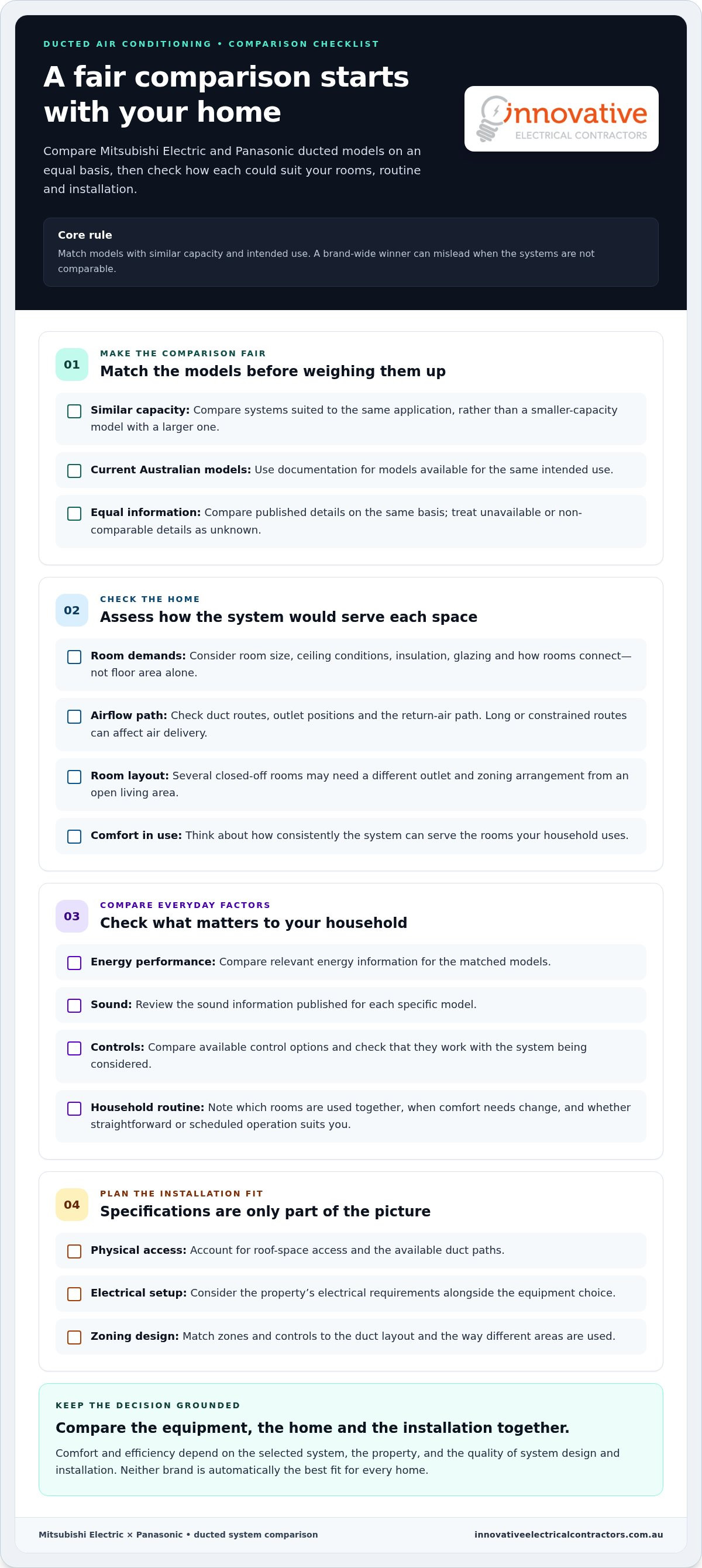
For a fair ducted air-conditioning comparison, match models with similar capacity and intended use, then assess their performance, features and installation requirements against the same home.
Start with comfort in the rooms you use, energy performance, control options and published sound information. Then consider how the system could fit the roof space, duct paths and existing electrical setup. Specifications help narrow your options, but they don’t account for every detail of the installation.
What makes ducted air conditioning different?
A ducted system uses a central indoor unit to condition air and distribute it through ducts to ceiling outlets in different rooms. This differs from a room-by-room split system, which generally has its own indoor unit serving a particular area. In a ducted system, the central unit, ducts, outlets and controls work together, so their design affects how air reaches each space.
For example, a floor plan with several closed-off rooms may need a different outlet and zoning arrangement from an open living area. Comfort and efficiency depend on the selected system, its design and installation, and the property itself, including its layout and insulation. Comparing unit specifications without considering those conditions gives you only part of the picture.
Why a brand-wide winner can mislead
Each manufacturer offers ducted models with different capacities, features and intended applications. Comparing a smaller-capacity system from one brand with a larger one from the other makes differences in performance or energy use difficult to interpret. A feature on one model shouldn’t be assumed to apply across that manufacturer’s entire range.
For a useful mitsubishi electric vs panasonic ducted air conditioning comparison, focus on current Australian models suited to the same application and similar capacity. Compare published information on an equal basis. If a detail isn’t available or comparable, treat it as unknown rather than filling the gap with assumptions.
Comfort: Consider how consistently the system can serve the rooms you use.
Efficiency: Compare relevant energy information for the matched models.
Controls and sound: Check which control options and sound details are documented.
Installation fit: Account for duct routes, ceiling access and electrical requirements.
These criteria help you build a shortlist without relying on blanket rankings. Next, consider how your home’s layout and system design influence which models make sense for the project.
How ducted system design affects Mitsubishi Electric and Panasonic performance
A manufacturer’s specifications describe the equipment, but they can’t predict how comfortable every room in your home will feel. Capacity, duct routes, outlet positions, the return-air path and zoning all affect how conditioned air moves through the property. These design choices matter whichever brand you’re considering.
That’s why a mitsubishi electric vs panasonic ducted air conditioning comparison needs to account for the home as well as the units. Published features and performance figures help you compare equipment. In practice, results also depend on the property and the quality of system design and installation.
Capacity, layout and airflow in a ducted home
Selecting capacity requires a property assessment, not a guess based on floor area alone. Room sizes matter, as do ceiling conditions, insulation, glazing and the way rooms connect. For instance, a sunlit room with large windows may have different heating or cooling demands from a shaded room of similar size.
Duct routes and outlet positions also shape airflow. Long or constrained routes can affect delivery, while an outlet in the wrong position may not distribute air effectively through the occupied part of a room. The return-air path needs consideration too, so air can circulate back to the indoor unit.
These details inform the design and how the system should serve each room. For broader guidance on comparing system types and selection factors, see this Australian air-conditioner buying guide.
Zoning, controls and everyday comfort
Zoning can direct airflow to selected areas when the system and its controls support that arrangement. It can be useful when household members use different parts of the home at different times. For example, you may want to condition living areas during the day and bedrooms in the evening, rather than treating every space as equally occupied.
Think about your household routine before comparing control functions. Note which rooms are used together, when comfort needs change and whether straightforward controls or scheduled operation would suit you. Then compare manufacturer features with current Australian model documentation and compatible accessories. A control option should influence your decision only if it works with the specific system being considered.
Well-planned zoning and controls can make a system easier to use, but they need to suit the duct layout and intended operation. A property-specific design and installation plan brings these choices together with capacity, airflow and electrical requirements. Innovative Electrical Contractors provides air-conditioning installation alongside electrical services, linking equipment selection with the practical needs of your home.
Mitsubishi Electric vs Panasonic ducted systems: compare these criteria
Start with equivalent models, then check what current Australian product documents state. For example, Australian lineup information for October 2026 identifies a 14 kW Mitsubishi Electric PEA-M140HAA and a 14 kW Panasonic S-140PE3R/U-140PZ3R5. Their matching stated capacity gives you a clearer starting point, but it doesn’t establish that their efficiency, sound or features are identical.
Match capacity before comparing efficiency, because figures from differently sized systems may not describe equivalent equipment or an equivalent application.
The table separates the available capacity information from details that need verification against current Australian manufacturer documents. “Not verified” means there isn’t a comparable figure available for this assessment, not that the model lacks the feature.
The model and capacity entries reflect Australian lineup information available for October 2026. Use each model’s current Australian documentation for energy, sound, control and warranty details, and record the document date. This keeps the mitsubishi electric vs panasonic ducted air conditioning comparison transparent instead of presenting missing information as a brand advantage.
Efficiency, capacity and sound: compare like with like
Energy labels and efficiency figures are meaningful only when you know what they measure and whether their test basis is comparable. Check the rating format, operating mode and conditions stated in each manufacturer document. Don’t infer household savings from a label alone: actual energy use also depends on the installation, settings and how the home is used.
Sound figures need the same care. A number measured at a different operating setting or under different conditions can’t support a fair ranking. Use like-for-like published data, and consider equipment placement and installation rather than assuming a particular system will be quiet in your home.
Controls, warranty and model-specific features
For controls and connectivity, distinguish what comes with the exact model from optional accessories. Compatibility matters, so check the relevant Australian product and accessory documents rather than relying on general brand information. Compare warranty coverage using each manufacturer’s current Australian terms, including any stated conditions, rather than relying on a general summary or an older document.
Once you have a model shortlist, air-conditioning installation planning can connect your equipment choice with the property’s practical requirements.
How to decide which ducted air conditioner suits your home
A clear decision process turns a brand comparison into a practical shortlist. Start with how you want your home to feel, then consider the property and compare installation proposals. This keeps the focus on what the system needs to do, not just the name or specifications on the unit.
Match the system to your home and household
Before reviewing models, note which rooms need consistent comfort, when each area is occupied and which control functions matter to your household. A family that uses living spaces during the day may prioritise different zones from a household that mainly wants bedroom comfort overnight. Existing ducts, ceiling access and available routes can also affect the design.
Set your comfort priorities. List the bedrooms and living areas that matter most, note when people are home, and record preferences for zones, schedules or simple controls.
Identify property constraints. Consider the home’s layout, roof or ceiling access, existing ductwork and electrical infrastructure. These details can influence feasible unit locations, duct paths and zoning.
Arrange a property-specific assessment. Use the home’s conditions and household needs to inform capacity and system design, rather than selecting a unit based only on its brand or floor area.
Build a suitable shortlist. Compare models intended for the same application and ask for a proposed design that explains how each option will serve the rooms you’ve prioritised.
Review and compare installation proposals
Compare proposals on the same basis. Check the exact model, proposed capacity, design assumptions, zones, controls and included installation work. A proposal should make clear which rooms are served and how the duct layout relates to your requirements. This helps separate equipment differences from differences in installation scope or design.
Consider existing infrastructure too. Reusing some ductwork or electrical provisions may affect the proposed work, while changes to access or routing may lead to a different installation plan. Electrical requirements are part of the project assessment. The modern electrical services guide provides broader context on electrical considerations in Australian properties.
For a sound mitsubishi electric vs panasonic ducted air conditioning comparison, review each proposal’s assumptions alongside the model specifications. If one includes different zones, controls or installation work, it isn’t a direct comparison until you understand those differences. Clear documentation gives you a better basis for weighing comfort, scope and equipment together.
Ready to turn your shortlist into a home-specific plan? Plan your ducted air-conditioning installation with system design and electrical requirements in view.
Plan Mitsubishi Electric or Panasonic ducted installation with confidence
Choosing a suitable model is only part of the decision. It also needs to fit the home, the intended room layout and the practical conditions for installation. A considered plan connects the equipment choice with airflow, controls and electrical requirements, so you can assess how the system is expected to work as a whole.
Innovative Electrical Contractors provides air-conditioning installation and electrical services for this planning stage. The aim is to match the proposed system and installation approach to the property, rather than treating the equipment choice as a stand-alone decision.
What a considered ducted installation plan addresses
A project-specific plan accounts for the home’s layout and how the system can be installed within it. The location of the indoor and outdoor equipment, available access, roof or ceiling conditions and practical duct routes can all affect the design. Return-air placement and proposed zones also need to work with the rooms you want to condition.
Electrical requirements belong in the same conversation. Consider existing infrastructure and the needs of the selected system alongside coordination of equipment, controls and ductwork. A clear plan helps identify where the property may shape the design before work proceeds.
Depending on the home, the planning process should address:
Equipment locations and access for installation and future servicing.
Duct paths, outlet positions and return-air arrangements.
Zones that reflect the rooms and household routines the system must serve.
Electrical requirements and how the installation components fit together.
These points are specific to each property. A layout that works in one home may not suit another, even if both are considering the same model. Installation planning should reflect the building and proposed system, without relying on assumptions about access, duct routes or existing infrastructure.
Move from comparison to a suitable system
Use the comparison to shortlist Mitsubishi Electric and Panasonic models that appear suitable for the intended application. Then assess the property and installation requirements against that shortlist. Review the proposed design alongside the equipment details, including how the system will serve the required rooms and whether its controls suit your household’s preferences.
The most suitable choice is the system that meets your requirements as designed and installed. A brand or model may look compelling on paper, but a home-specific plan helps show whether it’s a practical fit. This connects model specifications with the installation conditions that influence comfort and day-to-day use.
For a mitsubishi electric vs panasonic ducted air conditioning comparison, bring your preferred options and comfort priorities into the installation discussion. Innovative Electrical Contractors provides air-conditioning installation and electrical services to help plan a system around your property. Discuss your air-conditioning installation and take the next step towards a suitable ducted system.
Take the next step towards a system that fits
Your shortlist is a starting point, not a commitment to a particular brand. The next step is to connect the models you’re considering with the conditions in your home, including the installation plan and electrical requirements. That’s where an informed mitsubishi electric vs panasonic ducted air conditioning comparison becomes a practical decision.
Bring your comfort priorities and preferred options into a project discussion. Innovative Electrical Contractors provides air-conditioning installation and maintenance, with electrical services to support installation planning. These considerations help shape a ducted system plan around the property, rather than forcing the home to fit a model chosen on specifications alone.
Discuss your ducted air-conditioning project and take a considered next step towards a system designed for your home.
Frequently Asked Questions
Can ducted air conditioning be installed in an existing home?
Yes, ducted air conditioning can be installed in an existing home if there’s a suitable place for the indoor unit, space for duct routes and an appropriate location for the outdoor unit. A retrofit assessment can also consider ceiling access, electrical supply and condensate drainage. The home’s construction may affect the installation approach, so an existing house can require different planning from a new build.
Can existing ductwork be reused when replacing a ducted air conditioner?
Sometimes, but the ductwork needs to suit the replacement system and remain in serviceable condition. For example, damaged, poorly sealed or inadequately insulated ducts may undermine the performance of new equipment. Their size, layout and outlet positions matter too. Inspecting the existing system before replacement helps determine whether the ducts can remain, need changes or should be replaced.
Does ducted air conditioning need a roof cavity?
No, a roof cavity isn’t the only possible location. Ducted systems need suitable space for the indoor unit and ductwork, which may be provided by a roof space or another design option, such as a purpose-built bulkhead. The right arrangement depends on the building, available access and how air can be distributed. A property assessment can establish which installation options are practical.
How often should a ducted air conditioner be serviced?
Follow the maintenance schedule in the manufacturer’s instructions for your specific model, as service needs can vary. Between professional visits, check and clean or replace accessible return-air filters as directed in the manual. Reduced airflow, unusual sounds, water around the unit or inconsistent heating and cooling are reasons to arrange an inspection rather than waiting for the next scheduled service.
Can ducted air conditioning work with smart-home controls?
It may be possible, depending on the system, compatible controllers or accessories and the smart-home platform. Some arrangements provide app-based operation or scheduling, but compatibility shouldn’t be assumed from the brand name alone. For a mitsubishi electric vs panasonic ducted air conditioning comparison, check the current Australian documentation for the exact model and any required accessory before treating smart-home integration as an included feature.
Do Mitsubishi Electric and Panasonic ducted systems use the same refrigerant?
Not necessarily. Refrigerant can vary between specific models and model generations, so don’t assume either manufacturer’s entire ducted range uses one type. Check the current Australian product documentation or the system’s identification plate for the exact refrigerant. This detail matters when comparing models or servicing an existing system, as refrigerants aren’t interchangeable without regard to equipment specifications.
Comments