
Hikvision vs Dahua IP Camera Cybersecurity and Image Quality in 2026

The camera hardware mounted on your exterior wall matters far less than the network architecture defending it. When evaluating hikvision vs dahua ip camera cybersecurity and image quality, most property owners get caught between competing low-light claims and unsettling headlines about hardware vulnerabilities. You simply want crisp, dependable night footage without exposing your private local network to remote intrusion or falling foul of Australia's mandatory IoT security standards.
Both manufacturers produce exceptional surveillance hardware, but real peace of mind comes from knowing how these systems behave under operational pressure. You will discover how proprietary optical technologies like ColorVu and Full-Colour stack up in true low-light conditions, cut through the confusion surrounding international hardware restrictions, and learn the practical safeguards needed to harden your installation. We break down the sensor benchmarks, analyse firmware risks, and reveal the exact network isolation strategies required to keep your premises secure.
Table of Contents
Hikvision vs Dahua: Architectural and Optical Comparison in 2026
Choosing between the two surveillance heavyweights requires looking past marketing claims. When assessing hikvision vs dahua ip camera cybersecurity and image quality, the physical components under the casing determine how clearly an incident is recorded and how reliably the unit performs during scorching Australian summers. Both manufacturers build their commercial-grade housings with robust cast aluminium and IP67 weather protection, keeping delicate image sensors cool and shielded against fine dust.
Hardware Standards and Image Sensor Specifications
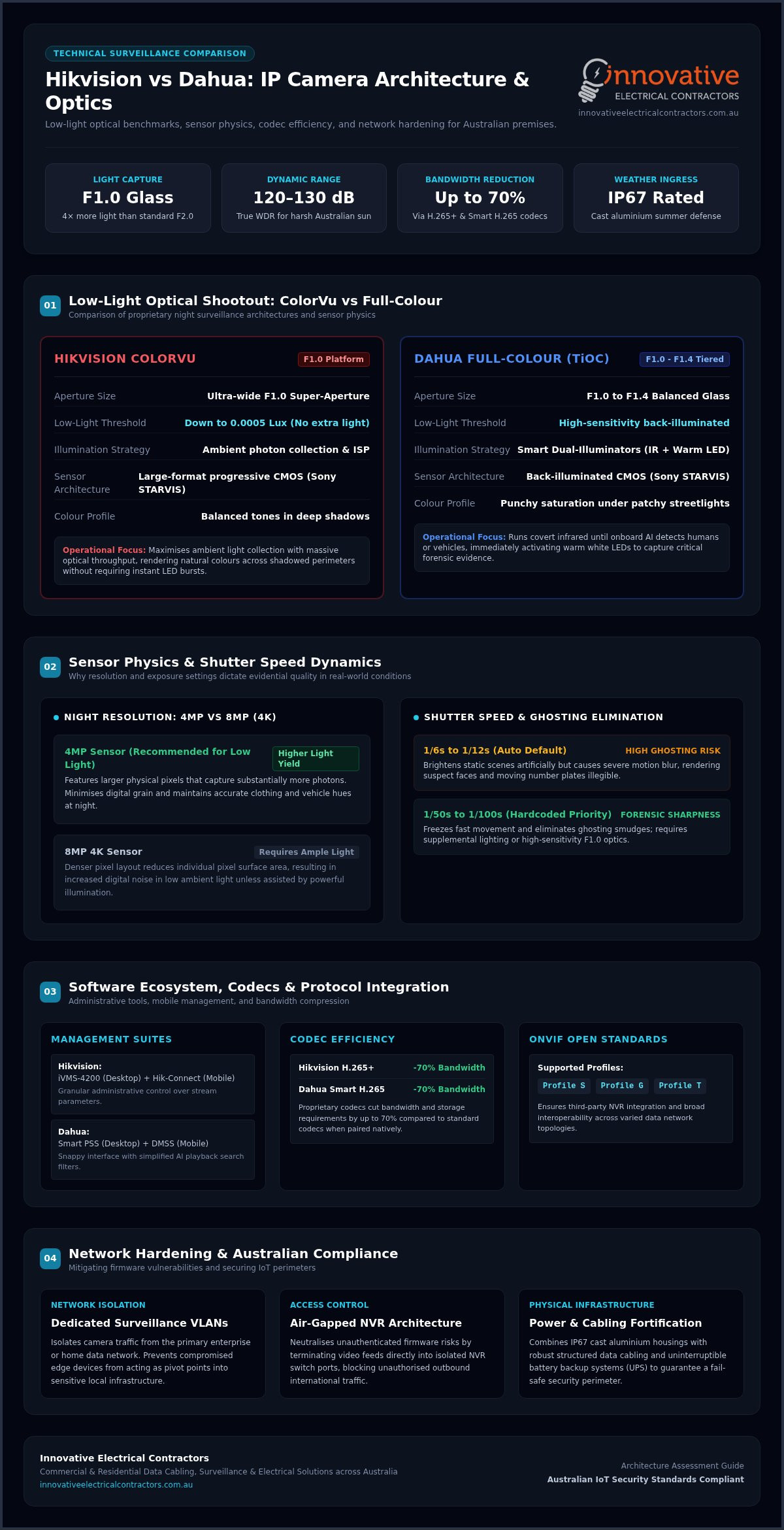
Optical clarity starts with the sensor. Both brands rely on large-format progressive scan CMOS sensors, frequently leveraging Sony STARVIS silicon to maximise photon capture across pitch-black perimeters. Hikvision pairs these sensors with ultra-wide F1.0 apertures in its flagship lines, admitting four times more light than a standard F2.0 security lens. Dahua balances its hardware between F1.0 and F1.4 glass across comparable tiers. In high-contrast environments, true hardware Wide Dynamic Range (rated at 120dB to 130dB) balances harsh Australian midday sun against deep building shadows, preserving crisp facial features and number plates without crushing detail.
Software Interfaces, NVR Protocols, and Integration
Daily usability depends on stable local firmware and responsive management platforms. Hikvision relies on its iVMS-4200 desktop suite alongside the Hik-Connect mobile portal, giving operators granular administrative control over stream parameters. Dahua counters with Smart PSS and DMSS, delivering a snappy interface that simplifies multi-channel playback and artificial intelligence search filters.
Both platforms support ONVIF Profiles S, G, and T, allowing smooth communication with third-party Network Video Recorders. Native brand pairing remains ideal, as proprietary codecs like Hikvision H.265+ and Dahua Smart H.265 cut bandwidth demands by up to 70 percent. Beyond software convenience, evaluating Hikvision background and state ownership remains an essential step for property managers designing fortified data environments. Determining the right fit in hikvision vs dahua ip camera cybersecurity and image quality ultimately requires matching the video architecture to your existing data cabling infrastructure.
Low-Light Image Quality Shootout: ColorVu vs Full-Colour
Marketing brochures promise daytime colour at midnight, but the physics of nighttime surveillance tell a different story. In the debate over hikvision vs dahua ip camera cybersecurity and image quality, low-light performance reveals real optical differences. Darkness strips away digital tricks, leaving the lens glass, sensor silicon, and exposure algorithms to do the heavy lifting.
Nocturnal Colour Reproduction and Sensor Physics
Capturing colour in near-total darkness demands massive optical throughput. Hikvision ColorVu utilizes an F1.0 super-aperture lens paired with an advanced image signal processor, allowing usable colour capture down to 0.0005 lux without supplemental illumination. Dahua Full-Colour counters with high-sensitivity back-illuminated sensors and F1.0 glass, delivering punchy saturation even under patchy street lighting. 4MP sensors consistently outperform 8MP 4K variants at night. Larger physical pixels gather significantly more photons, minimising digital grain and keeping clothing hues accurate.
Motion Capture, Shutter Speeds, and Ghosting
Static scenes look impressive in brochures, but moving targets expose camera flaws. To brighten an image, automated camera firmware often drops the shutter speed to 1/12 or 1/6 of a second. This introduces severe motion blur, rendering suspect faces and moving vehicle registration plates illegible smudges.
Hikvision ColorVu: Prioritises ambient collection, maintaining balanced colour tones across deep shadowed perimeters.
Dahua Full-Colour (TiOC): Employs smart dual-illuminators, running covert infrared until built-in AI detects a human or vehicle, then instantly triggering warm white LEDs.
Shutter Speed Priority: Hardcoding exposures to a minimum of 1/50 or 1/100 second eliminates ghosting, though it requires supplemental illumination.
Deciding between visible white LEDs and covert infrared requires balancing nuisance light against evidential value. Visible LEDs can annoy neighbours in residential areas, making smart dual-illumination a sensible compromise. Maintaining reliable feeds also requires protecting the underlying hardware. You should always follow proven steps to secure your home security cameras against external exposure while dialling in these advanced imaging parameters. If you are balancing complex site layouts across Australia, engaging professionals for integrated CCTV and access control design ensures both optimal camera placement and hardened network performance. Evaluating hikvision vs dahua ip camera cybersecurity and image quality means selecting optics that retain evidential clarity without creating blind spots.
The Cybersecurity Reality: Vulnerabilities, NDAA, and Australian Standards
Headlines regarding foreign surveillance gear often blur the line between geopolitical posturing and practical network risk. When weighing up hikvision vs dahua ip camera cybersecurity and image quality, property owners must separate public sector mandates from private enterprise realities. While both manufacturers have faced scrutiny over historical software exploits, the danger to your local network depends almost entirely on baseline configuration and device isolation.
Analysing Documented Vulnerabilities and Patch Responses
Every major IoT vendor deals with firmware flaws. Both brands have recorded critical Common Vulnerabilities and Exposures (CVEs) with severity scores reaching 9.8 out of 10. These have ranged from authentication bypasses to remote code execution bugs. Legacy flaws like CVE-2017-7921 remain frequent targets for automated botnets, earning an ongoing spot on CISA's Known Exploited Vulnerabilities Catalog. The actual threat rarely stems from deliberate backdoors; unpatched firmware, open default ports, and exposed Universal Plug and Play (UPnP) settings create the genuine entry points for malicious actors.
Compliance Guidelines for Australian Commercial and Domestic Properties
Regulatory frameworks differ significantly depending on who owns the building. The Australian federal government previously audited and removed Chinese-manufactured cameras from sensitive defence and departmental sites. That restriction does not automatically outlaw these devices across the private sector:
Government & Defence Mandates: Federal agencies and defence contractors follow strict supply-chain prohibitions aligned closely with US NDAA Section 889 rules.
Mandatory IoT Standards: Under the Cyber Security Act 2024, consumer-grade smart devices sold across Australia must meet strict security baselines, including a total ban on universal default passwords.
Private Commercial & Domestic Use: Australian private businesses and residences can legally deploy either brand, provided systems comply with national data handling laws and insurance underwriting terms.
Corporate underwriters increasingly review whether connected cameras sit openly on primary corporate subnets. Assessing hikvision vs dahua ip camera cybersecurity and image quality means recognising that both brands require disciplined maintenance, routine patching, and strict local network segmentation to stay fully secure.
Network Hardening: How to Fortify Either IP Camera Brand
Camera hardware represents only the outer perimeter of your surveillance system. In the ongoing debate over hikvision vs dahua ip camera cybersecurity and image quality, defensive network architecture remains the single most effective barrier against unauthorised access. You do not need to discard capable hardware when disciplined installation practices can completely isolate potential vulnerabilities from your broader business or residential network.
Network Segmentation and Managed Switch Configuration
Physical and logical isolation forms your primary line of defence. IP cameras should never reside on your primary office or household subnet alongside laptops, payment terminals, and servers. Instead, implement a dedicated surveillance Virtual Local Area Network (VLAN) across managed switches:
Zero Gateway Access: Strip default gateway assignments from camera IP settings. This prevents devices from initiating outbound connections to external internet servers or unverified cloud endpoints.
Strict Inter-VLAN Rules: Configure router firewall policies to block traffic from passing between your surveillance VLAN and sensitive internal networks.
Internal NVR Subnets: Connecting cameras directly to the integrated PoE ports behind a dedicated Network Video Recorder creates a physically separated subnet that shields individual cameras from direct local exposure.
Remote viewing should rely on self-hosted WireGuard or OpenVPN tunnels into your local router. This eliminates reliance on proprietary P2P cloud relays while granting swift, encrypted access from your smartphone.
Firmware Governance, Password Policies, and Port Lockdown
Device hardening requires locking down every unused communication pathway. Start by enforcing complex, unique credentials across all devices and enabling dual-factor administrative authentication where supported. Disable unencrypted services including Telnet, standard HTTP, and UPnP discovery within the device settings. Implementing 802.1X port-based network access control and uploading custom TLS certificates ensures only authorised hardware can communicate across your physical cabling.
Firmware maintenance should follow a disciplined, offline schedule. Download verified patches directly from regional manufacturer portals and install them manually after reviewing changelogs. Balancing hikvision vs dahua ip camera cybersecurity and image quality ultimately succeeds when professional data cabling and network defences back your hardware. To safeguard your property with an expertly isolated security perimeter across Australia, consult with our CCTV and access control specialists today.
Selecting and Deploying the Right Surveillance Solution for Your Property
Selecting the ideal ecosystem comes down to matching your site layout with the right sensor technology. In the final comparison of hikvision vs dahua ip camera cybersecurity and image quality, both brands offer distinct operational advantages when backed by competent engineering. The decision rests on whether your perimeter requires discrete optical monitoring or assertive deterrent capabilities.
Matching Brand Capabilities to Specific Security Applications
Every site presents distinct operational demands, making hardware alignment critical:
Residential Frontages: Hikvision ColorVu excels in quiet domestic settings. Its wide aperture gathers existing street lighting to produce clean nocturnal colour without shining distracting supplemental floodlights into neighbouring bedroom windows.
Commercial Yards and Perimeters: Dahua TiOC cameras shine in industrial yards, storage facilities, and carparks. The instant detection of perimeter breaches triggers active deterrent strobes and audio warnings, turning passive monitoring into immediate loss prevention.
Lifecycle Value: Dahua often holds an edge on initial hardware expenditure, while Hikvision provides deep cross-compatibility across extensive commercial camera catalogues.
Professional Integration and Certified Installation Standards
A high-end camera doesn't deliver results if its physical infrastructure is compromised. In Australia, structured network wiring must comply with AS/CA S009 installation standards, ensuring physical separation between low-voltage communications lines and mains electrical runs. Exterior cabling should always sit within rigid conduit to prevent physical tampering and weather degradation.
Power reliability is equally vital. Connecting your recorder and switchboard gear to dedicated battery storage systems guarantees continuous coverage during grid outages or deliberate tampering. You can explore standard-compliant wiring methods in our guide to CCTV installation.
Unifying cameras with modern access control systems creates a cohesive barrier against physical breaches. While evaluating hikvision vs dahua ip camera cybersecurity and image quality provides clarity, true protection demands disciplined network and electrical execution. Connect with our licensed technicians to schedule professional security solutions built for Australian properties.
Fortifying Your Perimeter with Confident Surveillance
Optical clarity means very little if your surveillance perimeter exposes your property to network threats. Balancing hikvision vs dahua ip camera cybersecurity and image quality ultimately comes down to deliberate hardware pairing and disciplined installation. While Hikvision ColorVu delivers superior passive nocturnal light gathering, Dahua TiOC cameras provide active deterrent tools that stop intrusions before they escalate.
Your hardware is only as secure as the infrastructure supporting it. Isolating cameras onto dedicated surveillance VLANs, eliminating direct outbound internet routing, and enforcing AS/CA S009 cabling compliance transforms either brand into a dependable security asset. Pairing this setup with uninterruptible battery backup ensures your property remains protected through severe weather and grid disruptions.
Taking control of your physical security starts with an engineered installation. Our fully licensed electrical team specialises in structured data cabling, commercial switchboard integration, and cyber-secure camera hardening across Australia. Ready to eliminate blind spots and protect your network? Upgrade your property with secure, professionally engineered CCTV today.
Frequently Asked Questions
Are Hikvision and Dahua cameras banned from use in Australia?
No, they are not banned for private residential or commercial use in Australia. The federal government removed both brands from defence and sensitive departmental buildings, mirroring overseas security policies. Private businesses and domestic homeowners can legally install either brand. However, devices must comply with mandatory IoT cybersecurity standards under the Cyber Security Act 2024, such as replacing universal default factory passwords with secure credentials during initial commissioning.
Which camera brand provides superior low-light clarity without visible white light?
Hikvision holds a technical advantage in total darkness without visible supplemental light. Its ColorVu technology utilizes an F1.0 super-aperture alongside advanced image processing algorithms, gathering usable ambient photons down to 0.0005 lux. Dahua Full-Colour delivers excellent results, but often relies on warm LED illuminators or switching to infrared illumination in zero-lux conditions to avoid motion blur on fast-moving targets.
Can an IP camera compromise other computers on the same local network?
Yes, an infected or unpatched IP camera can act as an internal pivot point across an unsegmented network. If malicious actors exploit known firmware vulnerabilities, they can scan your local subnet, intercept unprotected traffic, or target networked computers. This is why evaluating hikvision vs dahua ip camera cybersecurity and image quality must include setting up an isolated surveillance VLAN, preventing the camera hardware from ever communicating directly with your private computers.
What is the main difference between Hikvision ColorVu and Dahua Full-Colour?
The main difference lies in how each platform balances ambient light capture against supplemental illumination. Hikvision ColorVu leans heavily on physical F1.0 optics to collect natural ambient light continuously. Dahua Full-Colour, particularly within the TiOC series, prioritises smart dual-illumination. Dahua cameras operate covertly using infrared until artificial intelligence detects human or vehicular movement, immediately triggering visible white LEDs to capture full colour and actively deter intruders.
Do I need an internet connection to run a Hikvision or Dahua NVR system?
No, neither system requires an active internet connection to record footage locally. Both platforms function seamlessly as completely closed-circuit, air-gapped systems. Connecting cameras directly to the PoE ports on the rear of the NVR keeps all video traffic isolated on an internal private switchboard subnet. You only require an internet connection if you want remote mobile notifications or wish to view live feeds over a secure VPN.
Can professional network installation eliminate cybersecurity risks from IP cameras?
Professional installation neutralises almost all practical cybersecurity risks through network isolation. Licensed contractors isolate camera feeds onto dedicated VLANs, shut down unencrypted ports, and disable outbound wide area network routing. Addressing hikvision vs dahua ip camera cybersecurity and image quality comes down to infrastructure design. Even if a camera contains an unpatched vulnerability, an air-gapped or firewall-isolated unit cannot phone home or expose your core network to outside intrusion.
How do these surveillance cameras integrate with existing access control systems?
Modern IP cameras integrate with access control hardware through physical alarm inputs, IP relays, and ONVIF Profile C protocols. When a user presents a key fob or biometric credential at a door controller, the system triggers the camera to bookmark recorded footage, take a high-resolution snapshot, or verify the person's identity using facial recognition. This links physical perimeter entry records with immediate visual evidence across your central management software.

Comments