
Financial modelling for commercial battery storage: compare costs and returns
A battery that shifts electricity use at the right time can still be a poor investment if operating costs and future capital needs outweigh the savings. Financial modelling for commercial battery storage should compare the value of electricity price arbitrage with operating costs and lifecycle expenditure, using the site’s actual energy use and tariff structure.
It’s reasonable to focus on how much a battery could save. But a useful feasibility assessment looks beyond the purchase decision: it considers how the system will operate, what it will cost to maintain, and how its performance may change over its working life.
This guide explains how to compare owner investment, leasing and shared-revenue arrangements, and how to assess the assumptions behind each option. You’ll see how charging and discharging patterns affect returns, which costs belong in the model, and what to weigh before deciding whether a commercial battery suits your Australian business.
Table of Contents
What should you consider before installing a BESS?
Assess how the battery will operate, which value streams suit the site, and what obligations come with each project structure. In Australia, energy use, tariff design, connection requirements and lifecycle risks all shape the comparison.
Battery and Renewable Operating Characteristics
Solar generation varies with sunlight, while business demand follows operating hours. A battery stores surplus energy or lower-priced grid electricity, then discharges when site demand or prices rise. Power affects response speed; capacity affects supply duration. Small-business systems are described as ranging from 5 kWh to 100 kWh. Suitable duration depends on the load profile and intended discharge period.
Business Suitability by Energy Use and Tariffs
Sites with high consumption and steady energy use can make storage easier to assess. Review interval demand, solar output and tariff periods together. For industrial users with a power-receiving transformer capacity of 315 kVA and above, the described tariff has two price components. Model those charges alongside energy savings, cycling limits, degradation, warranty and long-term support.
Behind-the-Meter and Standalone Storage
Behind-the-meter storage can reduce a site’s grid purchases and support selected loads, while standalone, grid-connected storage relies on grid services and trading income. Revenue potential and connection requirements differ, so compare each option with its operating responsibilities and access to relevant markets.
Some Australian businesses may access a battery rebate: from 1 July 2025, the described programme offers 30% for eligible systems up to 50 kWh, with partial rebates between 50 kWh and 100 kWh. Businesses should check the applicable rebate terms and confirm whether their system meets the eligibility requirements. Tax treatment depends on the business and asset structure.
Self-Consumption and Battery Arbitrage
Self-consumption stores excess solar for later use, reducing the need to buy grid energy. Arbitrage charges from the grid when prices are lower and discharges when prices rise. An energy management contract can reduce upfront capital needs: a provider funds and supplies the system, then shares revenue. Described investor-enterprise splits include 10%:90% and 15%:85%.
Projects may require development approvals, network connection processes, engineering studies and fire safety measures. Compare options against site demand, tariff exposure, who is responsible for capital costs and the operational risks involved.
Peak-valley electricity price arbitrage
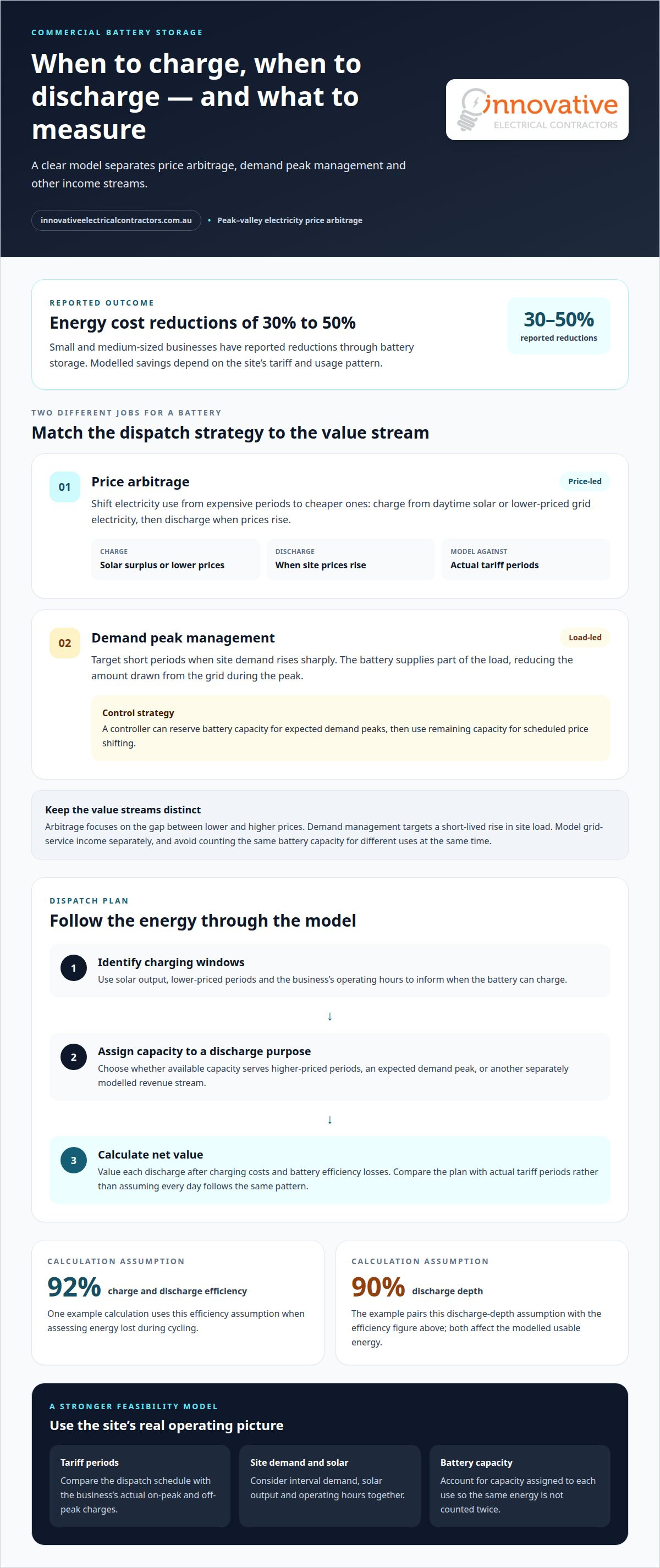
Commercial batteries can create value through electricity price arbitrage, demand charge reduction and grid services. Model each revenue stream separately, then assess how charging schedules, tariff periods and available battery capacity affect the combined result.
Peak Electricity Cost Reduction
Arbitrage shifts electricity use from expensive periods to cheaper ones. A battery can charge from daytime solar or lower-priced grid electricity, then discharge when site prices rise. For example, a business can store solar generated during quiet operating hours for later demand. Small and medium-sized businesses have reported energy cost reductions of 30% to 50% through battery storage, though modelled savings depend on the site’s tariff and usage pattern.
Demand Peak Management
Peak management targets short periods when a site’s electricity demand rises sharply. The battery supplies part of that load, reducing the amount drawn from the grid during the peak. This differs from price arbitrage, which focuses on storing energy when prices are lower and using it when prices are higher. A controller can reserve capacity for expected demand peaks, then use the remaining capacity for scheduled price shifting.
On-peak and off-peak operation needs a clear schedule. The control system charges when prices are lower and discharges during higher-priced periods, while accounting for solar output and the site’s operating hours. A useful model compares this dispatch plan with the business’s actual tariff periods rather than assuming every day follows the same pattern.
For payback analysis, calculate the value of each discharge after charging costs and battery efficiency losses. Then model demand reduction and grid-service income separately, avoiding double-counting capacity assigned to different uses at the same time. This shows whether the battery’s capacity is better reserved for a demand peak or used for another revenue stream.
A site assessment can connect these operating assumptions with practical commercial battery planning, including how the system fits existing electrical infrastructure.
Operating costs and lifecycle capital expenditure
A sound model separates regular operating expenses from major capital costs across the battery’s working life. Include charging, maintenance, performance changes and future replacement needs when comparing expected savings with total expenditure.
Battery Operating Costs
In an owner-investment model, the business funds the initial system and ongoing maintenance. Operation also involves paying for charging energy, then managing charge and discharge schedules against site demand. A revenue estimate should account for energy lost during cycling: one calculation uses 92% charge and discharge efficiency and a 90% discharge depth. These assumptions affect how much stored energy can support savings.
Lifecycle Capital Expenditure
Lifecycle capital expenditure covers more than the battery purchase. Include installation, any required electrical upgrades and future capital work needed to keep the system operating. Adding a battery to existing commercial solar may involve a separate battery inverter, switchboard upgrades, protection changes or metering work. Commercial battery system costs in Australia depend on the project: capacity, duration, equipment and site electrical work all influence the total.
Battery Project Operating Assumptions
Keep operating assumptions visible so the model can show their effect on returns. One battery revenue calculation uses 330 consumption days, with system efficiency attenuation of 5% in the first year and 2% per year after the first year. These inputs shape annual discharge and savings. They should sit alongside the planned charging profile, electricity tariff and maintenance requirements.
Test the same project under owner investment and alternative operating arrangements. With owner investment, the business carries both the initial investment and ongoing maintenance. Model charging costs separately from maintenance, then record future capital expenditure in the period it is expected. This keeps energy savings distinct from avoided costs and shows how operating assumptions affect the project’s overall financial result.
Commercial battery feasibility and financial modelling
A feasibility model should show whether projected income can cover investment, operating costs and lifecycle expenditure. Financial modelling for commercial battery storage is most useful when assumptions can be changed and each result traced to its source.
Start with a baseline using the site’s energy use, tariff and solar generation. Then model the battery’s charging and discharging schedule, including how much excess energy is available and when it can be used. Separate bill savings from market income so the same stored energy isn’t counted twice.
Next, test the project’s revenue streams independently. The model described for commercial storage includes five switchable ancillary revenue streams. Keep each stream separate, then test combinations against the battery’s available capacity and operating schedule. This shows whether a result depends on one income source or several working together.
Use a long-term cashflow view. A model can include a 30-year operating period, with installation and later capital expenditure recorded in the periods they occur. Compare owner investment, leasing and shared-revenue arrangements by showing who funds the system, who pays operating costs and how income is allocated.
Financing analysis needs its own checks. One model tests debt covenants using a trailing-12-month debt service coverage ratio (DSCR), which compares operating cash available for debt payments with scheduled debt service. If projected cashflow falls short in a scenario, the model makes that pressure visible before the investment decision.
Run sensitivities for electricity prices, utilisation, degradation, maintenance and revenue availability. Change one assumption at a time, then compare the effect on cash flow and payback. This identifies which inputs matter most and whether the project remains feasible under less favourable conditions.
For a site-specific assessment of battery integration and electrical requirements, discuss your commercial battery project.
Innovative Electrical Contractors: Commercial Electrical
Innovative Electrical Contractors supports businesses planning commercial battery storage through its Commercial Electrical and Solar & Battery services. Turn to the team when a feasibility model points towards a project and you need to consider how the battery fits the site’s electrical infrastructure and energy setup.
For sites with existing solar, adding storage can affect how energy is managed and used. Commercial Electrical work can address the site’s broader electrical requirements, while Solar & Battery services cover integrating solar generation and battery storage. The right approach depends on the project’s design and operating needs.
To discuss your commercial battery project, contact Innovative Electrical Contractors.
Turn your feasibility work into a practical next step
A model is most useful when it helps your business make a clear decision, not simply produce a payback figure. Use financial modelling for commercial battery storage to set decision thresholds before committing: identify the operating outcome the project needs to support, the assumptions that matter most and the scenario that would change your decision.
Then connect the financial case with the site’s practical requirements. Consider how storage would fit your existing electrical setup, how it supports your operating priorities and what needs to be resolved before moving from analysis to project planning. This gives your next discussion a clear purpose and keeps the decision grounded in your business needs.
Innovative Electrical Contractors can help with the electrical and battery considerations behind a commercial project. Contact Innovative Electrical Contractors to discuss your next step and move forward with a clearer plan.
Frequently Asked Questions
How does a financial model for commercial battery energy storage work in Australia?
Financial modelling turns a site’s energy profile and project assumptions into projected cash flows. Start with interval electricity use, solar generation and tariff details, then model when the battery charges and discharges. Add investment, operating costs and income separately. Comparing scenarios can show how changing the operating schedule or financing arrangement affects the decision. Financial modelling for commercial battery storage should use consistent assumptions throughout.
What are the upfront costs and ongoing operating costs of commercial battery storage in Australia?
Costs depend on the project’s design and site requirements, so compare a scoped estimate rather than relying on a generic figure. Upfront items can include battery capacity, inverter equipment, installation and electrical changes. Ongoing costs can include charging energy, maintenance and system operation. Present amounts in Australian dollars, and separate initial expenditure from recurring costs so the cash flow shows when each expense occurs.
How do Australian electricity tariffs and demand charges affect battery project economics?
Tariffs determine the value of shifting electricity use, while demand charges can make a site’s highest grid draw financially important. A battery may reduce imports during a measured peak, but the outcome depends on how the tariff defines that peak and when the site’s load occurs. Model the actual tariff structure and test whether battery discharge coincides with the periods that affect the bill.
How do battery efficiency, degradation, replacement and end-of-life costs affect project returns?
Efficiency losses mean the energy delivered is less than the energy used to charge the battery. Degradation can reduce usable output over time, changing projected savings and income. Model replacement timing against expected capacity and cycling, and account for applicable warranty conditions. Include replacement expenditure in the relevant period. Account separately for decommissioning costs and any residual value rather than assuming the system retains its original performance.
How should a commercial battery financial model calculate payback, NPV, IRR and levelised cost of storage?
Calculate simple payback by dividing initial investment by annual net cash benefit. NPV discounts each future net cash flow to present value, then subtracts the initial investment. IRR is the discount rate that makes NPV zero. Levelised cost of storage divides discounted lifetime costs by discounted energy delivered. Use the same project life, cash-flow boundaries and operating assumptions across all four measures.

Comments