
Solar and Battery Payback Period in Melbourne: Costs and Savings
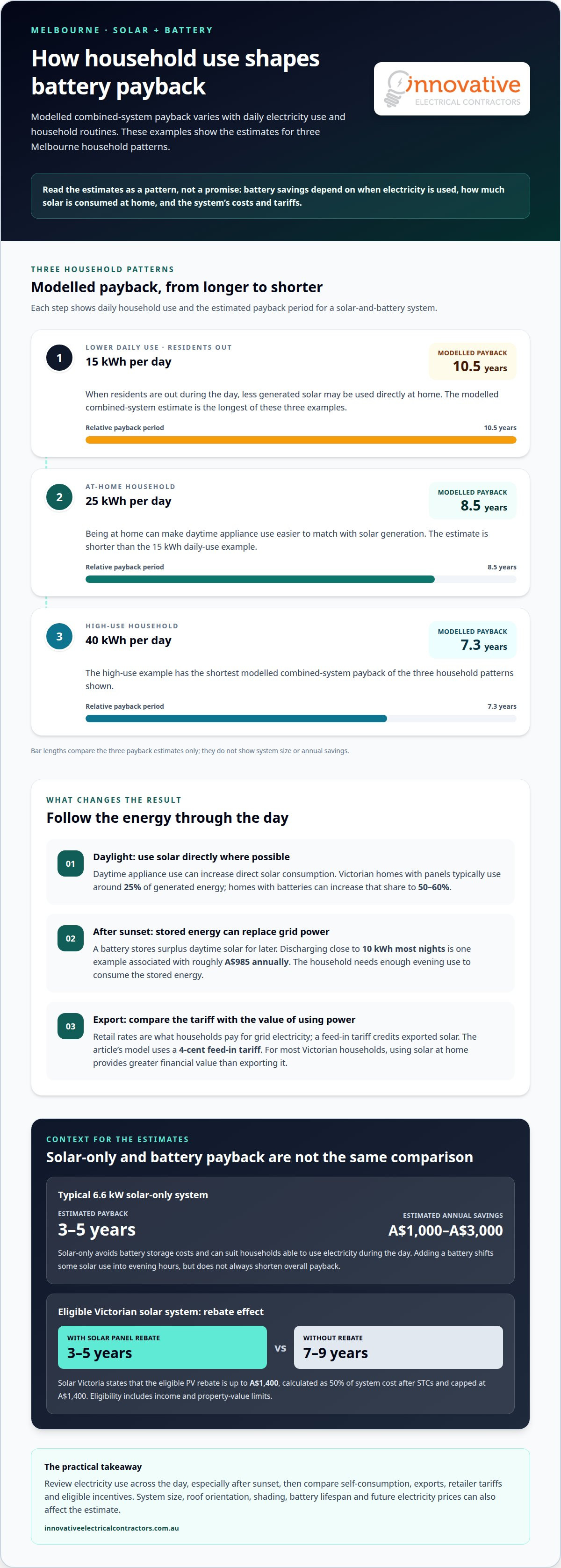
A solar-and-battery system installed by Innovative Electrical Contractors has a modelled payback period of 7.3 to 10.5 years across different household energy-use patterns, including for our Melbourne customers. The solar and battery payback period in Melbourne is estimated at 10.5 years for a household using 15 kWh, 8.5 years for one using 25 kWh, and 7.3 years for a high-use household consuming 40 kWh.
It’s understandable to focus on the upfront cost, but payback also depends on when your household uses electricity. A battery stores solar power for later, while the savings vary with daytime use, evening demand, electricity rates and system cost.
This guide explains how these payback estimates work, who may benefit most from a battery, and how solar-only savings compare with a combined system. You’ll also see how local electricity rates, feed-in tariffs and available incentives can affect the calculation for properties in Melbourne and beyond.
The aim is to help you decide whether a battery suits your home, not to promise one result for everyone. The factors that matter most can show what a modelled figure might mean for different household routines.
Table of Contents
Who Should Consider a Solar Battery?
In Melbourne, solar system size, roof orientation and shading affect how much electricity panels generate annually. Payback estimates also depend on battery lifespan, household energy usage and future electricity prices, which can change over time.
Evening electricity use and battery savings
A battery stores surplus daytime solar electricity for use after generation falls, making evening demand central to its savings. A household using more power after dark can draw more stored energy instead of buying electricity from its retailer. Discharging close to 10 kWh most nights gives an example of roughly A$985 annually.
These examples show why battery capacity alone doesn’t determine payback: your household needs enough evening use to consume the stored energy.
Household usage and solar savings
Household schedules shape how much generated electricity is used directly and how much is stored or exported. A Melbourne household using 15 kWh daily while residents are out has a modelled combined-system payback of 10.5 years. For an at-home household using 25 kWh daily, the estimate is 8.5 years; a high-use household consuming 40 kWh daily has an estimate of 7.3 years.
Daytime appliance use can increase direct solar consumption, while evening demand creates more opportunity to use stored energy. Reviewing household electricity use throughout the day helps explain why similar systems can deliver different savings.
Solar-only and combined payback
Solar-only systems avoid battery storage costs and can suit households able to use electricity during the day. A typical 6.6 kW system has an estimated payback of 3-5 years, with annual savings estimated at A$1,000-A$3,000. Combined systems add storage, shifting some solar use into evening hours, but a battery doesn’t always shorten the overall payback period.
For the combined-system examples above, modelled payback ranges from 7.3 to 10.5 years. Treat these as estimates: battery performance can change over its lifespan, while retailer tariffs and household use can shift annual savings. A federal battery rebate may reduce upfront costs for eligible systems, changing the calculation.
Melbourne electricity rates and solar feed-in tariffs
Retail rates and feed-in tariffs affect the value of each kilowatt-hour a Melbourne solar system generates. The difference between using solar energy at home and exporting it can change estimated savings.
Retail electricity rates and feed-in tariffs
Retail electricity rates are what households pay for grid power, while a feed-in tariff credits them for exported solar energy.
Exported electricity generally earns less than the cost of buying power at the rates used in an estimate. Storage is valuable when stored solar replaces electricity you would otherwise buy later, at the applicable rate. Retail plans differ, so tariff details matter to a payback estimate.
Victoria-specific eligibility also affects export calculations: systems larger than 100 kW cannot receive a feed-in tariff. Eligible Victorian residential customers with a smart meter can opt into the Victorian Midday Power Saver from 1 October 2026 through participating retailers. This can affect the value of daytime electricity under the relevant plan.
Solar self-consumption and exports
Self-consumption means using solar electricity at home rather than sending it to the grid. For most Victorian households, using solar electricity at home provides greater financial value than exporting it, given the difference between retail rates and the modelled 4-cent feed-in tariff.
Solar self-consumption can be increased by matching electricity use with daytime generation. Victorian homes with panels typically use around 25% of generated energy, while homes with batteries can increase that share to 50-60%. A battery shifts some solar energy into later use; it doesn’t make every exported unit more valuable.
When reviewing a solar system size, consider daytime demand, export volumes and tariff structure together. These factors help show whether storage and charging patterns could improve savings. For a tailored system discussion, explore solar and battery options alongside your household’s electricity use.
Victoria solar payback estimates with and without the solar panel rebate
In Victoria, an eligible solar system may pay back in approximately 3-5 years with the solar panel rebate, compared with approximately 7-9 years without it. Incentives can also reduce eligible battery costs, but solar and battery payback depends on the system and household savings.
Rebate effects on solar payback
A solar rebate reduces eligible upfront panel costs, which can shorten the time savings take to match the system cost. The estimated 3-5-year and 7-9-year solar payback periods show why it matters to include the rebate accurately.
Battery incentives are separate from the Solar Victoria PV rebate. From 1 May 2026, the federal Cheaper Home Batteries Program applies a 100% STC factor to the first 14 kWh of eligible battery capacity, according to the Clean Energy Regulator. From 1 May 2026, the Program applies a 15% STC factor to battery capacity from 28-50 kWh, according to the Clean Energy Regulator. The capacity bands affect how the discount is calculated.
Solar Victoria rebate and loan
The Solar Victoria PV rebate reduces the cost of eligible solar panels. Solar Victoria states that it provides up to A$1,400 off solar panels, calculated as 50% of system cost after STCs and capped at A$1,400.
Eligibility includes income and property-value limits. According to Solar Victoria, the rebate income cap is A$150,000 from 1 July 2026, and the property value must be under A$3 million. Solar Victoria also offers an optional matching interest-free loan of up to A$1,400.
For a meaningful estimate, separate panel savings from battery savings, then apply eligible incentives to the relevant system costs. Battery size, installation requirements, electricity use and solar generation all affect the calculation. Federal discount STC factors vary by battery capacity, so capacity matters when estimating the incentive.
Melbourne solar-and-battery payback periods
Modelled payback periods vary with household consumption, system size and how much stored solar replaces grid electricity. Compare the payback of solar and battery together with the battery’s payback on its own. The solar and battery payback period is not one fixed figure: estimates change when household use or system assumptions change.
Battery-only estimates show the role of household demand. In the model, an out-during-the-day household has an 11.9-year battery payback, while an at-home household has a 12.7-year estimate. For a big-energy-user household, the estimate is 10.9 years. These examples show that time spent at home doesn’t automatically mean faster battery payback; total consumption and when electricity is used both matter.
A Victorian homeowner’s typical solar battery payback estimate is 5-12 years. To compare options, divide the net system cost by estimated annual bill savings. For example, a battery costing A$12,000 and saving A$2,000 annually gives a simple six-year payback. This calculation is a starting point, not a complete lifetime-value measure: it doesn’t account for changes in savings or battery performance over time.
Compare system capacity with the amount of solar energy your household can use or store. A battery that regularly supplies evening demand can reduce electricity purchases; unused capacity contributes less to savings. A larger system may also have a different upfront cost and incentive calculation. Apply feed-in credits, retail rates and eligible rebates consistently, or the comparison between solar-only and combined systems won’t be meaningful.
For a clearer estimate, use actual electricity bills and household consumption patterns alongside the proposed system’s generation and capacity. This helps distinguish a typical model from your home’s likely outcome. Discuss a solar and battery system using your household’s energy needs as the starting point.
Innovative Electrical Contractors: Off grid solar,batter and generator's
Innovative Electrical Contractors provides Solar & Battery installations for Melbourne homes and businesses considering system costs, usage and payback. Once you’ve compared your electricity consumption with the expected solar generation, the next step is shaping a system around how you use power.
Innovative Electrical Contractors installs grid-connected solar and battery systems and off-grid systems with solar, batteries and generators. These options address different energy needs. For a home or business, the right design depends on the site, electricity demand and whether the system will connect to the grid.
A payback estimate is a useful starting point, not a substitute for assessing the system. Innovative Electrical Contractors can discuss the electrical and solar requirements that inform your decision.
Discuss your solar and battery requirements with Innovative Electrical Contractors.
Plan your next energy decision
The solar and battery payback period in Melbourne is most useful as a planning reference, not the only measure of a suitable system. Consider how your electricity needs may change, such as working from home more often, adding equipment or planning a property upgrade. Those changes can affect when you use power and how much value you get from stored solar.
For your next step, bring together your priorities: reducing grid use, managing evening demand or building greater energy independence. A considered discussion can connect those aims with a system design suited to your property and usage, rather than relying on a generic payback estimate.
Contact Innovative Electrical Contractors to discuss your solar and battery plans. A clear starting point can make the choices ahead easier to assess, so you can move forward with confidence.
Frequently Asked Questions
Alternatives: Is Solar Alone Enough?
Yes, solar alone can suit households that mainly want to reduce daytime grid electricity use. It may be a practical starting point if daytime demand matches solar generation and you don’t need stored power after sunset. For example, running a dishwasher or charging an electric vehicle during sunny hours can help you use generated electricity directly. A battery becomes relevant when storing surplus power is a priority.
Does a Battery Improve Payback?
Not always. A battery adds upfront cost, so it improves payback only when the value of stored electricity offsets that extra expense. Homes with regular evening demand may use more stored solar, while households with low after-dark consumption may use less of their battery capacity. Compare estimated annual battery savings with its net cost, including eligible incentives, rather than assuming storage automatically improves returns.
Does a battery provide blackout protection?
A battery can provide blackout protection only when the system is designed and configured for backup operation. A standard grid-connected solar setup may not keep household circuits running during an outage. Backup capability depends on the equipment, settings and circuits connected. If keeping selected essentials powered matters to you, include that requirement in the system design discussion.
Does using appliances during the day improve solar savings?
Yes, using appliances while solar panels are generating can help you consume more of your own solar electricity. For example, running a washing machine or dishwasher during the day may reduce the amount of power you export and later buy from the grid. The benefit depends on the appliance’s energy use, solar output at that time and your retailer’s tariff. Shifting flexible tasks is most useful when solar generation is available.
How long does solar usually take to pay for itself?
A typical 6.6 kW solar system has an estimated payback period of 3-5 years in the modelled comparison. Your household’s result depends on system cost, electricity prices, solar generation and how much energy you use directly. Rebates can change upfront cost, while daytime consumption affects ongoing savings. Treat a payback estimate as a comparison tool, not a fixed timeframe for every Melbourne home.
How much does a home battery cost in Victoria?
Capacity, equipment and installation requirements influence the final cost. A larger battery may store more solar energy, but it adds value only when household use draws on that capacity. Eligible incentives can reduce the upfront cost, so compare amounts after applicable discounts.

Comments