
Enphase Microinverters vs String Inverter with Optimisers: How to Choose in 2026

Panel-level optimisation doesn’t automatically make Enphase the right choice for a shaded roof. In the enphase microinverters vs string inverter with optimizers comparison, both approaches can help manage differences in panel output, but they convert and manage power differently. The better fit depends on your roof layout, energy use and battery plans.
When comparing systems, it helps to look beyond equipment names. Consider where conversion happens, how the proposed design handles shade and different roof orientations, what monitoring it provides, and how it could work with a future battery. This guide explains the main differences and offers practical checks to help you compare designs for your home or business.
Table of Contents
Enphase microinverters vs string inverter with optimisers: what is the difference?
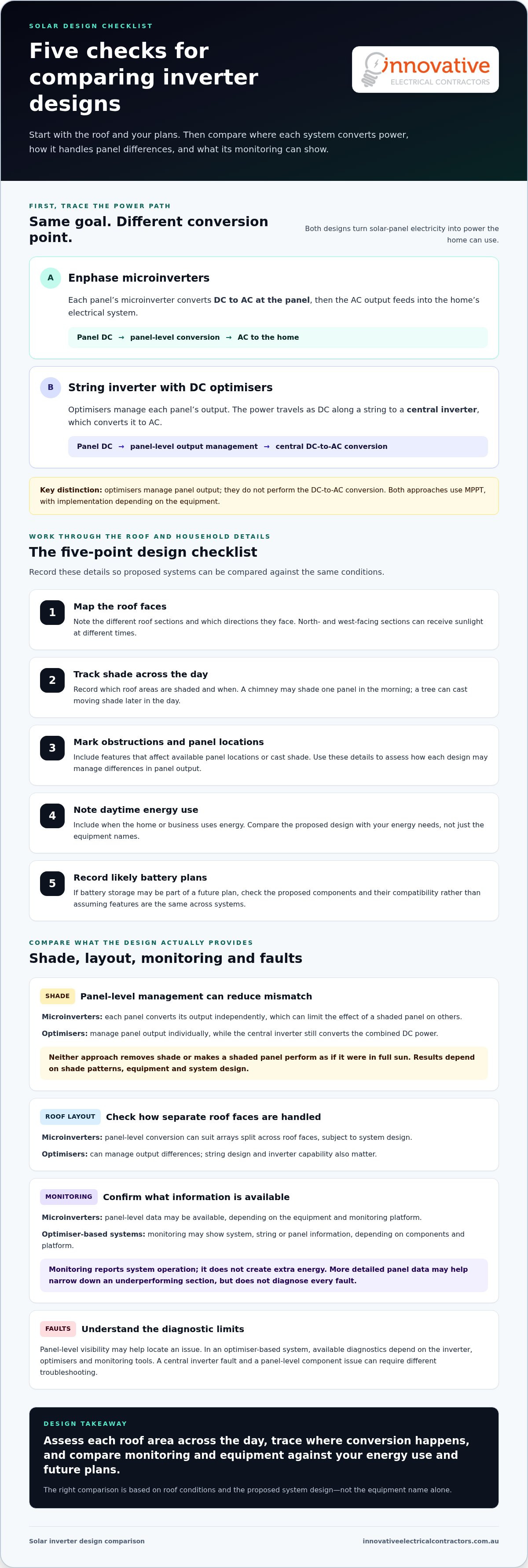
Both designs convert solar-panel electricity into power your home can use, but they do it at different points. An Enphase microinverter system converts each panel’s direct current (DC) into alternating current (AC) at the panel. In a string inverter system with DC optimisers, panel-level electronics manage each panel’s output, then send DC power to a central inverter for conversion. The enphase microinverters vs string inverter with optimizers comparison is a way to weigh these architectures against your roof, energy needs and future plans.
How an Enphase microinverter system converts solar power
Each panel produces DC electricity, which its connected microinverter converts to AC. The AC output then feeds into the home’s electrical system. For a basic introduction to this panel-level approach, see Microinverter. The key distinction is where conversion happens: at each panel rather than at one central unit.
Equipment and monitoring functions vary between models and system designs. Check the proposed components and their roles rather than assuming every system has the same features because it uses Enphase equipment.
How a string inverter with DC optimisers works
In this architecture, panels generate DC power and typically have an optimiser to manage each panel’s output. The optimised DC electricity travels along a string to a central inverter, which converts it to AC for household use. The optimiser and inverter have separate jobs: one manages panel output, while the other changes the type of electricity.
Optimisers can help manage differences in panel output, such as when roof sections face different directions. They don’t perform the DC-to-AC conversion. The specific monitoring and compatibility features depend on the selected equipment.
Microinverters convert at panel level; DC optimisers manage panel-level output while a central inverter converts the system’s DC power to AC. Both designs include electronics at the panels, but only a microinverter completes the DC-to-AC conversion there.
Both architectures use maximum power point tracking (MPPT), though its implementation depends on the equipment. MPPT adjusts how a panel or system operates to draw available power as sunlight and conditions change. With panel-level electronics, output can be managed panel by panel. In an optimiser-based string system, the central inverter remains the conversion point.
When comparing systems, trace the path from panel to home, identify where electricity is converted, and consider how monitoring and other equipment fit your plans. Those details provide a practical basis for assessing how roof conditions may affect each design.
How shading, monitoring and faults affect each inverter setup
Shade affects solar systems in different ways. A chimney shadow crossing one panel, a tree shading several panels in the afternoon, or roof faces receiving sun at different times can all influence system design. Panel-level electronics can reduce output mismatch between panels, but they can’t remove shade or guarantee a particular increase in production. The outcome depends on the shade pattern, system design and equipment.
Assess the conditions across the day for each roof area, rather than treating the roof as one surface.
What partial shade and roof layout mean for panel output
In a traditional string arrangement, panels operate together, so a panel producing less can affect the string’s output. Optimisers and microinverters can reduce this mismatch by managing panel output individually. They can’t make a shaded panel perform as if it were in full sun, and the effect varies with the design and conditions.
For example, a chimney may shade one panel in the morning, while a nearby tree casts a moving shadow across several panels later in the day. North- and west-facing roof sections also receive sunlight at different times. Mapping these details helps identify suitable panel locations and which system characteristics matter.
Monitoring, fault isolation and maintenance trade-offs
Monitoring reports information about system operation; it doesn’t create extra energy. Some setups provide panel-level visibility, while others focus on overall or string performance. The available detail depends on the equipment, communications and monitoring platform, so don’t assume all systems show the same information.
Detailed panel data may help locate an underperforming section, but it won’t diagnose every fault or remove the need for assessment. A central inverter fault and a panel-level component issue can require different troubleshooting. Neither, by itself, proves that the entire system is unreliable.
A coordinated solar and battery installation can bring roof conditions, monitoring preferences and the home’s electrical setup into the same design.
Which system fits your roof, budget priorities and battery plans?
There isn’t one inverter architecture that suits every home. A straightforward roof with similar sun exposure across its panels may leave more design options open. Partial shade, several roof orientations or plans to add panels can make panel-level control, monitoring and expansion more important. Make the enphase microinverters vs string inverter with optimizers decision by weighing these factors together, not by choosing an inverter type in isolation.
Separate your priorities as you compare designs:
Roof conditions: note how many roof faces will hold panels and where shade falls during the day.
Budget: compare the complete proposed system and its components, not just the inverter. Equipment, design and installation affect the overall fit.
Monitoring: decide whether panel-level performance information matters to you or whether a broader system view is sufficient. The available detail depends on the equipment and platform.
Expansion: consider whether you might add panels later and how the proposed design accommodates that possibility.
Storage: treat battery compatibility as a system-design question. Review the intended battery and inverter arrangement as a whole rather than assuming either architecture automatically supports every battery.
When a string inverter with optimisers may suit the project
This approach may suit a home where panel-level optimisation could help manage differences in shade or sunlight across roof sections, while a central inverter handles conversion. It may also fit your budget priorities, depending on the design and equipment. Consider how panels are grouped, the central inverter’s role and the compatibility of the selected components, rather than assuming optimisers alone determine suitability.
When microinverters may suit the project
Microinverters may be worth considering if the roof has different orientations or you value panel-level conversion and visibility, subject to the system’s capabilities. Roof layout, electrical setup and monitoring requirements still influence the final arrangement. If you’re considering a battery, include it in the design discussion early because compatibility and system operation depend on the equipment and configuration.
For future storage plans, consider how energy is used at home, when surplus solar is available and how a battery would connect to the wider electrical system. A system designed around today’s panels alone may not address those priorities. Reviewing solar battery maintenance guidance can also help you understand the care involved in planning for storage.
A simpler roof may not need the same design priorities as a shaded roof split across several faces. Compare the proposed layout, monitoring, expansion options and battery arrangement as one coordinated system. This gives you a clearer basis for balancing budget priorities with your household’s needs.
A practical checklist for comparing solar inverter designs
Start your comparison with the roof and household, not a brand name or a single headline feature. Use this five-step checklist to gather useful details before reviewing solar designs. It will help you compare panel layout, inverter architecture, monitoring and future energy options on a like-for-like basis.
Map the roof. Record each roof face that could hold panels and note its orientation. Include nearby chimneys, vents, trees and other obstructions. For a new build, include solar and electrical planning in the wider design process.
Note shade. Mark where shadows fall and when they’re most likely to affect the roof. A tree may shade one area in the morning and another later in the day. These observations help explain panel placement and whether panel-level electronics are relevant.
Check household loads. List major daytime electricity use, such as heating or cooling, pool equipment or home office needs. Add likely changes, such as an electric vehicle or a larger household. This gives the design team a practical picture of when your home uses energy.
Set your priorities. Write down whether you value panel-level monitoring, potential system expansion or battery storage. If you’re considering a battery, note whether backup power is also important. These are separate design questions, and the equipment arrangement needs to suit the intended use.
Compare complete designs. Review the panel layout, inverter architecture, monitoring functions and stated assumptions together. Compare how each design responds to your roof and loads, rather than judging it by inverter brand or one feature in isolation.
What to record before reviewing a system design
Keep your notes practical: roof faces and orientations, obstructions, known shade periods, major daytime loads and expected changes in energy use. Record whether you’re planning battery storage, backup power or later expansion. Clear observations help connect the proposed layout with how your home operates; technical measurements aren’t necessary to make them useful.
How to compare proposals on a like-for-like basis
Check that each design uses the same roof areas, household needs and future plans. Review the proposed panel arrangement, monitoring detail and battery assumptions. Also compare how the inverter design fits the electrical setup and the project’s grid-connection requirements, which depend on the installation. Broader electrical planning for Australian properties can put the solar design in context.
Use your checklist to guide a coordinated solar and electrical design review. Plan your solar and battery installation around your roof, energy use and future needs.
Plan the right inverter system with an electrical and solar installation team
Choosing between Enphase microinverters and a string inverter with optimisers is one part of the design. The system also needs to suit your roof, household energy use, electrical setup and storage plans. Reviewing these factors together helps ensure the inverter choice supports the intended operation of the whole installation.
What a coordinated solar system design should bring together
A considered design connects panel placement to roof faces, shade and household loads. It also accounts for the selected inverter architecture, monitoring preferences and battery plans. If off-grid operation or generator integration is relevant to the property, those goals need to shape the wider system design from the outset.
Equipment details matter. Battery and monitoring compatibility can depend on the specific inverter model and system configuration, so the design should make its assumptions clear. In Australia, applicable standards and network connection requirements also depend on the project, location and proposed equipment. These requirements need to be considered against current rules as part of planning.
Next steps for a considered solar installation
Before progressing a design, gather notes on roof faces, obstructions, shade, daytime electricity use and likely future changes. Include whether you’re considering a battery, backup power or later expansion. This gives the design process practical information and connects equipment choices to your household’s priorities.
Planning moves from reviewing the site and energy needs to developing a system layout, considering equipment compatibility and coordinating the electrical installation. The details are tailored to the property and proposed setup. Clear explanations of assumptions, network requirements and component roles make it easier to understand the design.
Innovative Electrical Contractors provides solar, battery and electrical installations for residential and commercial projects. Bringing these capabilities together connects inverter selection with energy use and electrical design, rather than treating each decision in isolation. The enphase microinverters vs string inverter with optimizers comparison is most useful when it leads to a system plan shaped around the property, not a universal winner.
Have your roof and energy notes ready, then discuss your solar and electrical project with Innovative Electrical Contractors.
Turn your solar plans into a considered design
Turn your roof observations and household priorities into a design that makes sense for the property. The enphase microinverters vs string inverter with optimizers decision can then be considered alongside the wider electrical setup, storage plans and how you expect to use energy. A clear design discussion should explain the proposed system and the assumptions behind it.
Innovative Electrical Contractors provides solar and battery installation, residential and commercial electrical contracting, and off-grid solar, battery and generator solutions. This joined-up capability helps keep inverter choices connected to the broader project, rather than treating them as a standalone decision.
Have your roof notes, energy priorities and future plans ready. Discuss your solar and electrical project with our team and take the next step towards a system designed around your needs.
Frequently Asked Questions
Do solar inverters work during a blackout?
Most standard grid-connected solar systems switch off during a blackout, even if the panels are in full sun. This prevents electricity flowing into the network while crews may be working on it. To keep selected household circuits powered, the system needs suitable backup equipment and a design that can operate independently from the grid. Backup capability depends on the inverter, battery and installation, so check which loads the system is designed to supply.
Can solar panels keep generating if the internet goes down?
Yes. An internet outage usually affects online monitoring, not the panels’ ability to generate electricity. If the solar system and grid are operating normally, generation can continue while the monitoring app temporarily stops updating. Some systems may store data for later upload, depending on the equipment. If readings remain missing after the connection returns, check the monitoring device and network connection before assuming the panels or inverter have stopped working.
Can I see how much power each solar panel produces?
Sometimes. Panel-level monitoring requires compatible equipment and a platform that reports individual panel data. Other systems may show total production or information at a broader system level. Decide whether seeing each panel’s output would help you track performance or identify changes. Features depend on the installed components, communications equipment and software, so they aren’t identical across all systems.
Does Enphase need a central inverter?
No. In an Enphase microinverter system, each microinverter converts the connected panel’s output, so a central inverter isn’t required for that conversion. The installation may still include other equipment for monitoring, communications or electrical connection. Components depend on the system design and model. Check the equipment documentation to understand what is installed, what each part does and how to access system information.
Are microinverters or optimisers better in hot Australian conditions?
There isn’t a universal winner based on heat alone. In the enphase microinverters vs string inverter with optimizers comparison, performance depends on the equipment, its operating limits, installation conditions and system design. Assess the proposed components for the site and how they’ll be installed. Roof exposure and the manufacturer’s model-specific guidance are more useful decision points than inverter architecture by itself.
Can I add a battery to either inverter system later?
A battery may be added later, but compatibility and the amount of redesign required depend on the existing inverter, battery and electrical configuration. A later addition may use a different connection arrangement from a battery included in the original installation. If storage is a possibility, keep records of the system’s components and design, and plan for likely battery use early. This gives the design a clearer basis for considering future integration.
How long does a solar inverter last?
It varies by inverter type, model, operating conditions and maintenance. String inverters are commonly described as lasting around 10 to 15 years, while microinverters may have warranties that extend to 25 years; warranty terms aren’t the same as a guaranteed service life. Check the documentation for the installed model and understand what its warranty covers. Keeping installation records can also help with future servicing or replacement planning.
Comments