
Daikin vs Mitsubishi Heavy Industries Multi-Split Systems: Which Suits Your Home?

The brand that looks strongest on paper may not be the best fit for your home. If you’re weighing a daikin vs mitsubishi heavy industries multi split system, the right choice depends on which rooms you need to condition, how you use them and what your property can accommodate.
Comparing model ranges can feel confusing when the options don’t line up neatly. Both brands have systems to consider, but a brand-wide verdict can overlook important differences between specific models. This comparison explains how multi-split systems work and what to assess across room coverage, comfort, controls and installation needs. You’ll also see why Mitsubishi Heavy Industries is distinct from Mitsubishi Electric, a separate manufacturer often included in air-conditioning comparisons. By the end, you’ll have a practical way to shortlist suitable options and understand how a project-specific air-conditioning installation can match a system to your home.
Table of Contents
Daikin vs Mitsubishi Heavy Industries multi-split systems: what are you comparing?
Compare Daikin and Mitsubishi Heavy Industries multi-split specifications fairly
Is one brand always better? Where the real multi-split trade-offs sit
Choose a Daikin or Mitsubishi Heavy Industries system for your rooms
Plan your multi-split installation with Innovative Electrical Contractors
Daikin vs Mitsubishi Heavy Industries multi-split systems: what are you comparing?
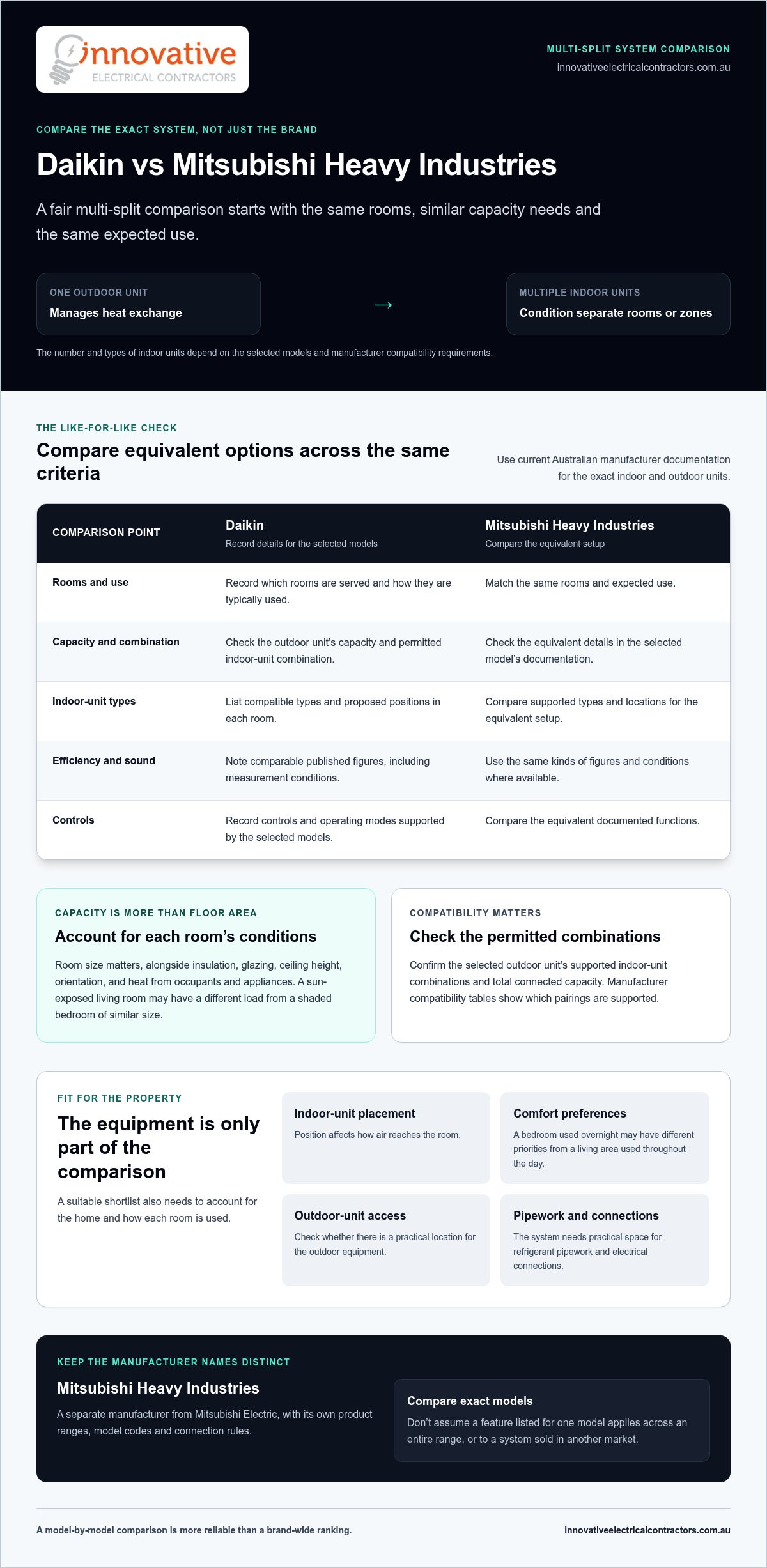
A multi-split air conditioner uses one outdoor unit connected to multiple indoor units to provide heating or cooling to separate rooms or zones. Instead of installing an outdoor unit for every room, the system links the indoor units to shared outdoor equipment. The number and types of indoor units that can be connected depend on the selected models and the manufacturer’s compatibility requirements.
That’s a useful starting point for comparing options. The question isn’t simply whether Daikin or Mitsubishi Heavy Industries has the stronger reputation. It’s whether a particular system can serve your rooms, suit the way you use them and fit your property. For a fair comparison, look at systems with similar capacity and intended room coverage, then check the compatible indoor-unit combinations and features in current Australian manufacturer documentation.
How a multi-split air conditioner works across several rooms
The outdoor unit manages heat exchange, while indoor units deliver conditioned air to the rooms they serve. Refrigerant pipework and electrical connections link the units. For example, a home needing comfort in a bedroom and living area might use two indoor units connected to one outdoor unit, if the selected models support that arrangement.
By contrast, separate single-split systems each pair an indoor unit with its own outdoor unit. Neither layout is automatically better. The right arrangement depends on room coverage, equipment compatibility and the practical space available for units and pipework.
Daikin and Mitsubishi Heavy Industries: keep the brands distinct
Daikin Industries and Mitsubishi Heavy Industries are separate manufacturers. Mitsubishi Heavy Industries is not Mitsubishi Electric, another distinct company whose systems are often discussed in air-conditioning comparisons. Daikin’s Daikin Industries Overview provides background on the company and its HVAC business, but a company profile doesn’t replace checking the specifications for a system sold in Australia.
Each manufacturer has its own product ranges, model codes and connection rules. Don’t assume a feature listed for one model applies across the manufacturer’s entire range, or to a system sold in another market. Compare documentation for the exact outdoor and indoor units being considered.
For the daikin vs mitsubishi heavy industries multi split system decision, start with a like-for-like comparison. Match the total capacity and number of rooms you need to serve, then confirm that each proposed combination is compatible. A two-room setup and a system intended to cover several rooms aren’t equivalent just because both use one outdoor unit.
Consider what each room needs, too. A bedroom used overnight may have different comfort priorities from a living area occupied throughout the day. Indoor-unit type and position affect how air reaches a room, while the outdoor unit needs a practical location. These details turn a brand comparison into a property-specific shortlist. The next step is to compare capacity, controls and installation requirements.
Compare Daikin and Mitsubishi Heavy Industries multi-split specifications fairly
A useful comparison starts with the same job on both sides: similar rooms, similar capacity needs and the same expected use. Like-for-like model comparisons are more reliable than brand-wide rankings because specifications and supported features can vary within a manufacturer’s range. Use current Australian manufacturer documentation for the exact indoor and outdoor units under consideration, rather than assuming a product range has one standard configuration.
Capacity, room coverage and compatible indoor units
Don’t choose capacity from floor area alone. Room size matters, but so do insulation, glazing, ceiling height, orientation and heat from occupants and appliances. A sun-exposed living room may have a different load from a shaded bedroom of similar size. The design needs to account for each space, rather than simply adding up room areas.
Then check the selected outdoor unit’s permitted indoor-unit combinations and total connected capacity. Don’t assume one outdoor unit can serve any number or type of rooms. The manufacturer’s compatibility tables show which pairings are supported.
Efficiency, sound and control features worth checking
Compare efficiency figures for equivalent models, checking that ratings use the same measure and operating conditions. Treat published figures as a guide to model performance, not a guarantee of what a home will use: sizing, settings and installation also matter. For sound, compare both indoor and outdoor unit data, including the stated operating mode and test conditions. An indoor-unit figure alone doesn’t describe outdoor noise.
Check controls model by model, too. Record which controls and operating modes each system supports instead of assuming an app, sensor or automatic function is standard across a brand. HVAC design also concerns thermal comfort and indoor air quality, topics covered in the EPA’s HVAC System Purpose and Standards resource.
Specifications can narrow the options, but the final choice also needs to suit the property and installation layout. A project-specific plan connects room requirements with compatible equipment and practical placement. Innovative Electrical Contractors provides residential and commercial air-conditioning installation and maintenance across Australia.
Is one brand always better? Where the real multi-split trade-offs sit
No brand is automatically the better choice for every home. A system that suits one household may not suit another, even if both are comparing Daikin and Mitsubishi Heavy Industries. General claims that one brand is quieter, more reliable or cheaper aren’t a sound basis for choosing unless they’re supported by current evidence for the specific models being compared.
Separate what can be verified from what comes down to preference. Published specifications can show supported combinations, efficiency ratings, sound levels and control functions. Preferences are personal: one household may prioritise comfortable bedrooms overnight, while another may focus on shared living spaces. These priorities help guide selection, but they don’t mean every model from a manufacturer performs the same way.
The better fit depends on the selected models’ specifications and how well their room coverage, comfort features and installation requirements match your household. That’s the practical answer to the daikin vs mitsubishi heavy industries multi split system question. Assess the complete system, not just the badge on the outdoor unit.
When a multi-split layout may suit the household
A multi-split layout may suit a home where several rooms need air conditioning but a shared outdoor unit is useful for the available space or layout. Room-by-room use helps shape the design: a bedroom used mainly at night has different operating priorities from a living area occupied through the day. Consider which rooms need units, when they’re used and where indoor units can be positioned to distribute air effectively. The selected equipment and property layout determine whether the arrangement is suitable.
What to weigh against separate split systems
With a multi-split, several indoor units share one outdoor unit. This can consolidate outdoor equipment, but it makes compatibility and overall system design especially important. Because connected rooms rely on the same outdoor unit, an issue affecting it may affect all those rooms. Separate split systems use individual outdoor units, offering a different layout with more equipment to position outside. Neither approach is universally better: available space, room needs and the chosen models all matter.
Weigh these trade-offs before treating a multi-split as the obvious answer:
Room zoning: Map which spaces need conditioning and how their schedules differ.
Shared equipment: Consider the convenience of one outdoor unit alongside the impact if it can’t operate.
Indoor-unit choices: Compare combinations supported by the exact system, not the range in general.
Property fit: Account for outdoor-unit placement, indoor-unit locations and the route for connecting pipework.
Don’t infer running costs, reliability or performance from brand reputation alone. Those comparisons need relevant model evidence and a design suited to the home. If neither multi-split arrangement fits the rooms or installation constraints, separate split systems are another configuration to consider. Match shortlisted models to your household’s actual room use and property layout before deciding.
Choose a Daikin or Mitsubishi Heavy Industries system for your rooms
Once you’ve shortlisted suitable models, map the system to your home before settling on a brand. A room-by-room plan shows whether the proposed indoor units, capacity and layout match how you live. It also gives an installer useful details for assessing the property and planning an air-conditioning installation.
Map each room to its cooling and heating needs
Start with the rooms you want to condition. Record each room’s dimensions, occupancy, sunlight, insulation, glazing and typical use. A bedroom used mainly overnight may have different comfort priorities from a busy living area, while a spare room used occasionally may not need the same operating pattern. A whole-home estimate can hide these differences, so consider each room before comparing system combinations.
Use this sequence to organise your shortlist:
List the rooms. Note which spaces need heating and cooling, and which are used only occasionally.
Describe how each room is used. Record typical occupancy and times of use, along with comfort priorities such as quiet operation or a consistent temperature.
Note room conditions. Include dimensions, window exposure, insulation and ceiling height so the room requirements can be assessed in context.
Match models to the plan. Compare current manufacturer documentation for capacity, compatible indoor-unit types and permitted combinations.
This gives a clearer basis for the daikin vs mitsubishi heavy industries multi split system decision than choosing by brand name alone. For broader guidance on selecting a system for Australian conditions, refer to the Australian air conditioner buying guide.
Check the installation plan before settling on a model
Equipment needs to suit the building as well as the room schedule. Consider where indoor units can serve each space and where the outdoor unit can sit with practical access. The pipework route, condensate drainage and electrical supply also affect the proposed layout. An installation assessment brings these factors together and helps align the equipment with the property.
Access matters as well. The chosen locations need to work for installation and future maintenance, and not every wall or outdoor space will suit every arrangement. A model may meet room requirements on paper yet prove awkward if its connections or proposed unit positions don’t fit the available layout. Review manufacturer compatibility information alongside these site considerations before making a final selection.
Bring your room notes and comfort priorities into a project-specific air-conditioning assessment. Innovative Electrical Contractors provides residential and commercial air-conditioning installation and maintenance across Australia. Plan your air-conditioning installation around your rooms and property requirements.
Plan your multi-split installation with Innovative Electrical Contractors
A brand comparison is a starting point, not a complete system design. The next step is to connect shortlisted models with the rooms you want to condition, your household’s comfort priorities and the practical limits of the property. This creates a clearer basis for planning an installation suited to your home or business.
What a considered project assessment should account for
A project-specific assessment brings the key decisions together. It considers what each room needs, whether the proposed indoor and outdoor units are compatible, and how the system can fit the property. Room use, unit placement and available space all help shape the plan. Clear information at this stage helps align the system with the building, rather than relying on brand preference alone.
Before discussing the project, note the details that will help clarify your requirements:
Rooms to be conditioned: Include each room and how it’s typically used.
Comfort priorities: Note preferences such as quiet operation in sleeping areas or consistent comfort in shared spaces.
Property constraints: Identify possible indoor and outdoor unit locations, access considerations and any known limits on the installation layout.
Shortlisted options: Bring the model details and current manufacturer specifications you’ve compared, including compatible unit combinations.
This preparation turns the daikin vs mitsubishi heavy industries multi split system comparison into a practical discussion about your property. It also helps identify which details need to inform the final system design.
Move from brand comparison to an installation plan
Before settling on a system, compare the chosen model information with the actual room plan. The proposed indoor-unit combination needs to match the manufacturer’s compatibility information, while capacity and unit locations need to suit the property. Installation conditions matter as well: equipment placement and practical routes for connections can influence how the design works in the space.
When discussing the project, outline which rooms matter most, when they’re used and what comfort means for your household. If you’re still weighing options, explain which system types you’re considering and what’s driving the decision. Innovative Electrical Contractors provides air-conditioning installation and maintenance for residential and commercial customers across Australia, with the project requirements guiding the plan.
Once your needs are clear, you can move from comparing brand names to planning an installation that fits the property. Explore our air-conditioning solutions.
Turn your shortlist into a home-ready plan
Your shortlist is most useful when it becomes a clear brief for the property. Rather than trying to crown a brand winner, use your room priorities and preferred system type to guide a project-specific decision. The daikin vs mitsubishi heavy industries multi split system comparison is a starting point, not a decision to make on reputation alone.
Before taking the next step, note which rooms matter most, how they’re used and any practical limits on unit placement. Bring along the model details you’ve shortlisted, too. This gives the project discussion a useful focus and helps connect your comfort priorities with a system plan for the property.
Innovative Electrical Contractors provides air-conditioning installation and maintenance for residential and commercial customers across Australia. Ready to turn your requirements into a project plan? Discuss your air-conditioning project with Innovative Electrical Contractors.
Frequently Asked Questions
Can a Daikin multi-split system be compared directly with a Mitsubishi Heavy Industries system?
Yes, if the systems are matched for capacity, indoor-unit combination and intended room coverage. For a daikin vs mitsubishi heavy industries multi split system comparison, choose options designed for a similar job, such as conditioning the same number and type of rooms. Then compare the exact model documents. A broad brand ranking can obscure differences between individual models, including supported features and the conditions used to measure efficiency or sound.
Is Mitsubishi Heavy Industries the same as Mitsubishi Electric?
No. Mitsubishi Heavy Industries and Mitsubishi Electric are separate manufacturers, despite the similar names. Check the manufacturer name and full model reference on the product documentation before using a specification in your comparison. A feature listed for a Mitsubishi Electric model, for example, shouldn’t be assumed to apply to a Mitsubishi Heavy Industries system. Keeping the names distinct helps you avoid comparing the wrong product range or relying on incompatible technical details.
How many rooms can a multi-split system cool or heat?
The number depends on the specific outdoor unit and the indoor-unit combinations its manufacturer permits. A system intended for a couple of rooms may not suit a layout with several bedrooms and a large living area. List the rooms you want conditioned, then compare that plan with the model’s current connection information. Room requirements matter as well, so room count alone can’t establish whether a system is suitable.
Are multi-split systems more efficient than separate split systems?
Not in every situation. Efficiency depends on the exact equipment, system design, room heating and cooling demands, and how the spaces are used. For a useful comparison, look at current manufacturer data for equivalent configurations and note the rating measure and operating conditions. Then consider your household’s routine: conditioning rooms only when they’re occupied may lead to different use patterns from running units throughout the home all day.
Can different indoor-unit types be connected to one multi-split outdoor unit?
Sometimes, but only when the manufacturer’s documentation lists that combination as compatible with the selected outdoor unit. Supported indoor-unit types and pairings can differ between models. Before planning around a particular style, such as a wall-mounted or ceiling-mounted unit, check the outdoor unit’s compatibility information and exact model references. A product range description alone doesn’t establish that a specific combination will work.
What should I compare before choosing between these multi-split systems?
Start with the rooms to be served and the indoor-unit combinations each system supports. Then compare capacity, current efficiency information, published sound data and controls for equivalent models. Note the exact model numbers and whether each figure relates to an indoor or outdoor unit. Also consider practical details such as equipment placement and how the proposed system fits your property, rather than focusing on a single specification.
Do I need an installer to assess a multi-split system before choosing a model?
A project-specific assessment is a practical step because the equipment needs to suit both the rooms and the property. Bring a room list, typical usage patterns, comfort priorities and any model details you’re considering. Innovative Electrical Contractors provides air-conditioning installation and maintenance for residential and commercial customers across Australia. Discussing those project details helps shape an installation plan around your property instead of relying on a general brand recommendation.

Comments