
Commercial Switchboard Upgrade Costs and Services in Melbourne
The cost of a commercial switchboard upgrade depends on the existing board, the site’s power demands and the work needed to support its circuits and equipment. When delivering projects across Australia, Innovative Electrical Contractors ensures pricing is based on the individual site and set out in a detailed quote. An upgrade involves more than replacing the board: assessment, installation and testing are also part of the work.
For a business, reliable power helps keep day-to-day operations running smoothly. This guide explains what affects the cost, when an upgrade or replacement may be needed, and what to expect from the process. It also covers how commercial and industrial requirements differ from those of a home, so you can plan the work around your site’s needs.
Table of Contents
How much does a switchboard upgrade cost?
Commercial switchboard upgrade costs depend on the existing board, electrical demand and work required. A quote is based on the site’s condition, circuit needs, protective devices and installation complexity.
Capacity for Appliances and Renovations
New appliances, machinery or renovated workspaces can increase a business’s electrical load. An assessment compares the existing switchboard and circuits with the equipment and operating needs planned for the site.
Consider total demand, available circuits and whether the electrical system can support additional loads. Offices, shops and industrial sites have different requirements. For example, a warehouse adding machinery may need more capacity than an office fit-out. The quote reflects the board’s condition, circuit requirements, protective devices and installation complexity.
Testing and Victorian Safety Certification
Testing checks that circuits and installed safety switches operate as intended before the upgraded board is put into service. The electrician tests the circuits and provides compliance documentation when the work is complete.
In Victoria, every switchboard upgrade requires a Certificate of Electrical Safety. Choose a licensed electrician who assesses the board, plans the replacement, installs suitable protective devices, tests circuits and supplies the required documentation. These steps help address electrical hazards and support safety standards.
Permits, Inspections and Utility Approvals
A switchboard upgrade requires a temporary disconnection from the network supply. Reconnection is coordinated with the network distributor and can occur only after a licensed inspector signs off.
Permit requirements depend on the project scope. Include distributor coordination and inspection in the work sequence. After-hours completion can be scheduled when the outage plan and reconnection arrangements allow it. Agree on the outage window and business access before installation, so staff know when electrical systems will be unavailable.
Commercial switchboard upgrades and replacements
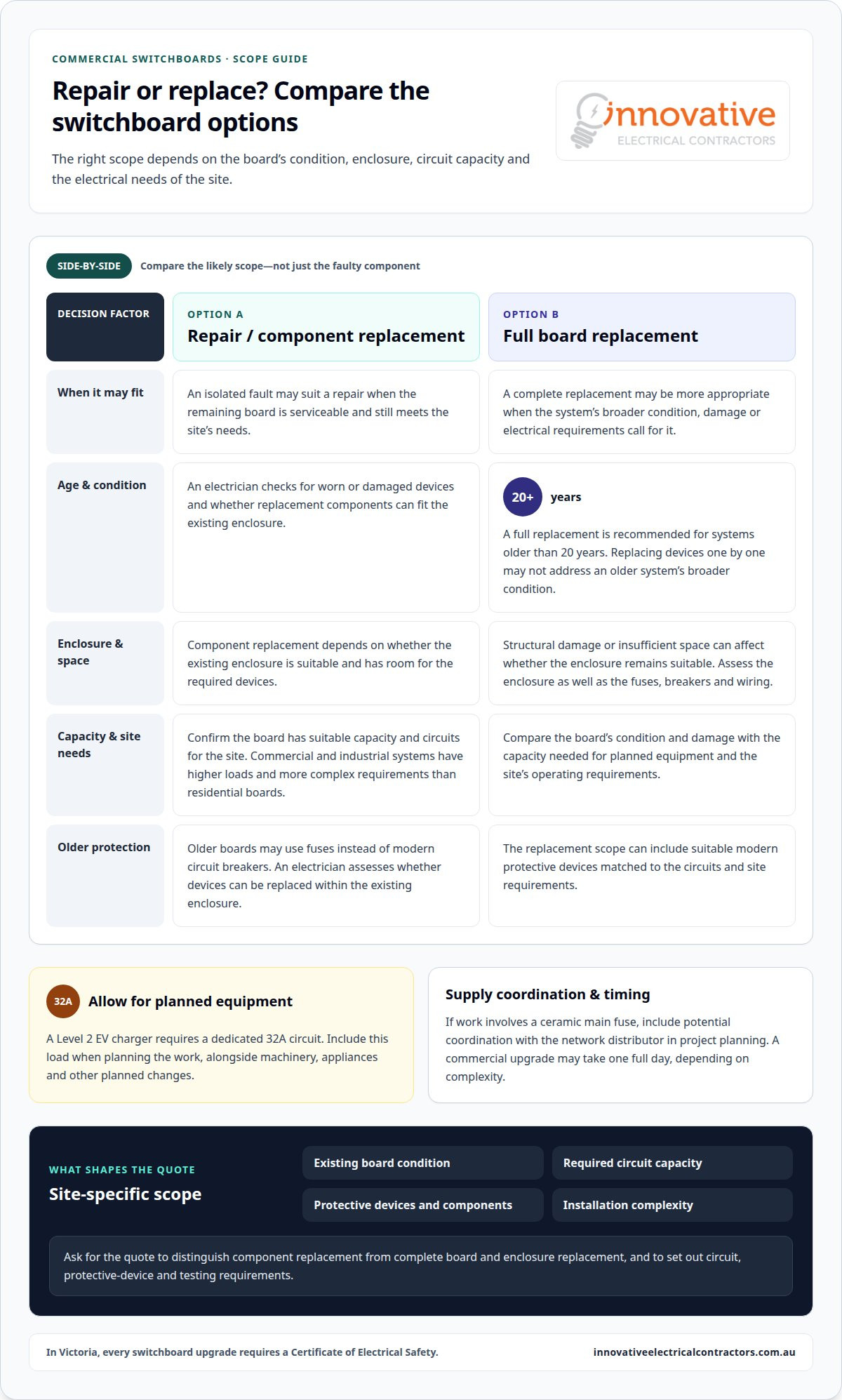
A switchboard upgrade may involve replacing selected components or the complete board. The right option depends on component condition, enclosure damage and the site’s electrical requirements.
Removing and Replacing Old Components
Older electrical switchboards may contain fuses instead of modern circuit breakers. Fuse systems are outdated and less safe than modern breakers. An electrician assesses the board and identifies worn or damaged devices, then determines whether components can be replaced within the existing enclosure.
Commercial boards also need suitable space and capacity for their circuits. A Level 2 EV charger requires a dedicated 32A circuit, so include that load when planning the work. For businesses planning dedicated charging infrastructure, specialists like EV Cart Australia can help determine the exact hardware and power supply requirements. Residential boards and commercial installations have different demands; replacement components must suit the site.
The enclosure matters too. Structural damage or insufficient space for required devices can affect whether it remains suitable. Assess the enclosure alongside the fuses, circuit breakers and wiring, rather than treating component replacement as the only decision.
Repairs Versus Full Replacement
A repair may suit an isolated fault where the remaining board is serviceable and meets the site’s needs. Repeatedly replacing individual devices may not address an older system’s broader condition. A full replacement is recommended for systems older than 20 years.
Compare the board’s condition and any damage with the capacity required for planned equipment. Commercial and industrial switchboards handle higher loads and more complex systems than residential boards. These differences can make full replacement more appropriate than a limited repair.
If the work involves a ceramic main fuse, include potential supply coordination with the network distributor in project planning. A commercial upgrade may take one full day, depending on complexity.
Ask for the proposed work to distinguish component replacement from a complete board and enclosure replacement. This breakdown clarifies what the work addresses and whether the upgraded switchboard will suit future electrical demand.
Switchboard assessment, installation and testing
A sound upgrade starts with inspecting the existing switchboard and mapping the site’s electrical needs. That assessment informs the design, replacement scope and checks completed before sign-off.
Assessment and Tailored Recommendations
A licensed electrician assesses the board, property size, electrical needs and specific site requirements. They review existing circuits, appliances and any reported faults, then determine whether the current setup supports the business’s operations.
For example, a site adding machinery needs its planned equipment considered alongside existing circuit demand. The assessment helps identify whether the board needs more capacity, modern protective devices or replacement. Share planned changes and known faults during the site review, so recommendations reflect both current use and future requirements.
Upgrade Design and Planning
Design translates the assessment into a practical installation plan. It sets out the required board capacity, circuit arrangement and protective devices for the building’s electrical system.
Planning should account for the site’s specific requirements, including appliances or machinery that affect demand. The electrician then organises the replacement work and identifies which circuits need testing afterwards. A clear sequence helps the business plan for the temporary loss of power during installation.
Upgrade Quotes
After assessing the site, the quote should describe the proposed work and components involved. Check that it distinguishes repairs from replacement and identifies circuit, protective-device and testing requirements.
The scope affects the work involved: a board with faults may need different treatment from one being expanded for new equipment. The quote should reflect the actual switchboard condition and planned electrical demand, rather than assume a standard residential setup suits a commercial site.
After installation, each circuit should be tested before sign-off. Testing checks the completed work and helps identify faults that need attention. Keep the compliance documentation with the site’s electrical records, alongside switchboard details and upgrade recommendations. This gives facilities staff a useful reference when equipment or building requirements change.
Commercial and industrial switchboard requirements
Commercial and industrial switchboards must suit their electrical loads and connected systems. An office, warehouse and workshop can each have different demands, depending on equipment, operating patterns and circuit needs. A board designed for residential use may not provide the capacity or arrangement required for commercial wiring.
Protective devices matter too. A circuit breaker disconnects power when it detects an overload or short circuit, helping protect wiring and appliances. A Residual Current Device (RCD) monitors current flow and can shut off power when it detects a fault. An RCBO combines residual-current protection with protection against overloads and short circuits.
For regulatory compliance, commercial upgrades should meet relevant Australian Standards and Energy Safe Victoria regulations. Applicable requirements depend on the installation and work scope, so include safety and compliance needs in the design and inspection.
Check the board against the site’s actual supply and wiring, not just its current equipment. A business planning new machinery, extra circuits or a different operating layout should include those changes in the assessment. This helps match the upgrade to current demand and planned use.
Local coordination can affect work planning. In most Western suburbs properties, replacing a ceramic main fuse may require coordination with United Energy or Powercor. Include supply arrangements and inspection timing in the project sequence, especially where the site relies on uninterrupted operations.
List equipment and planned additions for the assessment.
Review circuit capacity, protective devices and wiring condition.
Plan any supply coordination and required inspection before work begins.
These checks help distinguish an outdated board from one that can support the site’s needs with targeted changes. For a site-specific assessment of commercial electrical requirements, discuss your commercial electrical project.
Innovative Electrical Contractors: Commercial Electrical
Innovative Electrical Contractors provides commercial electrical work, including switchboard upgrades and fault finding. Businesses can turn to the team when an existing board needs assessment or replacement, or changes to support new equipment and operating demands.
For a useful starting point, outline the site’s current electrical needs, any known faults and planned changes, such as machinery or added circuits. This keeps the discussion focused on the building’s actual requirements and the work involved. Commercial switchboard needs differ between offices, warehouses and industrial sites, so the proposed solution should suit the premises and how they are used.
Contact Innovative Electrical Contractors to discuss your commercial switchboard requirements, or visit the website.
Plan the next step for your site
A switchboard project is also an opportunity to plan how the site will use power as operations change. Before taking the next step, gather a clear picture of equipment already in use, planned additions and recurring electrical issues. This context makes it easier to discuss site-specific capacity, timing and the work that matters most to your business.
Innovative Electrical Contractors provides Commercial Electrical and Electrical Services, as well as off-grid solar, battery and generator solutions for broader energy planning. A commercial switchboard upgrade in Melbourne should start with your building’s actual needs and a practical plan for moving forward.
Contact Innovative Electrical Contractors to discuss the next step for your site. A clear starting point can help you plan with confidence and align electrical decisions with how your business operates.
Frequently Asked Questions
How Long Does It Take?
A commercial switchboard upgrade may take one full day, depending on complexity. The work can include removing the existing board, fitting replacement equipment and completing final checks. A site with complex systems or extensive circuit changes may need a different schedule from a straightforward replacement. Plan access and equipment isolation around operating hours, then tell staff which areas could be affected.
What does a commercial switchboard upgrade in Melbourne involve?
The process involves assessing the existing board and demand, selecting suitable capacity and protective devices, carrying out the installation, then testing the circuits. For example, a warehouse adding machinery needs the planned equipment considered as part of the electrical design. Work can also require temporary supply disconnection and distributor coordination. Keep the completed work’s documentation with the site’s electrical records.
How much does a commercial switchboard upgrade cost in Melbourne?
The price depends on the specific site and is set out in a quote. The quote reflects the board’s condition, the work required, circuit and protective-device needs, and installation complexity. The equipment and electrical demand of a commercial site also shape the scope. A site assessment gives the electrician the information needed to define the work before pricing it.
What factors affect the price of a commercial switchboard upgrade?
Key factors include the existing board’s condition, the number and arrangement of circuits, and whether the enclosure needs replacement. Required protective devices and any changes to the supply can also affect the work. If an older panel contains asbestos, its safe removal may add to the project scope. A detailed assessment helps identify these factors for the quote.
Does a commercial switchboard upgrade require a certificate of electrical safety in Victoria?
Yes. In Victoria, a Certificate of Electrical Safety is required by law for every switchboard upgrade. It documents completed electrical work and forms part of the close-out records. Have the circuits tested and the certificate issued before treating the job as complete. Keep it with the building’s maintenance records and switchboard information for future service and planning.
How long does a commercial switchboard upgrade take, and will power need to be shut off?
A commercial upgrade may take one full day, depending on its complexity, and the site must be temporarily disconnected from the network supply during the work. Reconnection is coordinated with the network distributor. In Melbourne, power can be reconnected only after a licensed inspector signs off. Plan business operations around the outage and reconnection sequence.
Comments