
Commercial Solar Finance for Leased Premises, Loans and PPAs
Updated: Nov 3
Leasing your premises doesn’t automatically rule out commercial solar finance. Businesses can use internal funds or a commercial loan, while a lease or power purchase agreement (PPA) may provide alternatives. For leased sites, lenders may require a substantial period to remain on the premises lease. To decide how to finance a large-scale solar project for a business, compare these options with your site requirements and cash flow.
Upfront capital is a reasonable concern, particularly if you don’t own the building. The financing structure also affects who owns and maintains the system, how payments work, and what happens if your business moves before the agreement ends.
This guide explains how development loans, leases and PPAs work, and how projected energy savings can inform your decision. It covers leased premises, early project costs and long-term commitments, helping you compare financing structures and their trade-offs.
Table of Contents
Can I get Commercial Solar Finance when I lease my new premises?
Yes. Australian businesses can use cash, commercial or green loans, chattel mortgages, leases, PPAs or co-financing. For leased premises, lenders may require substantial time remaining on the lease.
Energy efficiency loans and co-financing
An energy efficiency loan can fund improvements such as a solar system, while co-financing combines funding sources, such as borrowed money and business capital. This can spread upfront costs and preserve cash flow for operations. Lenders assess the business’s credit position, assets and ability to repay. The funding mix affects repayments, ownership and the capital available for other project costs.
Incentives may reduce eligible project costs. Eligible Queensland businesses can receive a QBEST rebate covering 50% of purchase and installation costs, excluding GST. The Clean Energy Regulator says each megawatt hour generated by a qualifying electricity-generating system earns one STC.
Cash purchases and solar loans
A cash purchase uses business funds to pay for the system; a solar loan spreads payments over an agreed term. Paying cash avoids loan repayments but ties up capital. A loan can preserve working cash, although interest and repayments add financing costs. Before choosing a structure, compare the repayment schedule with forecast project savings and other financial obligations.
Lender due diligence commonly considers the business’s financial position, credit, assets and ability to repay, as well as project costs and expected cash flow. For a leased site, the remaining lease term is also relevant. Project documents and energy-use information help lenders assess the proposal and its funding requirements.
Personal loans and green loans are other borrowing routes, with suitability shaped by the borrower and project. Permanent project loans may require a debt service coverage ratio of at least 1.25:1.00 before distributions. A cash flow waterfall sets how project income is allocated, including debt service and operating needs. For leased premises, align financing obligations with the lease term and planned use of the solar system.
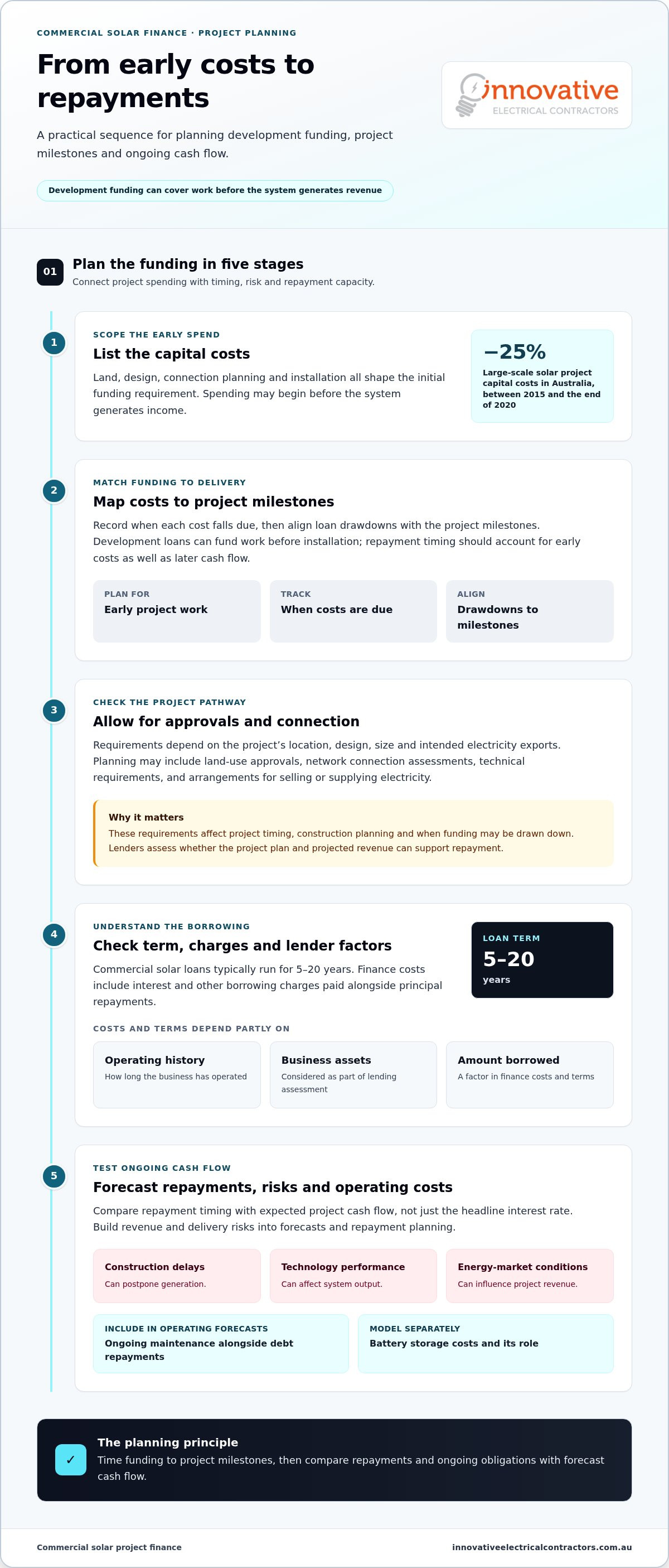
Project development loans and early-stage costs
Development loans can fund work before installation, when project capital is committed before the solar system generates revenue. Choose financing and repayment timing to account for both early costs and later cash flow.
Solar project capital costs
Finance costs and repayments
Finance costs are the interest and other borrowing charges paid alongside principal repayments. Commercial solar loans typically run for 5-20 years, while costs depend partly on how long the business has operated, its assets and the amount borrowed. Compare repayment timing with expected project cash flow, not just the headline interest rate. Early-stage development loans may cover initial work, with longer-term financing arranged for construction or operation.
Revenue and delivery risks also affect a project’s ability to service debt. Construction delays can postpone generation, technology performance can affect output, and changing energy-market conditions can influence revenue. Include these factors in financial forecasts and repayment planning.
Approvals, grid connection and market requirements
Approval and connection requirements depend on the project’s location, design, size and intended electricity exports. Development planning commonly considers land-use approvals, network connection assessments, technical requirements and arrangements for selling or supplying electricity. These factors affect project timing, construction planning and when funding may be drawn down. Lenders also assess whether the project plan and projected revenue can support repayment.
Include ongoing maintenance in operating forecasts alongside debt repayments. If the project includes battery storage, model its costs and role separately from generation. For businesses assessing the electrical scope alongside financing, commercial solar and battery systems are part of the project planning picture.
Power purchase agreements
A commercial solar power purchase agreement (PPA) lets a business buy solar electricity without owning the system. A third-party developer installs, owns and operates the equipment on the business’s property, then sells the generated power at an agreed fixed rate. Commercial PPAs typically run for 15-25 years. The provider handles maintenance and system performance, while the business avoids upfront system capital. PPA customers receive separate invoices from their electricity retailer and solar provider, so both billing arrangements matter.
A solar lease is another way to use a system without buying it outright. The business pays a fixed monthly fee, while the finance company retains ownership until the final lease payment. Commercial solar leases typically last 10-20 years. Unlike a PPA, a lease payment is for use of the system, not a set amount of generated electricity. A rental agreement can describe a similar arrangement, so compare the payment basis, ownership and maintenance responsibilities in the contract.
Australian project examples show how long-term power purchase arrangements can support renewable energy projects. The Whitsunday Solar Farm in Queensland had a 20-year PPA with the Queensland Government. The Gannawarra Solar Farm in Victoria had a 13-year PPA with EnergyAustralia. For a business, these examples highlight why the agreement period matters: compare the contracted supply term with expected site use and electricity needs.
Energy services agreements and shared savings agreements offer other structures. An energy services agreement may combine energy improvements with service payments, and some projects can be cash-flow positive from day one. Shared savings agreements tie repayments to achieved savings rather than relying solely on a fixed system payment. Terms differ, so check how savings are measured, who owns the equipment, and which party is responsible for performance and maintenance. Before signing a PPA, lease or savings agreement, compare contract payments with expected solar use and existing electricity bills to understand the long-term cash commitment.
Cash flow and energy-cost savings
Assess solar finance against electricity savings and scheduled payments, not repayments alone. Compare the upfront investment, ongoing expenses and expected savings over the project’s operating period.
Cash payment versus solar finance
A cash payment uses business capital to fund the system, while solar finance spreads payments over time. Paying cash avoids loan interest but uses capital that could otherwise support essential facility fit-outs, such as warehouse storage solutions from colbydandenong.com.au. Finance preserves more upfront cash, although repayments and interest become ongoing expenses. Before deciding, compare each option with forecast electricity savings and other investment priorities.
Cash-flow-positive solar systems
A system is cash-flow positive when its savings exceed its financing payments and relevant operating expenses over the period measured. For example, annual savings of $1,800 and loan repayments of $1,200 leave a stated $600 annual surplus. By contrast, savings of $1,440 against repayments of $1,800 create a $360 annual shortfall. These examples show why projected savings alone don’t establish an advantage; compare them directly with payments and expenses.
For a wider performance view, commercial solar systems in Australia typically have payback periods of 3-7 years. Actual cash flow also reflects electricity use, system output, maintenance and agreement terms. Build forecasts that account for seasonal consumption and the timing of loan payments, rather than treating annual savings as evenly available cash.
Project sponsors are advised to limit operational cash sweeps to a maximum of 50 percent during the operational period, preserving cash for debt service. A cash sweep directs available project cash towards obligations or investment priorities. Cash equity investment can reduce the amount borrowed, but commits business funds upfront. Model both choices against operating expenses, debt payments and reserve needs.
To connect a solar system’s design with your business’s energy needs, discuss commercial solar planning.
Innovative Electrical Contractors: Commercial Electrical
Innovative Electrical Contractors provides commercial electrical services for businesses planning the electrical work around a solar project. Once you’ve compared funding structures, consider how the proposed system fits your premises, energy use and electrical requirements.
Contact the team to discuss your project’s commercial electrical scope or whether solar and battery installations suit your site. For businesses seeking an independent power setup, off-grid solar, battery and generator systems are also available. Matching the electrical solution to the site helps ground project planning in your business’s operating needs.
For a conversation about your commercial electrical or solar project, contact Innovative Electrical Contractors or visit innovativeelectricalcontractors.com.au.
Set your solar project up for its next step
Before comparing finance proposals, prepare a decision brief that links the project to your business plans. Record who will oversee the decision, what the site needs from its energy system and which financial outcomes matter most. This gives decision-makers a shared basis for comparing offers and weighing long-term commitments against operational priorities.
Deciding how to finance a large-scale solar project for your business also means considering the electrical work needed to put the plan into practice. Innovative Electrical Contractors provides electrical services for business needs alongside solar planning.
Contact Innovative Electrical Contractors to discuss your commercial electrical requirements and take a considered next step towards your solar project.
Frequently Asked Questions
How much does a large-scale business solar project cost in Australia per MW?
There is no single per-MW budget that suits every Australian solar project; costs depend on system size and site requirements. Build the estimate from the installation scope, then assess land, engineering, grid connection work, storage and approvals separately. A project exporting electricity to the grid may have a different cost profile from one designed mainly for on-site use. Treat the budget as project-specific, not as a standard rate.
How do solar PPAs work for Australian businesses, and what are typical terms and rates?
A solar PPA lets a business buy electricity generated by a system installed and owned by a third party on its premises. Commercial PPAs typically run for 15-25 years. There’s no single rate that applies to every Australian agreement; the contracted price reflects the project and its terms. Compare any price-adjustment clauses, supply arrangements and obligations if the business changes premises during the agreement.
How can a business finance solar through a commercial loan, lease or equipment finance?
A business can borrow to own a system, use a lease, or finance equipment through arrangements such as a chattel mortgage. Commercial solar loans typically run for 5-20 years, while leases typically last 10-20 years. With a chattel mortgage, the business owns the system while repaying the finance company. Compare ownership, repayment timing and contract obligations against the business’s planned use of the premises.
What returns, payback periods and IRR can businesses expect from large-scale solar in Australia?
Commercial solar systems in Australia typically have payback periods of 3-7 years, but that is not an IRR figure or a guaranteed project return. IRR depends on the project’s initial investment and the timing of its net cash flows. Estimate electricity savings using the business’s actual consumption and system output, then account for operating expenses, finance payments and revenue from exported electricity.
How can businesses compare self-funding, debt, leasing and a solar PPA?
To decide how to finance a large-scale solar project for your business, compare each option using the same assumptions: expected generation, on-site electricity use, exported power, operating expenses and contract period. Self-funding commits capital upfront; debt adds repayments; leasing leaves ownership with a third party under the lease terms; and a PPA charges for generated electricity. A side-by-side cash-flow forecast clarifies the trade-offs. Include the possible effects of moving sites or changing energy needs during the agreement.

Comments