
Solar Panel Cost Melbourne: 2026 Pricing Guide and ROI Analysis

The cheapest solar quote sitting in your inbox right now might actually be the most expensive investment you make over the next decade. While a low upfront price is tempting, many Melbourne homeowners are getting caught out by "solar cowboys" who ignore aging switchboards or use components that won't survive a Victorian winter. Understanding the true solar panel cost Melbourne households face in 2026 means looking beyond the sticker price to the long-term return on investment.
It's frustrating to deal with confusing rebate eligibility rules and the sudden realisation that your home needs a three-phase power upgrade before the first panel even hits the roof. We've designed this guide to cut through the noise and provide clear, honest pricing for systems ranging from 6.6kW to 10kW. You'll discover how to maximise the latest Solar Victoria rebates, manage the new $150,000 household income cap, and ensure your system is battery-ready. By focusing on quality electrical infrastructure rather than just the cheapest panels, you can secure the lower quarterly power bills you're after without the typical installation headaches.
Table of Contents
Current Market Trends: Solar Panel Cost Melbourne 2026
The 2026 landscape for solar in Melbourne has shifted significantly as the city moves toward a gas-free future. With the Victorian Government's mandate for all-electric new homes starting in January 2027, solar is no longer just an optional upgrade; it's the foundation of a modern home. This shift is driving a surge in demand, but it's also changing how we calculate the solar panel cost melbourne households should expect. The focus has moved away from simply chasing the lowest price toward building a system that can handle the total electrification of a household, including heat pumps and electric vehicles.
The history of Solar power in Australia shows a clear trend of falling hardware costs, but 2026 has introduced new variables. While panel efficiency is at an all-time high, local labour rates and the complexity of Victorian compliance have stabilised the bottom line. Electricity tariffs in Victoria now heavily penalise peak-time usage while offering minimal feed-in rewards, with average retailer rates for 2026/27 sitting at just 0.8c per kWh. This means the real value of solar today isn't in what you sell back to the grid; it's in how much coal-fired power you avoid buying.
Choosing the cheapest quote in this market is a risky strategy. Many "budget" installers cut corners on the very infrastructure that ensures safety, such as high-quality isolators and proper roof mountings. A low-cost system might save a few hundred dollars today, but it often leads to system failure or expensive remedial work when it's time to add a battery or upgrade your switchboard. True value lies in a system designed by a qualified electrical contractor who understands the long-term load requirements of an all-electric Melbourne home.
Average Price Points for Common System Sizes
While every roof is different, market indicators for 2026 provide a helpful baseline for your budget. Most Victorian households find the best balance between cost and self-consumption with these configurations:
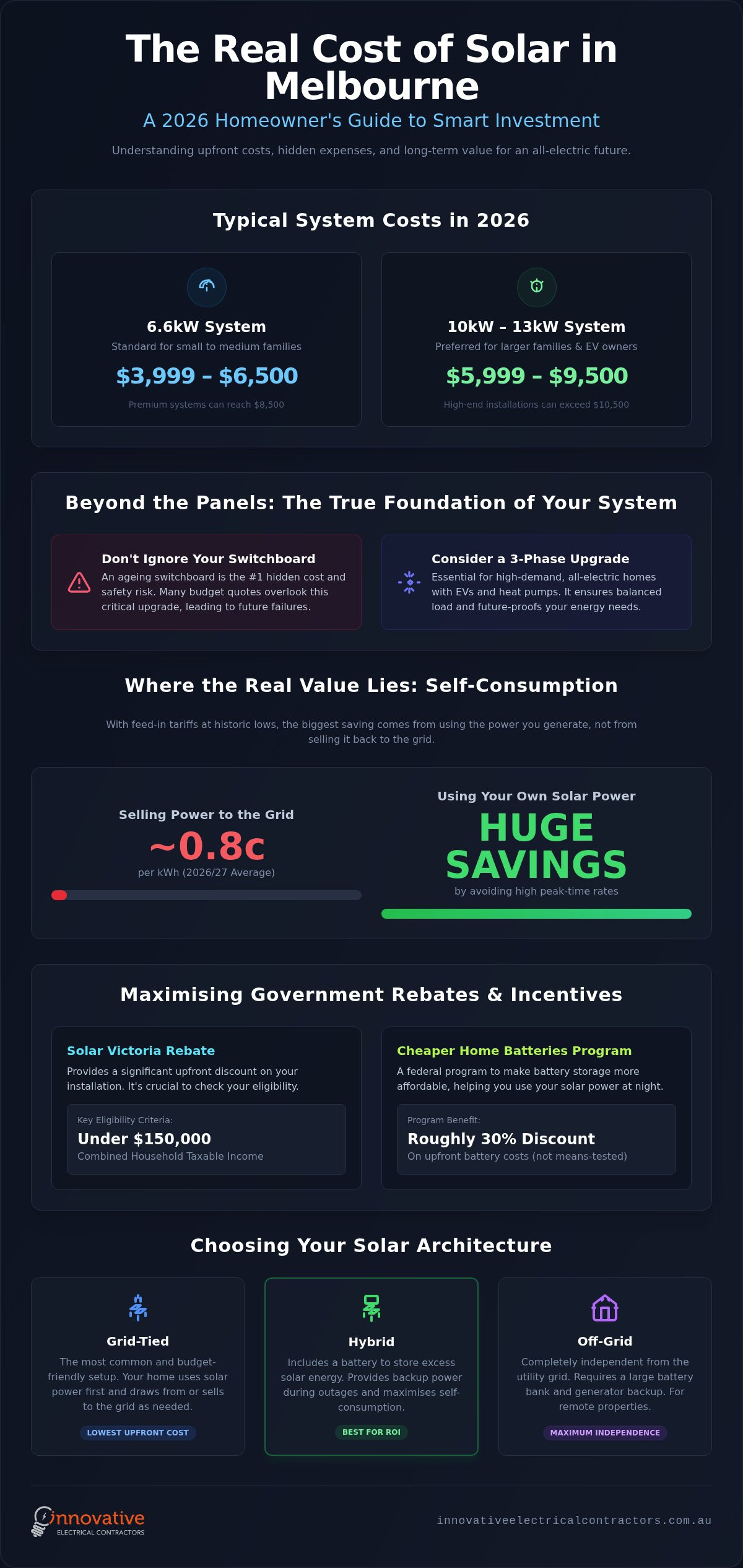
6.6kW Systems: The standard entry point for small to medium families. Prices typically range from $3,999 to $6,500 for quality components, though premium systems can reach $8,500.
10kW to 13kW Systems: Now the preferred choice for larger families or those planning for an EV. Expect to see indicative pricing between $5,999 and $9,500, with high-end installations exceeding $10,500.
Commercial-Scale Systems: For Melbourne businesses, costs are highly variable based on roof area and peak demand requirements, often requiring bespoke engineering to maximise ROI.
Why Melbourne Solar Costs Vary Between Suburbs
The physical location and architecture of your home play a massive role in the final solar panel cost melbourne installers quote. A single-storey tin roof in the outer suburbs is a straightforward job, but the narrow streets and multi-storey townhouses of the inner-north or bayside areas introduce significant logistical challenges. Installation teams must account for:
Roof Pitch and Material: Terracotta and slate tiles require more care and time to navigate than standard corrugated iron, increasing labour costs.
Access Requirements: Multi-storey homes often require specialised scaffolding or lifting equipment to safely transport panels to the roof.
Travel and Logistics: Sites in the outer-growth corridors often have more space for equipment, whereas inner-city sites might require permits for street parking or crane access.
Comparing Household Solar Power Solutions: Grid-Tied vs Hybrid vs Off-Grid
Choosing the right system architecture is the most critical decision in determining your total solar panel cost melbourne. While hardware prices have stabilised, the difference in complexity between a simple grid-connect setup and a full off-grid solution is vast. Each path offers a different level of energy security and financial return. In 2026, the case for batteries is stronger than ever. The federal Cheaper Home Batteries Program provides a discount of roughly 30% on upfront costs for systems between 5kWh and 100kWh. This isn't means-tested, making it a powerful tool for those looking to move toward total self-consumption. Using a Clean Energy Council accredited installer ensures your battery integration meets strict safety standards while maximising these incentives.
Grid-Tied Systems: The Budget-Friendly Entry
Standard grid-tied systems remain the most common choice for suburban Melbourne. They rely on the grid to act as a virtual battery, but with feed-in tariffs dropping to record lows, the ROI is now tied strictly to daytime usage. These systems use standard string inverters, which are reliable and cost-effective. However, they don't provide backup during a blackout. For households on flat tariffs, the focus is on sizing the system to match daytime loads like air conditioning and pool pumps. Maintenance is generally low, usually involving a professional panel clean and electrical health check every two years to ensure the system performs at its peak.
Hybrid and Off-Grid: The Path to Independence
Hybrid systems bridge the gap by using battery-ready inverters. These carry a cost premium over standard inverters but allow for seamless battery additions later. If you want true independence, you might consider off grid solar systems melbourne. This requires a much larger solar array, a dedicated battery bank, and often a backup generator to ensure power during consecutive cloudy Victorian days. While the initial investment is higher, the long-term savings on connection fees and rising tariffs can be substantial. These systems require more robust hardware, with high-end off-grid components built for extreme durability compared to standard residential gear.
The longevity of your system depends heavily on the quality of the initial installation. Grid-tied inverters typically last 10 to 12 years, while specialised off-grid equipment is designed for much longer service lives under heavy demand. If you're ready to explore how these different architectures impact your long-term solar panel cost melbourne, our team can help you optimise a solar strategy tailored to your specific property and energy needs.
The Hidden Costs: Electrical Infrastructure and Compliance
Many homeowners focus entirely on the sleek look of panels on their roof. They often overlook the complex electrical work required behind the scenes. Think of your switchboard as the heart of your solar system. It manages the flow of energy between your panels, your household appliances, and the Victorian grid. If your board is outdated, it simply won't be able to handle the increased load. This infrastructure requirement is a major factor in the total solar panel cost melbourne families should budget for in 2026.
Compliance with Australian Standards is non-negotiable for safety and rebate eligibility. Your installation must meet AS/NZS 5033 and AS/NZS 4777, which dictate how systems are wired and how inverters interact with the grid. Using a Master Electrician ensures these standards are met with precision. This professional oversight is vital when applying for Solar Homes Program rebates, as Solar Victoria requires strict proof of compliant installation from accredited contractors before releasing funds.
High-demand homes often face an additional hurdle: the 3-phase power upgrade. If you're running multiple air conditioners or charging an electric vehicle, a standard single-phase connection might limit your solar export capacity. Upgrading to 3-phase power allows you to install larger systems, often 10kW or more, while maintaining a stable connection. It's an investment in your home's future-proofing that standard solar-only companies often fail to mention in their initial quotes.
Switchboard Upgrades and Fault Finding
Old porcelain fuses and a lack of modern safety switches are clear signs your home isn't solar-ready. Modern solar installations require dedicated circuit breakers and RCD protection to prevent electrical fires and equipment damage. Addressing these issues early prevents "surprise" costs during the installation process. You can learn more about the technical requirements for these upgrades on our electrical services page.
Smart Monitoring and Energy Management
The value of solar in 2026 is found in "self-consumption" rather than exports. Installing consumption meters and smart apps allows you to track your energy use in real-time. This data lets you automate heavy loads, such as air conditioning or security systems, to run when your panels are producing the most power. Integrating these systems creates a truly smart home that slashes your reliance on expensive grid power during peak evening periods.
Maximising ROI: Rebates and Feed-in Tariffs in Victoria
Calculating your return on investment requires a clear look at the incentives available to Victorian households in 2026. The financial math has changed, and the focus is now firmly on reducing your upfront solar panel cost melbourne through "rebate stacking." By combining federal discounts with state-specific programs, savvy homeowners can slash thousands from their initial investment. It's not just about the panels, either. The current landscape rewards those who integrate storage and smart management to keep their generated power behind the meter.
The Federal Small-scale Technology Certificate (STC) scheme remains your first line of defence against high costs. This acts as a point-of-sale discount applied directly by your installer. Because the STC program is scheduled for a complete phase-out by 2030, the value of these certificates reduces every January. Securing your installation earlier in the year ensures you capture a higher certificate value before the next scheduled reduction. This federal incentive works alongside the state's Solar Homes Program to provide a multi-layered financial cushion.
Navigating the Solar Victoria Application
As of July 1, 2026, the eligibility rules for the Solar Victoria rebate have tightened. The combined household taxable income cap is now $150,000 per year. If you fall under this threshold and your property is valued at less than $3 million, you can access a rebate of up to $1,400. To help manage the remaining balance, the state offers an optional interest-free loan of up to $1,400 with a four-year repayment term. If you're looking to add storage, you should also investigate the current solar battery rebate options, which provide a 30% discount on upfront battery costs through the federal Cheaper Home Batteries Program.
Understanding 2026 Feed-in Tariffs (FiT)
The days of making a profit by selling power back to the grid are largely over. With energy retailers now setting their own rates, the average minimum feed-in tariff for the 2026/27 financial year has settled at approximately 0.8c per kWh. While some retailers offer up to 8c per kWh, this is still far below the cost of buying electricity from the grid. To maximise your ROI, you must prioritise self-consumption. This means:
Running heavy appliances like dishwashers and washing machines during the middle of the day.
Setting your electric hot water system or heat pump to trigger during peak solar production.
Joining a Virtual Power Plant (VPP) to allow the grid to draw from your battery during peak demand for higher credits.
If you're ready to see how these incentives apply to your specific property and energy usage patterns, you can request a detailed solar ROI analysis from our local team of experts.
Choosing a Melbourne Solar Installer: Quality Over Quickness
The final piece of the puzzle isn't a panel or an inverter. It's the person holding the drill. In a market flooded with too-good-to-be-true offers, your choice of installer determines whether your solar panel cost melbourne results in a decade of savings or a decade of repairs. Many companies operate as sales offices first and installers second, subcontracting the actual labour to the lowest bidder. This often leads to a massive disconnect between what was promised in the showroom and what is actually bolted to your roof.
Look for red flags in your initial quotes. If a company provides a price without asking for photos of your switchboard or checking your roof material, they're likely hiding future variation fees. A reputable Melbourne-based installer should be a Solar Victoria-registered retailer and employ Clean Energy Council accredited designers. Most importantly, ask if a licensed electrician will be on-site for the duration of the build. It's your right to ensure the person wiring your home is actually qualified to do so; don't settle for a team that only uses unlicenced labourers for the heavy lifting.
Warranty and Maintenance: Protecting Your Investment
A solar system is a 25-year commitment, but many solar cowboys don't last five. You need to distinguish between product warranties, performance warranties, and labour warranties. If your installer vanishes, claiming a labour warranty becomes nearly impossible. Regular upkeep is also essential for longevity, especially for complex setups. You can read more in our guide on solar battery maintenance to understand how to protect your storage investment over the long haul. Checking a company's local track record through Victorian-specific reviews is a non-negotiable step before signing any contract.
The Innovative Electrical Difference
We don't just bolt panels to roofs. As expert electrical contractors, we look at your home as a complete energy ecosystem. This holistic approach ensures your solar works perfectly with your air conditioning, security systems, and EV chargers. We specialise in the complex 3-phase and switchboard work that standard installers often avoid. By combining rooftop solar for homes with smart home technology, we help you achieve genuine energy independence. If you want a quote that reflects the real solar panel cost melbourne for a high-performance system, we're ready to help. Our team provides honest, transparent assessments that prioritise your home's safety and your long-term ROI above all else.
Take Control of Your Melbourne Energy Future
Investing in renewable energy is a long-term commitment to your home's independence. We've seen that the real solar panel cost melbourne families face isn't just about the hardware on the roof. It involves ensuring your electrical infrastructure is safe, compliant, and ready for the 2027 all-electric mandate. By choosing quality Tier 1 components and leveraging the full suite of Solar Victoria rebates, you can turn a complex installation into a seamless financial win.
As Victorian solar specialists, we know that a methodically planned system is the only way to guarantee a high ROI. Our team of expert Master Electricians ensures every component, from the switchboard to the battery bank, meets the highest safety standards. Don't leave your energy future to chance or "solar cowboys" who cut corners on compliance. You deserve a partner who values precision as much as you value your savings.
Take the first step toward lower power bills and a more sustainable home. Request a comprehensive solar and electrical audit from Innovative Electrical today and get the honest, expert advice your property deserves. We're here to help you power your home with confidence.
Frequently Asked Questions
Are solar panels still worth it in Melbourne with lower feed-in tariffs?
Yes, solar remains a highly effective investment because the primary financial gain has shifted to self-consumption. While feed-in tariffs have decreased to an average of 0.8c per kWh, you're still avoiding retail electricity costs that are significantly higher. By using your own power for heating, cooling, and appliances during the day, you're essentially paying yourself the full retail rate. It's a strategy that provides immediate relief from rising quarterly bills and protects against future price hikes.
How much does a 6.6kW solar system cost in Melbourne in 2026?
For a standard 6.6kW system, the typical solar panel cost melbourne households encounter ranges from $3,999 to $6,500 for a quality installation. Premium systems with high-efficiency components can reach $8,500. These figures generally include the upfront STC discount but may vary based on your roof's complexity and the specific hardware selected. It's important to remember that the cheapest quote often excludes essential electrical infrastructure work required for long-term safety and performance.
Does the Solar Victoria rebate still exist for batteries?
In 2026, the focus for battery incentives has shifted toward the Federal Government's Cheaper Home Batteries Program. This initiative provides a discount of approximately 30% on the upfront cost of installing a storage system between 5kWh and 100kWh. Unlike some previous state-based schemes, this program isn't means-tested; it allows more households to achieve energy independence. Combining this federal support with the existing Solar Victoria PV rebate helps significantly reduce the total cost of a hybrid solar setup.
How long is the typical payback period for household solar power?
Most Australian households see a full return on their investment within 4 to 7 years. This payback period depends heavily on how much of your generated power you consume at home versus how much you export to the grid. Households that automate heavy appliances to run during daylight hours or integrate battery storage often achieve faster ROI. Given that systems are designed to last 25 years, you'll enjoy nearly two decades of essentially free electricity after recovering the initial costs.
Can I install solar if my house only has single-phase power?
You can certainly install solar on a single-phase property, though it usually limits your inverter capacity to 5kW. This typically supports a 6.6kW panel array, which is sufficient for many medium-sized homes. However, if you plan to install a 10kW system or an electric vehicle charger, you might need to consider a 3-phase power upgrade. This allows for larger energy exports and provides a more stable electrical foundation for a fully electrified, high-demand household.
What happens to my solar cost if I need a switchboard upgrade?
A switchboard upgrade will increase your initial investment, but it's a critical safety requirement for many older properties. If your current board uses porcelain fuses or lacks modern safety switches, it won't be compliant with Australian Standards for solar integration. While this adds to the solar panel cost melbourne installers quote, it ensures your home can safely handle the bi-directional flow of electricity. It also provides peace of mind by modernising your home's entire electrical heart.
Is it better to wait for solar panel prices to drop further?
Waiting for hardware prices to fall is often a counterproductive strategy. The federal STC rebate, which acts as a significant upfront discount, is scheduled to reduce every January until it's phased out in 2030. Any small drop in panel prices is usually offset by the reduction in available government incentives. Every month you wait is another month spent paying full price for grid electricity, which often outweighs the potential savings of a slightly cheaper system later.
Do I need to clean my solar panels to maintain their efficiency?
Regular cleaning is essential to keep your system performing at its peak efficiency. Dust, bird droppings, and industrial grime can create "hot spots" or shading that reduces your total energy harvest by 10% or more. We recommend a professional inspection and clean every 1 to 2 years to ensure your panels stay in top condition. This maintenance also allows an electrician to check for any loose wiring or debris that could pose a safety risk over time.


Comments