
How to Organise Access Control for Your Australian Property in 2026

A truly reliable access control system is an electrical infrastructure project, not a simple gadget purchase. If you have ever tracked down lost physical keys, struggled to manage door permissions for staff, or worried about what happens to electronic latches during a sudden blackout, you understand the frustration of outdated security. You shouldn't have to juggle technical headaches just to keep your entryways secure and accessible.
Mastering modern access control means combining commercial-grade hardware with intuitive remote management and seamless CCTV integration. Whether you are safeguarding a busy commercial property or looking for keyless peace of mind at home, you can build a dependable setup operated directly from your smartphone. This practical guide walks you through selecting the right locking hardware, meeting Australian safety standards, and planning a professional installation that keeps your property properly protected.
Table of Contents
What is Access Control and Why Does Your Property Need It?
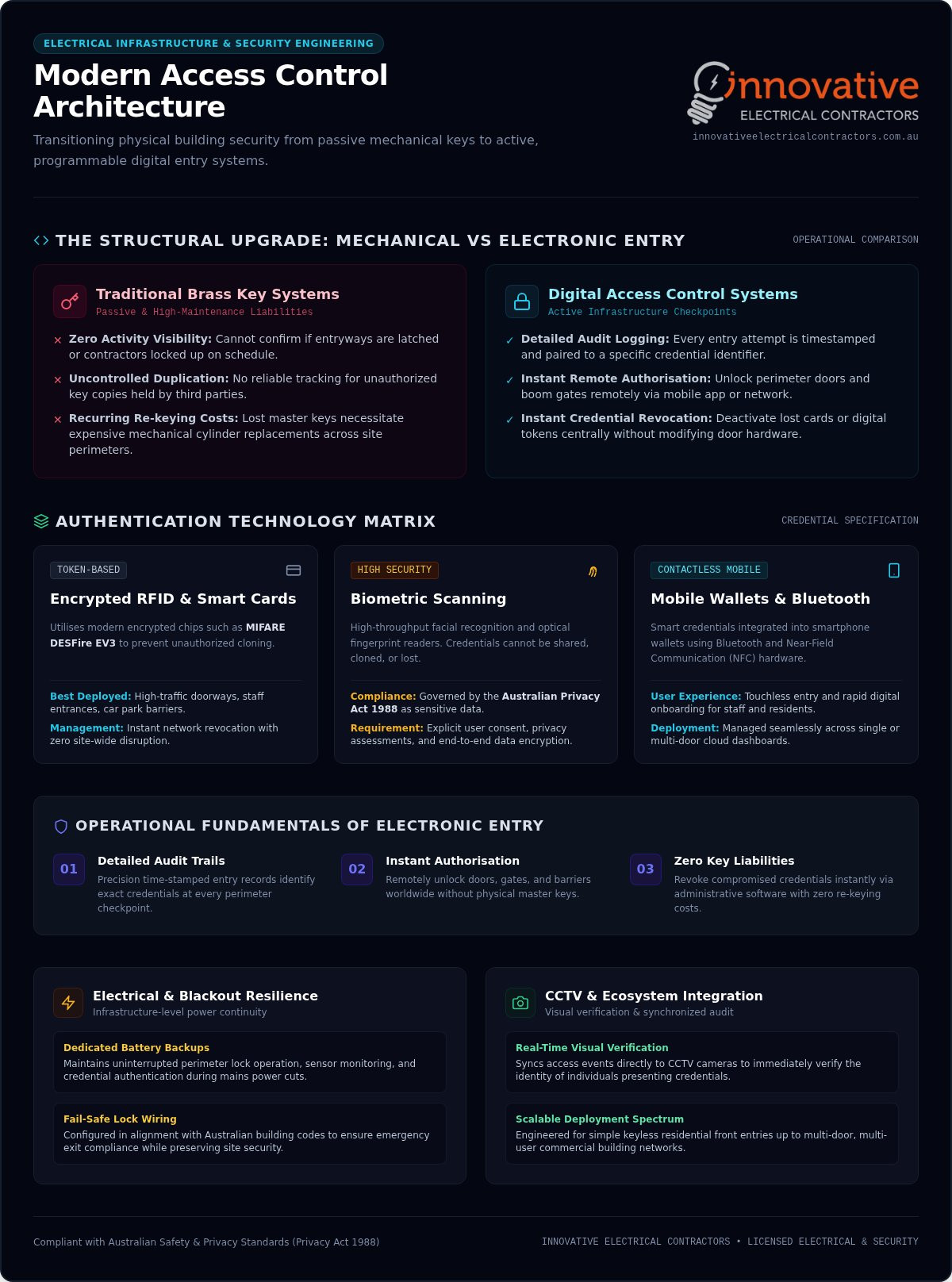
Physical access control is a specialised security solution that replaces mechanical locks with electronic authentication to manage who enters and exits your property. While IT professionals often use the term for user logins and network permissions, physical entry systems deal directly with the perimeter doors, boom gates, and interior rooms of a physical building. Moving away from traditional brass keys to intelligent digital credentials transforms a door from a passive barrier into an active checkpoint.
Electronic systems replace mechanical vulnerability with verified entry logs. When you upgrade your setup, you gain measurable operational improvements:
Detailed audit trails: Every entry attempt is logged with an exact time and credential identifier.
Instant remote authorisation: Unlock gates or doors from anywhere without having to hand over a physical key.
Zero lost-key liabilities: Deactivate missing credentials instantly through software rather than paying for urgent lock changes.
The Problem with Traditional Key Systems
Relying on standard pin-tumbler locks introduces recurring operational liabilities. When a staff member departs without handing back a master key, or a family member misplaces a house key, you have no real way of knowing who holds an unauthorized copy. Re-keying mechanical cylinders across multiple perimeter doors drains operational budgets quickly. Traditional locks also leave you blind to internal activity. They cannot confirm whether a contractor locked up on time or if an entryway remained unlatched overnight. Digital permissions replace that guesswork with verifiable, real-time control.
Why 2026 is the Year to Go Keyless
Electronic security has shifted from high-maintenance proprietary systems to fast, mobile-first hardware. Today, commercial sites and private homes can deploy smart credentials stored securely in mobile phone wallets alongside encrypted cards. High-speed networking allows property managers to modify clearances instantly across multiple doors from a single dashboard. Advancements in modern security solutions have made this commercial-grade reliability accessible for everyday residential builds. Deploying integrated hardware now protects your property's long-term value while streamlining entry for everyone who belongs there.
Comparing Access Control Technologies: RFID, Biometrics, and Mobile
Selecting the right authentication method determines how securely and smoothly your entry points operate. While basic PIN pads remain common, shared codes are routinely passed around, undermining the integrity of your security perimeter. Upgrading your building's access control setup requires weighing user convenience against credential security, environmental wear, and Australian regulatory standards.
Modern authentication methods deliver distinct operational strengths depending on your site layout:
Encrypted RFID: Highly durable physical tokens engineered for high-traffic doorways, car park barriers, and staff entrances.
Biometrics: High-security scanning where credentials cannot be shared, cloned, or handed off to third parties.
Mobile credentials: Contactless access using smartphone Bluetooth and NFC chips for streamlined user onboarding.
RFID and Proximity Cards
Radio frequency identification fobs and smart cards remain the backbone of commercial security installations. Unlike legacy cards that could be copied with cheap handheld tools, modern deployments utilise advanced encrypted chips like MIFARE DESFire EV3. When an employee misplaces a proximity card, administrators can instantly revoke permissions across the network. The rest of the site continues operating without disruption, keeping ongoing credential management fast and cost-effective.
Biometric Access: Fingerprints and Facial Recognition
Biometrics offer unmatched credential security because physical traits cannot be borrowed or lost. High-throughput facial recognition readers and optical fingerprint scanners now authenticate approved users in fractions of a second, even in demanding industrial environments. However, commercial operators in Australia must account for compliance. Under the Privacy Act 1988, biometric data constitutes sensitive information. Property owners must obtain explicit consent from individuals, complete privacy assessments, and implement secure data encryption before deploying biometric sensors across standard doorways.
Mobile Credentials and Bluetooth Entry
Smartphones have rapidly transformed into digital door keys. By utilising encrypted Bluetooth Low Energy and NFC protocols, readers grant entry as an authorized phone approaches, creating a completely hands-free experience for residential properties. For commercial managers, the platform simplifies visitor handling. You can issue temporary digital passes to delivery drivers or short-term contractors directly to their devices, setting exact expiry times to prevent unauthorized access after hours.
Every property presents different structural demands, from external gates exposed to weather to high-security interior server rooms. If you are planning an upgrade, consulting with a specialist from Innovative Electrical Contractors ensures you select the correct commercial-grade readers and locking hardware for your site layout.
Designing Your System: Residential vs. Commercial Access Control
Property owners often hesitate to upgrade because they worry the technology is overly complex to operate. In reality, a well-designed access control installation simplifies daily routines by tailoring hardware to the scale of the premises. A residential entrance demands effortless, welcoming operation for family members, whereas a commercial site requires granular perimeter auditing, multi-tiered credential permissions, and automated compliance fail-safes.
Pairing your door hardware with professional CCTV installation elevates both environments. Linking video feeds directly to entry events provides instant visual verification whenever an access event occurs.
Access Control for the Modern Australian Home
Residential systems focus on straightforward usability. Schoolchildren and elderly grandparents don't want to navigate convoluted menus; they need instant, reliable entry via an encrypted fob, an outdoor video intercom, or a simple phone tap. Most domestic setups utilise "fail-secure" electric strikes. This means the latch stays locked externally during an electrical blackout to preserve perimeter protection, while an interior mechanical lever always allows immediate, single-handed egress from within the home.
Scaling Up for Commercial and Industrial Sites
Commercial facilities handle higher foot traffic and varied contractor schedules across multiple entry points. Rather than issuing universal access, commercial systems apply custom permissions tailored to operational roles:
Schedule-based permissions: Authorise cleaning contractors or waste management services exclusively during designated operational windows.
Multi-door partitioning: Restrict staff access to public reception desks, workshop bays, or secured inventory rooms based on individual job clearance.
Compliance audit trails: Maintain time-stamped digital records of all entries and exits to support workplace safety obligations.
Fire safety automation: Interface magnetic locks and emergency exits directly with the building's fire alarm system to ensure doors release instantly along paths of travel.
Under the Australian National Construction Code (NCC Part D3D26), commercial escape doors must guarantee keyless egress without twisting or special effort. A licenced electrical and security contractor ensures commercial installations comply with these strict building codes while keeping internal operations seamless and secure.
How to Plan Your Access Control Installation: A Step-by-Step Guide
Executing an electronic access control deployment requires a disciplined, trades-focused approach. Because these systems tie directly into structural doors, low-voltage power supplies, and building networks, they are electrical infrastructure projects rather than quick DIY installations. Engaging certified technicians to run cabling and integrate dedicated electrical services guarantees that every strike, sensor, and controller operates safely under continuous daily use.
Step 1: The Security Audit and Door Hardware Selection
Every deployment begins with a physical survey of your entry points. You need to inspect the frame material, door weight, and mechanical alignment of each portal before picking locking devices. Solid timber and aluminium frames generally suit heavy-duty electric strikes, which house the mechanical latch cleanly. Frameless glass doors or commercial emergency exits often require surface-mounted electromagnetic locks (mag-locks) or drop-bolts. Choosing the right lock prevents mechanical binding and guarantees a positive seal every time the door swings shut.
Step 2: Cabling and Power Infrastructure
Wireless components are prone to RF interference and dead batteries. Professional installations rely on hardwired, low-voltage cabling installed in accordance with Australian customer cabling rules (AS/CA S009). The central controller, along with its auxiliary power supplies, should sit securely in a locked communications cupboard or utility room. A reliable installation features dedicated battery backup systems, ensuring that power supplies instantly step in during mains electrical dropouts so your entry points stay active.
Step 3: Software Configuration and User Enrolment
Once the physical hardware is energised, the control system must be commissioned and configured:
Define clearance groups: Establish specific access tiers for residents, permanent staff, and third-party contractors.
Program custom schedules: Create recurring automated lock and unlock windows matching your site's weekly workflow.
Execute blackout testing: Disconnect primary mains power manually during commissioning to verify that fail-safe and fail-secure mechanisms engage correctly.
A properly engineered installation provides dependable protection without disrupting daily entry. Contact Innovative Electrical Contractors today to plan a compliant, high-security installation tailored to your property.
Integrating Access Control with Your Smart Security Ecosystem
Treating entry points as isolated barriers limits their protective value. When access control communicates directly with your wider electrical, surveillance, and automation systems, your property operates as a coordinated defence network. Unifying these technologies eliminates blind spots, giving property owners total visibility over daily site traffic.
The Power of CCTV Integration
Visual verification bridges the gap between digital event logs and physical reality. If someone presents an invalid fob or triggers an "Access Denied" alert after hours, an integrated system instantly bookmarks the camera feed covering that doorway. You receive a push alert with an accompanying video snapshot, showing you exactly who attempted entry. This camera-to-door link also streamlines daily deliveries. When a courier rings your intercom, you can verify their identity via real-time video and trigger the door latch remotely, creating a robust, unified security solution for your property.
Smart Home and Building Automation
Connecting access hardware to property automation unlocks substantial convenience and energy efficiency:
Custom arrival scenes: Authenticating at an exterior entrance can automatically disarm perimeter alarms, illuminate hallway lighting, and open internal roller shutters.
Automated climate management: System logs can signal air conditioning systems to set unoccupied office zones or residential living spaces to economy mode once occupants depart.
Unified perimeter monitoring: A single software platform displays door statuses, sensor alerts, and camera feeds side by side.
Coordinating complex electronic hardware with your property's electrical infrastructure demands proven expertise. Innovative Electrical Contractors specialises in end-to-end installations, combining certified electrical craftsmanship with advanced security hardware to deliver dependable, compliant protection for properties across Australia.
Take Control of Your Property's Security Today
Moving away from physical keys transforms how you protect your building and manage daily traffic. Replacing vulnerable mechanical cylinders with encrypted credentials eliminates re-keying costs, delivers clear audit logs, and gives you effortless control over every doorway. Backed by solid low-voltage cabling and paired with visual CCTV verification, an electronic entry network keeps your site secure under all conditions.
High-grade security requires flawless electrical infrastructure. As fully licenced and insured Australian electrical contractors, Innovative Electrical Contractors brings extensive expertise to both residential smart homes and commercial security installations. We supply and commission professional-grade hardware designed for long-term durability and safety compliance.
Ready to modernise your premises? Secure your property with a professional access control system from Innovative Electrical Contractors and enjoy complete confidence in your entry security.
Frequently Asked Questions
Is access control more secure than a standard deadbolt?
Yes, commercial-grade access control provides far superior overall security compared to a traditional mechanical deadbolt. While a quality mechanical cylinder resists physical forced entry, it cannot prevent unauthorised key duplication, lost key theft, or cylinder picking. Electronic systems log every access attempt in real time, resist credential cloning with advanced encryption, and let you revoke lost cards instantly without physically altering the door.
What happens to my electronic locks during a power outage?
Electronic access systems maintain continuous operation during blackouts using dedicated uninterrupted battery backup units housed within the central power supply enclosure. Depending on whether your hardware is configured as fail-secure or fail-safe, exterior locks remain locked to protect your perimeter while interior door levers always allow immediate egress. Backups run standard controllers and strikes for hours until mains power returns.
Do I need a licenced electrician to install access control in Australia?
Yes, installing access control systems legally requires licenced electrical and security professionals to guarantee safety and compliance. Connecting central controllers to mains power requires a licenced electrician, while installing low-voltage data cabling requires ACMA-registered technicians under Australian regulations. Engaging qualified trades ensures your hardware meets building fire codes, prevents circuit overloads, and protects your property insurance coverage.
Can I manage my business access control system from my smartphone?
Yes, modern cloud and hybrid access platforms let administrators manage doors, credentials, and schedules directly through dedicated mobile apps. You can instantly unlock entrances remotely, grant temporary digital keys to contractors, revoke permissions for departed staff, and review real-time entry logs anywhere you have an internet connection. Push notifications also alert you immediately if a door remains propped open.
What is the difference between "Fail-Safe" and "Fail-Secure" locks?
The primary difference centres on whether the electronic lock automatically unlocks or stays locked when operating power drops out. Fail-safe locks require continuous electrical current to remain latched; if power fails, they unlock automatically to allow safe emergency evacuation. Fail-secure locks require electrical current to release; when power drops, they stay latched from the outside while still allowing mechanical lever exit from within.
How many users can a standard access control system handle?
Standard commercial controllers readily support hundreds to tens of thousands of individual user profiles across multiple credential formats. Even compact controllers designed for residential complexes or small offices typically accommodate up to a thousand active users with individual access rights. Larger multi-door installations scale across dozens of secure entryways, handling vast user directories without requiring physical key registers.
Can I integrate my existing CCTV cameras with a new access control system?
Yes, most modern access platforms integrate cleanly with existing IP-based CCTV cameras using open networking protocols. Industry standards like ONVIF allow access controllers to communicate directly with existing network video recorders. This integration automatically ties recorded footage to specific door transactions, letting you view synchronised security clips whenever a card swipe, valid entry, or forced door alarm occurs.
Is it possible to install access control on an existing heritage door?
Yes, access hardware can be fitted to heritage timber doors using specialised, non-invasive installation techniques. Licenced technicians use concealed architectural strikes, wireless electrified locksets, or heritage-matched hardware that preserves original timber joinery and antique door furniture. Cabling can be routed discreetly through existing frame cavities, delivering modern electronic security without compromising the historic character of your building.


Comments