
Solar Manufacturer Warranty vs Installer Warranty in Australia

A 25-year solar warranty may cover panel performance, not every fault in your system. A product defect, inverter issue and installation problem can each fall under different terms. That’s why understanding solar manufacturer warranty vs installer warranty australia matters before you rely on the headline number.
Warranty wording can make equipment cover, workmanship cover and performance promises sound interchangeable. If something goes wrong, it may not be clear who to approach first or whether a long warranty includes labour, call-outs or particular claim conditions.
This guide explains who generally covers equipment faults, installation issues and performance claims, and what to look for in the written terms. You’ll also learn how Australian Consumer Law’s consumer guarantees sit alongside voluntary warranties, and why your rights may extend beyond a stated warranty period.
Understanding the responsibilities can help you compare warranty documents and plan a solar and battery installation with the relevant records and terms in view.
Table of Contents
Solar manufacturer warranty vs installer warranty in Australia: who covers what?
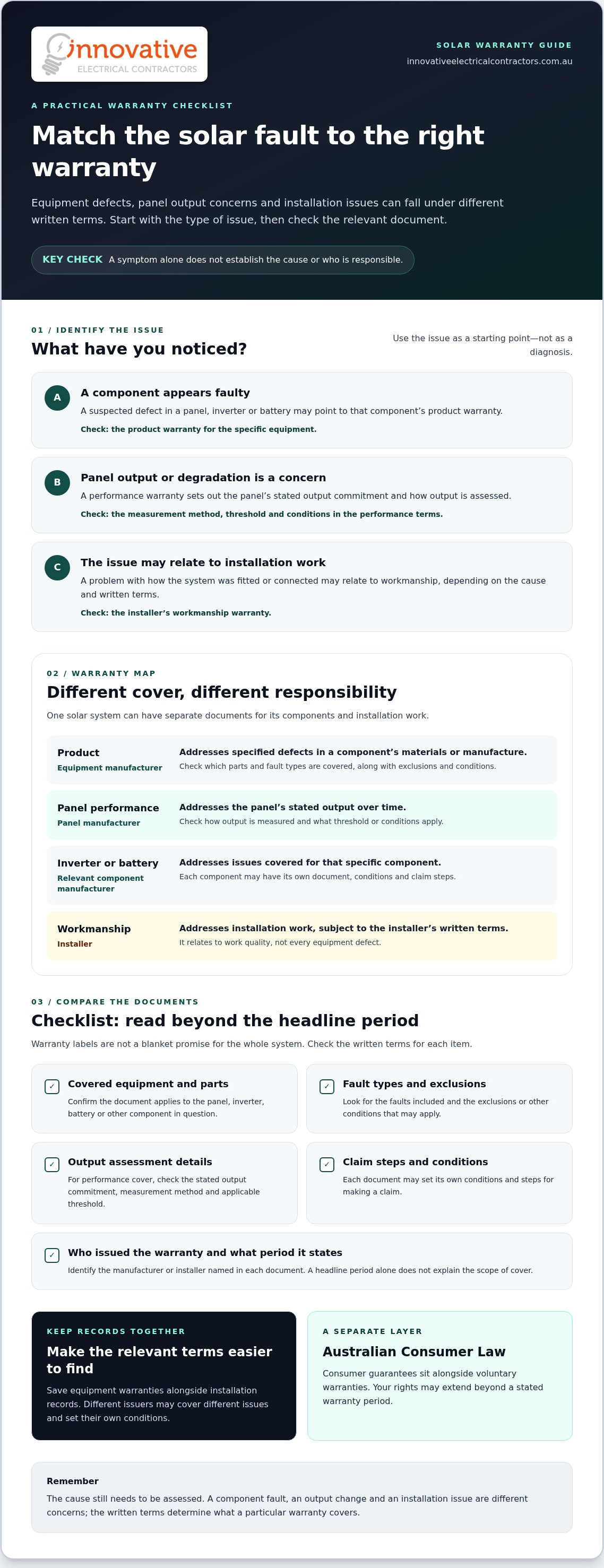
A manufacturer warranty generally covers faults in the solar equipment it makes, while an installer’s workmanship warranty generally relates to the quality of the installation work. One system can have separate terms for panels, an inverter and a battery, as well as cover for installation work. Each document may name a different issuer, cover different issues and set its own conditions.
That distinction matters because a component fault and an installation fault are different claim types. A panel that appears faulty may raise a product-warranty question; a loose mounting point may raise a workmanship question. The cause still needs to be assessed, so a symptom alone doesn’t establish who is responsible.
As a general guide, equipment defects fall under the relevant manufacturer’s product warranty, while faults in the installation work fall under the installer’s workmanship warranty, subject to the terms of each cover.
Equipment fault: the component’s manufacturer may be relevant if the issue is a defect covered by its product warranty.
Output or degradation concern: check the panel’s performance warranty, which sets out its stated output commitment and measurement conditions.
Installation issue: the installer’s workmanship terms may apply if the problem relates to how the system was fitted or connected.
These categories help you find the document that may be relevant, but they don’t diagnose a fault. A system issue can have more than one possible cause, and the written terms determine what a particular warranty covers.
What does a solar manufacturer warranty cover?
A product warranty may cover defects in a solar panel, inverter or battery, subject to its written terms. This is separate from a panel’s performance warranty, which addresses its stated output over time rather than whether the panel has a physical or manufacturing defect. For background on how panels generate electricity, see this overview of solar panel technology.
Coverage isn’t automatically the same across components or manufacturers. The documents define which parts are covered, the term, exclusions and any applicable conditions. Check the exact warranty for the equipment installed. A headline period alone doesn’t explain the scope of cover or how output is assessed.
What does an installer warranty cover?
Workmanship cover relates to installation work and is governed by the installer’s written terms. Depending on those terms, examples might include how mounting, wiring or roof penetrations were completed. These examples don’t guarantee coverage for a particular fault: the cause, the work involved and the warranty conditions all matter.
Workmanship cover doesn’t replace the manufacturer’s warranty for a component defect. The two types of cover address different parts of the system, so keeping the documents together makes it easier to identify the relevant issuer and terms if an issue arises. Save the equipment warranties alongside the installation records.
Product, performance and workmanship warranties: understand the differences
Warranty labels describe different kinds of cover, not one blanket promise for the whole system. Use the table to match the issue you’ve noticed with the document that may be relevant. The exact periods, exclusions and remedies depend on the applicable written terms, not the category name.
A component defect, gradual output change and installation fault are different concerns. For example, a suspected manufacturing fault in an inverter differs from a panel’s output changing over time, and both differ from a wiring issue linked to installation work. The symptom alone doesn’t confirm the cause or establish that a warranty applies.
Product warranty versus solar panel performance warranty
A product warranty concerns specified faults in the panel itself, such as a defect in materials or manufacture, according to the document. A performance warranty instead sets out the manufacturer’s stated output commitment over time and how it is assessed. It doesn’t promise a particular household bill saving: bills also depend on factors such as energy use and when electricity is consumed.
For either type, check the exact document for the covered product, assessment method, exclusions and any steps needed to make a claim. A performance term isn’t a catch-all for every panel issue.
How inverter, battery and workmanship cover differ
Inverters and batteries are separate components, so their warranties may set different conditions from panel cover. Workmanship terms relate to installation quality rather than a component’s own product cover. If the system isn’t operating as expected, the issue may need assessment before you can tell which category is relevant.
A long performance term doesn’t mean every fault is covered. It applies to the output commitment described in that document, not automatically to defects or installation work.
For a clearer comparison, organise each warranty document by component and note its issuer, covered issue, exclusions and claim instructions. That makes the solar manufacturer warranty vs installer warranty australia distinction practical, rather than relying on headline terms. For a planned system, solar and battery installation can be considered with warranty responsibilities in mind from the outset.
How to compare Australian solar warranty terms and consumer rights
A warranty headline is only a starting point. To compare solar offers properly, match each promise to the component, issuer and conditions in the written documents. Keep voluntary warranties separate from your Australian Consumer Law (ACL) consumer guarantees: they’re related protections, but they aren’t the same thing.
What to check in the written warranty documents
Review the full warranty documents alongside the quote and installation paperwork. A clear record makes it easier to identify which terms may relate to a fault and what information a claim may require. Compare documents for the actual equipment and installation, rather than relying on a general description or headline duration.
Identify the issuer and start date. Note who provides each warranty and when its cover begins. Check whether dates are tied to purchase, installation or another event stated in the document.
Match cover to the component. Record whether the document applies to panels, an inverter, a battery or installation work. Check what fault or performance commitment it addresses.
Read exclusions and conditions. Look for requirements about maintenance, unauthorised changes, damage and any other limits written into the terms. Keep maintenance records; solar battery maintenance guidance can help explain why records and stated conditions matter.
Check the claim process and possible remedy. Note the contact point, evidence required and timeframes described in the document. Check whether labour, transport or other costs are addressed, and how any remedy is described.
Keep the supporting paperwork together. Save the quote, invoices, product details, installation records, warranty documents and maintenance history. These can help establish what was supplied and which terms apply.
How Australian Consumer Law relates to warranties
Voluntary warranties are offered under written terms. ACL consumer guarantees are separate rights that apply automatically to goods and services supplied to consumers. The Australian Competition and Consumer Commission (ACCC) explains that these guarantees include expectations such as acceptable quality and fitness for purpose, depending on the circumstances.
A manufacturer or installer warranty doesn’t replace applicable consumer guarantees, and its end date doesn’t necessarily mark the end of your rights. Equally, a fault doesn’t automatically qualify for a particular outcome. The relevant facts, the product or service and the circumstances affect what protections and remedies may apply.
For a practical comparison of solar manufacturer warranty vs installer warranty australia, keep the written warranty terms and your consumer rights as two distinct layers. If a dispute arises, consult the ACCC’s consumer rights and guarantees guidance and the relevant state or territory consumer agency for information specific to your situation.
What to do when a solar system fault appears
A fault can be unsettling, but a clear record and the right warranty documents make it easier to work out what to do next. Don’t assume a symptom proves the cause. Low output, an app alert or water near a roof penetration may each have different explanations, and assessment is needed before assigning responsibility.
Which warranty route fits common fault scenarios?
Use the symptom as a starting point, then follow the written claim pathway for the relevant component or installation work. This helps keep a suspected defect separate from a possible workmanship issue without attempting a remote diagnosis.
Record what you’ve noticed. Write down when the issue began, what has changed and whether it appears consistently. Note any alerts or unusual system behaviour.
Check the relevant documents. Find the warranty for the panel, inverter or battery if you suspect a component issue. If the concern relates to mounting, wiring or a roof penetration, review the installer’s workmanship terms.
Identify the likely claim route. A suspected component defect points to the component issuer’s documented process. A suspected installation problem points to the installer’s written workmanship process. Low output or an alert is a symptom, not proof of either cause.
Follow the claim instructions. Use the contact point and evidence requirements in the relevant document. Keep a copy of what you submit and any response you receive.
What records can support a warranty claim?
Gather the quote, invoice, system design, commissioning records and warranty documents. Add dated photos where they can be taken safely, monitoring data, alert details and a plain description of the problem. Keep copies of emails, letters and any claim reference so the timeline remains clear.
Don’t climb onto the roof, open electrical equipment or attempt repairs to gather evidence. If you notice smoke, a burning smell, exposed wiring or water close to electrical equipment, keep clear and seek appropriate professional help. Follow the system’s safety instructions, and don’t interfere with components to test a theory.
If the installer has closed, a workmanship claim may be harder to progress through that business. That doesn’t automatically decide whether a claim is covered or remove other possible rights. Manufacturer cover remains a separate consideration for equipment faults, and Australian Consumer Law consumer guarantees are also distinct from voluntary warranty terms. For information about your situation, consult the ACCC’s consumer rights and guarantees guidance or your relevant state or territory consumer agency.
Clear records help make the solar manufacturer warranty vs installer warranty australia distinction useful when a fault appears. For a planned system, solar and battery installation services can be considered alongside the system’s documentation and warranty terms.
Choose solar installation with warranty responsibilities clearly understood
Before committing to a solar or battery installation, look beyond the headline warranty period. A useful comparison shows which equipment is proposed, who issues each warranty and where the written terms can be found. That gives you a clearer picture of how product cover and installation responsibilities are treated, without assuming one warranty covers the entire system.
A practical pre-installation warranty checklist
Use this checklist to compare the paperwork alongside system design and project details. If a document or term isn’t clear, resolve that before relying on it as part of your decision.
Match the equipment to its documents. Check that the quote identifies the proposed panels, inverter and battery, where applicable, and that you can locate the relevant manufacturer warranty information.
Identify who issues each warranty. Separate manufacturer cover for equipment from any written terms covering installation work. Note which components each document applies to.
Read beyond the duration. Compare what’s covered, exclusions, conditions and the steps for making a claim. A longer term doesn’t necessarily mean broader cover.
Know what records you’ll receive. Plan to keep the quote, equipment information, installation records, commissioning documents and claim instructions together after the work is complete.
Organise documents for future reference. Save digital copies in one folder and retain the originals. Clear records can make it easier to find the right warranty terms if a question arises later.
This approach turns solar manufacturer warranty vs installer warranty australia into a practical comparison: match each promise to its issuer, component and conditions instead of treating every warranty as interchangeable.
How an electrical contractor fits into the solar decision
System planning connects equipment choices with the electrical work required for the project. Understanding those parts together can help clarify responsibilities: equipment documentation relates to the components, while workmanship terms relate to the installation work. Neither should be assumed to replace the other.
Innovative Electrical Contractors provides solar and battery installation services, electrical contracting for residential and commercial projects, and off-grid systems combining solar, batteries and generators. Considering the system as a whole can help you organise the relevant equipment information and installation records from the outset.
Good preparation won’t remove every possible warranty question, but it can make it easier to find the right document and understand what it says. Keep the documents accessible, note any conditions that call for ongoing maintenance, and refer to the written claim instructions if an issue comes up.
For more information about the company’s work, see solar and battery installation services.
Make warranty clarity part of your next solar decision
A solar project is easier to plan when the paperwork is treated as part of the decision, not something to sort out after installation. Before moving ahead, make space to understand how each component and the installation work are documented. That can help you feel more prepared to manage the system over time.
Keep the phrase solar manufacturer warranty vs installer warranty australia in perspective: the most useful comparison connects the written terms to the system being planned. Clear expectations support better decisions, whether you’re considering solar for a home, a business or an off-grid setup.
Innovative Electrical Contractors provides solar and battery installations, electrical contracting, and off-grid systems combining solar, batteries and generators. As you plan your next project, keep the equipment warranties and installation terms together so they’re easy to refer to.
Planning a solar or battery project? Explore solar and battery installation services.
Frequently Asked Questions
How long do solar manufacturer and installer warranties last in Australia?
There’s no single term for every component or installer. In Australia, solar panel product warranties commonly range from 15 to 25 years, while performance warranties often run for 25 years. Inverter cover may be shorter, and battery terms vary. Installer workmanship warranties also differ, with terms commonly around 5 to 10 years. Treat these as general market ranges, not a promise. Check the dated documents for your specific system.
Can I claim under Australian Consumer Law after a solar warranty expires?
Possibly. An expired voluntary warranty doesn’t automatically end any applicable Australian Consumer Law consumer guarantees. Whether a consumer guarantee applies depends on factors such as the product or service, the fault and the circumstances, including what would be a reasonable lifespan. It doesn’t mean every post-warranty issue qualifies for a remedy. Keep your purchase and fault records, and consult the ACCC or your state or territory consumer agency for guidance.
What happens if my solar installer closes before a workmanship issue is fixed?
If the installer has closed, a claim under its workmanship warranty may be difficult to progress directly with that business. Keep your contract, invoice and records of the issue. If you bought the system from a retailer or supplier, you may also have rights against that business under Australian Consumer Law, depending on the circumstances. A manufacturer warranty remains a separate avenue for an eligible component issue. The ACCC and state or territory consumer agencies offer dispute guidance.
Does a solar panel performance warranty cover output loss caused by shading?
Usually, a performance warranty concerns the panel’s specified output under the conditions set out by its manufacturer; it doesn’t necessarily cover reduced system generation caused by shade. A new tree, building work or seasonal shade can affect how much sunlight reaches a panel without indicating a panel defect. Check the warranty’s measurement conditions and compare monitoring data over time. Don’t treat a lower system reading alone as proof of a performance-warranty claim.
Are solar warranties transferable when I sell my home?
Some warranties may transfer, while others may require notice, registration or particular sale documents. Don’t assume cover follows the property automatically. Before settlement, locate the panel, inverter and battery documents, then check each issuer’s transfer conditions and any time limits. Give the buyer copies of the system records and written warranty terms. If a transfer step is required, follow the stated process and retain evidence that it was completed.
Can using another electrician affect my solar system warranty?
It can, depending on what work is done and the wording of the warranty. A document may restrict cover for damage linked to unauthorised repairs or modifications, but that doesn’t automatically mean every warranty is cancelled for all issues. Before work is arranged, review the relevant terms and keep a record of the work performed. Don’t open equipment or attempt electrical changes yourself; follow the system’s safety information.
Does solar insurance replace a manufacturer or installer warranty?
No. Insurance and warranties serve different purposes. A policy may respond to specified insured events, subject to its exclusions and excess, while a warranty addresses the issues defined in its own terms. Neither should be assumed to cover every system fault. Check your insurance policy for covered events, notification requirements and exclusions, then keep it alongside the equipment warranties. For a suspected defect or installation issue, use the relevant written warranty process as well.


Comments