
Commercial Power Quality Audits: AU Business Guide

Equipment trips without warning, sensitive electronics behave erratically or production stops for no obvious reason. A search for a commercial power quality audit often starts with a practical question: what is happening to the electrical supply, and what should we do next?
Downtime, equipment faults and a report full of hard-to-interpret readings can all be concerning. Innovative Electrical Contractors notes that a power quality audit measures electrical behaviour over time, including voltage dips and swells, harmonics and interruptions. The results can help show when issues occur and guide further investigation, but measurements alone don’t prove the cause. This guide explains what an audit can measure, how to interpret common findings and how to plan practical next steps. It also covers how electrical fault finding and, where appropriate, switchboard upgrades can form part of a considered response to business electrical issues.
Key Takeaways
A commercial power quality audit melbourne search can be a first step towards understanding recurring electrical issues and identifying what evidence may help explain them.
Voltage stability, load balance and harmonic distortion measurements each reveal different aspects of electrical supply behaviour.
Audit findings can help investigate equipment faults, but don’t automatically prove the cause.
Prepare useful site information by recording symptoms, affected equipment, event timing and recent operational changes.
Use the findings to prioritise next steps according to the evidence, business impact and site conditions.
Table of Contents
What a commercial power quality audit can tell you about your electrical supply
Equipment behaves unpredictably, faults recur or circuit protection trips, yet no obvious fault explains the pattern. In a commercial workplace, the cause may not be apparent during a brief inspection. A structured investigation of the electrical supply can help build a clearer picture of what is happening and when.
A power quality audit measures and analyses electrical supply behaviour at a site. It examines characteristics such as voltage and current over time, then documents the conditions observed. The results can guide further investigation, but they don’t automatically prove that a particular disturbance caused a fault or that one corrective action will resolve it.
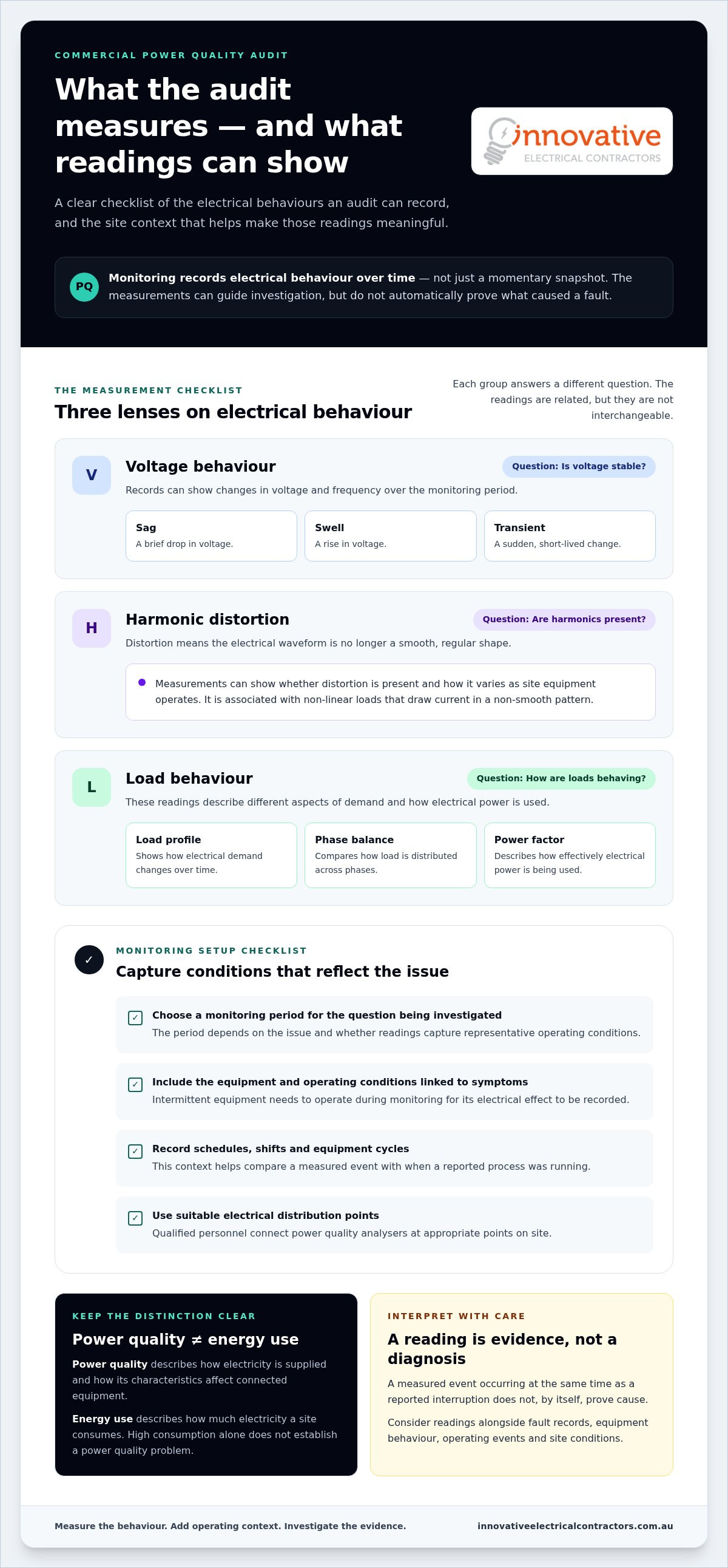
Power quality describes how electricity is supplied and how its characteristics affect connected equipment; energy use describes how much electricity a site consumes. A site can use a modest amount of electricity and still experience supply disturbances. Conversely, high consumption alone doesn’t establish a power quality problem. For a general overview, see What is Electric Power Quality?
The phrase “commercial power quality audit melbourne” often reflects a practical concern: could electrical supply conditions be contributing to operational problems? An audit’s value is not simply a set of readings. It provides evidence to consider alongside fault records, equipment behaviour and site conditions.
What does power quality mean in a commercial workplace?
Electrical equipment relies on voltage and current staying within conditions it can use reliably. A voltage sag is a short-lived drop; a swell is a rise. A transient is a brief, sudden change, while harmonic distortion means the electrical waveform is no longer a smooth, regular shape. These are possible disturbances to investigate, not findings to assume in advance.
Different loads can respond differently. Sensitive electronic controls may react to brief changes that larger equipment tolerates, while motors and other substantial loads may behave differently as supply conditions shift. One event might disrupt a control system without stopping every machine on site. Identifying which equipment is affected helps make measurements more meaningful.
Which warning signs may justify investigating power quality?
Record recurring unexplained faults, nuisance tripping, equipment failures, flickering lights, overheating equipment and unexpected interruptions. Note what was running and when each symptom occurred. These details can help reveal patterns, but none proves that power quality is the cause.
Similar symptoms can have different explanations. A circuit breaker trip, for example, may relate to a fault in equipment or the installation rather than a supply disturbance. Careful electrical fault finding helps distinguish possibilities and identify what needs attention. Assess audit findings alongside the site’s electrical condition, operating events and affected equipment, rather than treating them as a diagnosis on their own.
What a commercial power quality audit measures and how monitoring works
A power quality audit creates a record of electrical behaviour that can be reviewed alongside equipment symptoms and operating conditions. Measurements should be selected to investigate specific questions, rather than collected without context. If you’re considering a commercial power quality audit melbourne, knowing what each group of readings can show makes the process easier to follow.
Monitoring captures electrical behaviour over time, not just a momentary snapshot. An issue may appear only when particular equipment starts, a production cycle changes or the site reaches a certain load. A single reading could miss that pattern.
How power quality analysers capture site conditions
Qualified personnel connect power quality analysers at suitable electrical distribution points. The monitoring period depends on the issue being investigated and whether the readings capture representative operating conditions. A quiet period may not show what happens during a busy shift. Equipment that runs intermittently needs to operate during monitoring for its electrical effect to be recorded.
Operating schedules, shift patterns and equipment cycles help put readings in context. If an interruption is reported during a particular process, noting when that process runs can help establish whether a measured event occurred at the same time. The recording still needs interpretation: timing alone does not prove cause.
What voltage, harmonics and load measurements reveal
Measurements can be grouped by the question they help answer:
Is voltage stable? Records may show voltage sags, which are brief drops; swells, which are rises; and transients, which are sudden, short-lived changes. Frequency variation can also be assessed. These are possible events to measure, not conditions to presume.
Are harmonics present? Harmonic distortion is a change to the electrical waveform associated with non-linear loads, such as equipment that draws current in a non-smooth pattern. Measurements can show whether distortion is present and how it varies as site equipment operates.
How are loads behaving? A load profile shows how electrical demand changes over time. Phase balance compares how load is distributed across phases, while power factor describes how effectively electrical power is being used. These measures provide different views and shouldn’t be treated as interchangeable.
If a voltage event appears at the same time as a reported equipment fault, that alignment gives the investigation useful evidence. It doesn’t establish, by itself, that the event caused the fault. Load or phase readings may also highlight a pattern that needs further technical assessment, rather than point automatically to a particular fix.
Clear interpretation depends on both measurements and site context. Commercial and industrial electrical work, fault finding and switchboard upgrades may be relevant once an issue has been properly assessed. Businesses reviewing broader commercial electrical requirements can use the findings to guide decisions about practical next steps.
How to interpret audit findings and distinguish power quality from energy use
An audit report is most useful when it helps answer practical questions: what was measured, what equipment or operations may be affected, and what should be investigated next? A reading is evidence of a condition at a particular time. On its own, it isn’t proof of the cause of a fault or a reason to make a specific change.
Energy audits examine consumption; power quality audits examine electrical supply behaviour. These investigations answer different questions. A lower energy bill doesn’t show that voltage disturbances or other supply issues have been resolved. A power quality finding doesn’t automatically point to an energy-saving opportunity.
Power quality audit versus energy audit
Power quality auditAsks whether electrical supply behaviour may be affecting equipment. It typically examines readings and recorded events such as voltage changes, waveform distortion or load patterns.
Energy auditAsks how a site uses electricity and where consumption or efficiency may be improved. It typically considers usage patterns and the operation of energy-consuming systems.
A business may investigate one without needing the other. Recurring equipment interruptions may call for a closer look at supply behaviour, while a high energy bill may prompt a review of consumption. Some sites have both concerns, but one investigation shouldn’t be assumed to answer the other. Keeping the distinction clear helps set sensible expectations about what a commercial power quality audit can establish.
How to read a report without overinterpreting it
Separate the report into three parts: measured values and event records, the technical interpretation of those observations, and any recommended action. Check which conclusions are directly supported by recorded data and which are possibilities requiring further investigation. A voltage event recorded near the time of a fault gives you a useful lead, not automatic proof that the event caused it.
Compare event times with operating schedules, maintenance records and staff reports. If an event coincides with a reported interruption, note the match. If equipment was operating normally at the same time, that context matters too. A pattern can strengthen a line of enquiry, but other site conditions may also need assessment.
To make the findings easier to act on, group each item under four headings:
Observed condition: What value or event did the monitoring record, and when?
Affected equipment: Which systems were operating or reported to have a problem?
Operational consequence: Was there an interruption, disruption or other documented effect on work?
Next investigation: What evidence or technical assessment is needed before deciding on a response?
This approach keeps priorities grounded in evidence and business impact. A recurring event linked to a critical process may need timely technical assessment; an isolated reading without a matching symptom may warrant a different level of follow-up. Careful electrical fault finding can help investigate site issues. Any corrective work should follow from the confirmed condition and appropriate assessment.
How to prepare your site for a commercial power quality audit
Good preparation gives measured data useful context. You don’t need to diagnose the fault yourself. Record what staff observed, when it happened and what the site was doing at the time. This helps relate monitoring to actual operating conditions without assuming what the investigation will find or what action should follow.
Build a useful log of electrical symptoms
Keep a straightforward record of each incident. Include the date and time, affected equipment, visible warning signs and operating conditions staff noticed. Note whether the issue occurred during a particular shift, production cycle or equipment start-up. Specific observations are more useful than a general note that a machine is unreliable.
Gather relevant fault reports and maintenance records with the log. Together, these records can help compare reported events with monitored conditions and identify gaps for follow-up. Avoid guessing at a cause: record what happened and leave technical interpretation to the investigation.
Record the event: Note the date, time and what staff saw or heard.
Identify what was affected: Name the equipment or process and whether other systems were involved.
Add operating context: Record which loads were running, whether equipment was starting up and which shift or cycle was underway.
Gather related history: Keep maintenance notes, previous fault records and relevant site changes together.
Share site context and plan safe access
Prepare an overview of major electrical loads and normal operating schedules. Include changes that may affect demand or equipment behaviour, such as recently installed machinery, altered production hours or changes to how equipment is used. This context can help explain why an event appears at a particular time, but it doesn’t establish the cause in advance.
Coordinate access with the people responsible for the site. Identify relevant distribution areas and make sure the appropriate contact can explain site operations and access arrangements. Clear access helps qualified personnel work safely and understand which equipment is operating during the monitoring period.
Leave electrical equipment alone. Don’t open switchboards, attach instruments or attempt electrical measurements yourself. Access to electrical distribution equipment and measurement work should be handled by qualified electrical personnel. Your role is to provide accurate observations and operational context, not to investigate live equipment.
A practical handover can include the symptom log, maintenance history, operating schedule, major loads and a note of recent site changes. Keep a copy for the people involved so details aren’t lost between conversations. Preparation makes it easier to compare records with monitored events, but conclusions should be guided by the evidence and technical assessment.
If your notes point to wider electrical faults or commercial site requirements, discuss your commercial electrical requirements with our team.
Next steps after a power quality issue is identified
A finding is a starting point, not an instruction to install a particular device or change the electrical system straight away. Before deciding what to do, review the recorded evidence alongside the equipment involved, the operational impact and the urgency of any risk. A search for “commercial power quality audit melbourne” may bring up common remedies, but no single fix suits every site or measured issue.
Turn findings into prioritised electrical actions
Separate immediate safety concerns from reliability improvements and longer-term system changes. If a finding suggests a potential safety issue, have it assessed promptly by qualified electrical professionals. For other findings, consider the strength of the evidence, which equipment is affected and how much disruption the issue causes. A recurring problem affecting a critical process may deserve earlier attention than an isolated event with no known operational impact.
For each agreed action, record the reason, who will coordinate it and what follow-up is needed. This keeps recommendations connected to evidence and makes it easier to assess whether the issue has been addressed. Use qualified electrical professionals for diagnosis, design and electrical work. Don’t treat a report as permission for unqualified staff to access or alter electrical equipment.
Corrective options need to suit the confirmed issue, the site’s electrical conditions and applicable requirements. Filters, power factor correction and surge protection may be relevant in some situations, but they aren’t universal solutions. Selecting equipment or making changes based only on a familiar symptom can miss the actual cause or lead to a poor fit for the installation.
Plan practical commercial electrical follow-up
Once the evidence has been reviewed, suitable follow-up may involve commercial electrical work, further fault finding or a switchboard upgrade, depending on the site assessment. A recorded event, for example, may raise a question that needs further investigation before any modification is considered. A proposed upgrade should relate clearly to the identified condition and site needs, rather than being treated as a default remedy.
Keep the decision trail clear: note the finding, technical assessment, agreed response and how its effect will be reviewed. This makes future troubleshooting more informed and helps business teams understand why work is being considered. It also supports a measured approach to wider electrical planning, including the principles covered in Modern Electrical Services for Australian Properties.
Innovative Electrical Contractors provides commercial and industrial electrical work, electrical fault finding and switchboard upgrades. If your findings raise questions about practical electrical work for your site, discuss your commercial electrical requirements with our team.
Make your next electrical decision with confidence
Make the next step manageable by keeping a clear record of the issue, the evidence supporting action and the operational concern it addresses. If electrical work is agreed, retain those notes and compare conditions afterwards during similar operating patterns. This gives your team a useful reference for future planning instead of relying on memory when a fault recurs.
A search for commercial power quality audit melbourne can start a more informed conversation about your site’s electrical needs. Base decisions on measured evidence and appropriate technical assessment, not assumptions or a one-size-fits-all fix.
For practical support with your next commercial electrical decision, discuss your commercial electrical requirements with Innovative Electrical Contractors. A clear, considered next step can help your business move forward with greater confidence.
Frequently Asked Questions
How long does a commercial power quality audit take?
There’s no single duration. Monitoring needs to capture conditions relevant to the issue. A fault that occurs during a regular daily process may be easier to observe than one that happens unpredictably or only during occasional equipment use. Site access, operating schedules and the time needed to review results also affect the overall process. The monitoring plan should reflect the symptoms being investigated.
Can poor power quality damage commercial equipment?
Some power quality problems can disrupt equipment and may contribute to damage, particularly where sensitive electronics are involved. However, a failure doesn’t automatically mean the supply was responsible. A fault could originate within the equipment or electrical installation. If a device repeatedly malfunctions, preserve any error codes or maintenance notes and have it assessed rather than assuming a supply issue is the cause.
Is a power quality audit the same as an energy audit?
No. They investigate different business questions. A power quality audit focuses on electrical supply behaviour that may affect equipment, while an energy audit looks at how a site consumes electricity and where efficiency may be improved. For example, unexpectedly high usage may prompt an energy assessment, while unexplained control-system resets may warrant looking at supply conditions. One result doesn’t establish the other.
What information should I provide before an audit?
Provide a clear account of the issue and identify the equipment involved. Include asset labels or model details if available, any displayed fault codes, and whether the problem follows a particular task or operating cycle. Maintenance history and a list of recent changes to machinery or operating hours can add useful context. Keep records factual: note what staff observed rather than assigning a technical cause.
Can a power quality audit identify the cause of nuisance tripping?
It may help show whether recorded electrical events coincide with nuisance tripping, but that timing alone doesn’t prove causation. A protective device can trip for different reasons, including a fault or an issue with the connected load. Note which circuit or equipment was affected and what was operating at the time. A qualified electrical professional can assess the installation and determine what further fault finding is appropriate.
Does a power quality audit automatically fix electrical problems?
No. An audit is an investigative process, not an automatic repair. Its findings can inform decisions, but any response needs to be selected and carried out separately, based on the evidence and site conditions. A recorded disturbance, for instance, may lead to further inspection before anyone recommends electrical changes. Don’t treat a report as approval to alter equipment or protection settings without appropriate technical assessment.
When should a business investigate recurring voltage fluctuations?
Investigate recurring fluctuations when they coincide with equipment resets, interruptions, unusual operating behaviour or disruption to a business process. Record when they occur and whether they follow a consistent pattern, such as a particular machine starting. If there are signs of an immediate electrical safety concern, keep people clear of affected equipment and arrange appropriate professional assessment. Recurring symptoms deserve attention, even if their cause isn’t yet clear.



Comments