
Solar Battery Installation Guide: How to Power Your Home in 2026

Your solar battery is only as good as the electrical architecture behind it. While many homeowners focus on the brand of the unit, a successful solar battery installation actually depends on your switchboard capacity and how well the system integrates with your home's unique wiring. It’s completely normal to feel overwhelmed by technical jargon like AC versus DC coupling or the worry that you'll choose an undersized unit that won't keep the lights on during a blackout.
We know you're looking for more than just another appliance; you're looking for lower power bills and the security of energy independence. This guide provides a comprehensive, step-by-step roadmap to help you plan, size, and install a system that truly works for your household in 2026. We’ll explore the latest lithium iron phosphate (LFP) technology, explain how to ensure your switchboard is ready for the upgrade, and show you how to maximise the self-generated energy your panels are already producing. By the end, you'll have the confidence to move forward with a safe, compliant, and perfectly sized storage solution.
Table of Contents
Planning Your Solar Battery Installation in 2026
Planning a solar battery installation in 2026 requires looking beyond the shiny casing of the unit. You first need to determine if your existing solar PV system is compatible. Many older inverters aren't "battery-ready," meaning you might need a hybrid inverter or an AC-coupled solution to bridge the gap. As feed-in tariffs continue to fluctuate across Australia, the value of exporting power to the grid has diminished. True energy independence now comes from self-consumption, using every kilowatt-hour your roof produces instead of selling it back for cents.
Setting realistic expectations for blackout protection is vital. Not all home energy storage systems provide full "islanding" capabilities by default. If you want your home to run seamlessly when the grid goes down, your installer must configure specific backup circuits. This ensures critical loads like your fridge and lights stay on while heavy appliances are isolated to preserve your stored power.
Assessing Your Daily Energy Consumption
Start by downloading your smart meter data from your energy provider's portal. This data reveals your peak evening loads, which is usually when the sun goes down and the family comes home. Identify your "heavy lifter" appliances, such as reverse-cycle air conditioning or pool pumps. These devices can drain a small battery in under an hour. Modern Lithium Iron Phosphate (LFP) batteries are preferred in 2026 for their safety and longevity, but they still require careful sizing. Your "base load", the power used by appliances that never turn off, determines the absolute minimum battery size you should consider.
The Importance of Site Readiness
Where you put the unit matters as much as the brand you buy. While many units are rated for outdoor use, the harsh Australian heat can degrade battery chemistry and shorten its lifespan. A shaded, well-ventilated area or a spot in the garage is often the best choice. You'll need enough clearance for safety and future expansion. A professional site audit will also check if your switchboard requires an upgrade to handle the additional load of a solar battery installation, ensuring the system remains compliant with current Australian Standards. We often find that older homes need a switchboard refresh before they can safely host a new storage unit.
Understanding Battery Architectures: AC vs DC Coupling
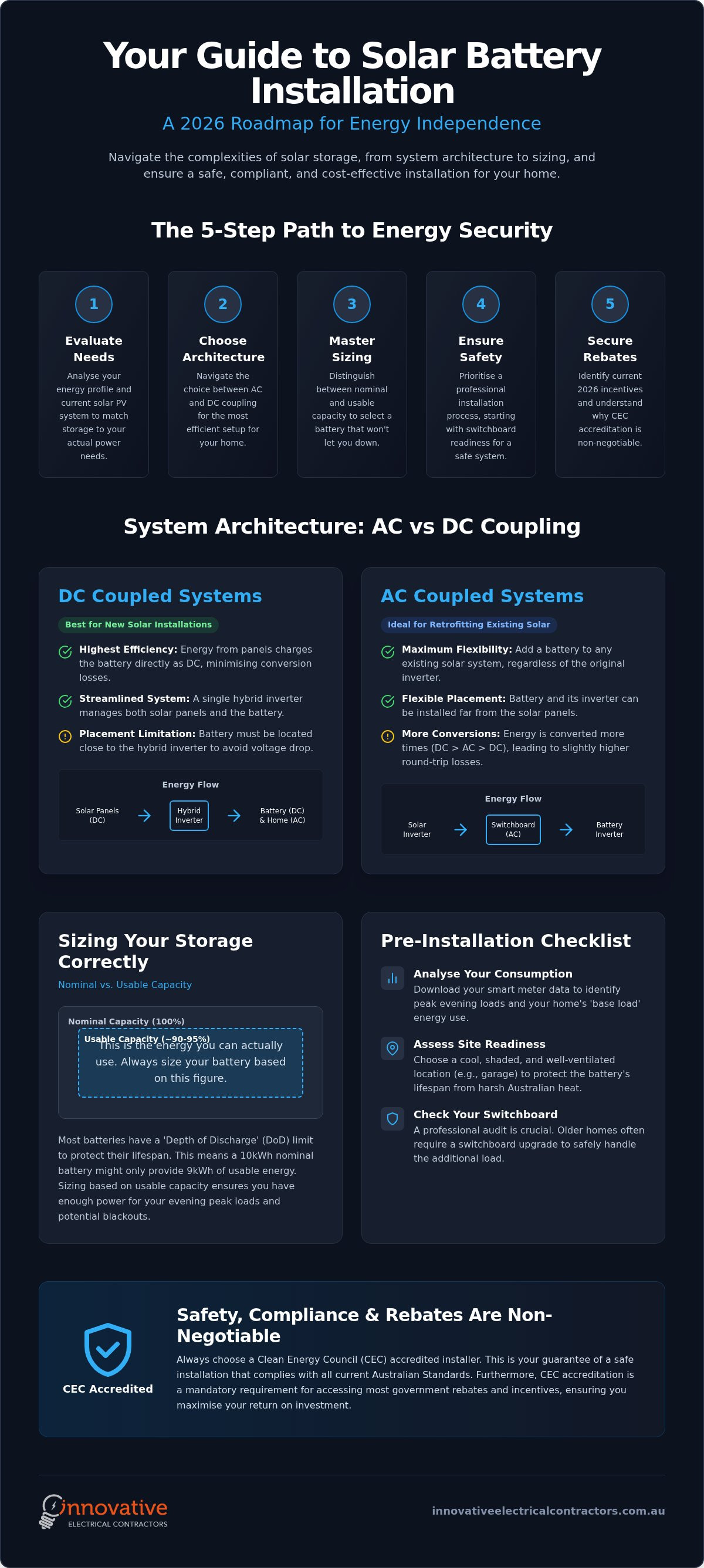
Choosing the right architecture is the most technical decision you'll make during a solar battery installation. It determines how energy flows from your roof to your appliances and, eventually, into storage. There are two primary ways to wire your system: DC (Direct Current) and AC (Alternating Current) coupling. The choice usually depends on whether you are installing a brand-new system or adding storage to an existing solar array.
DC Coupled Systems: High Efficiency for New Builds
In a DC-coupled setup, your solar panels and battery both connect to a single hybrid inverter. This is the gold standard for new installations. The energy from your panels stays as DC power as it charges the battery, which avoids the conversion losses found in other configurations. Hybrid inverters manage both the panels and the battery simultaneously, creating a streamlined system with a single point of control. One limitation to consider is the physical distance; batteries in a DC system must be located close to the inverter to prevent significant voltage drops.
AC Coupled Systems: Retrofitting Existing Solar
If you already have solar panels and a standard inverter, AC coupling is often the best path for a solar battery installation. This method allows you to keep your current equipment. The battery has its own dedicated inverter that connects directly to your home's switchboard. This "bolt-on" solution offers much more flexibility in placement, as the battery unit can be located further away from the solar panels without losing performance. It also allows you to manage multiple inverters within a single household network, though this requires precise configuration to ensure they work in harmony.
Every conversion from DC to AC matters for your long-term return on investment. In an AC-coupled system, energy converts from DC (panels) to AC (house) and then back to DC (battery). This round-trip loss can be several percentage points higher than a DC-coupled hybrid system. While global standards and programmes like the Federal Clean Energy Credit in the United States highlight the worldwide push for storage, Australian homeowners must prioritise these technical efficiencies to see the best results on their power bills. Local rebates are often tied to system performance, so minimising conversion losses is essential.
Managing multiple inverters requires a high level of technical skill. If the two inverters don't communicate correctly, your battery might charge from the grid during expensive peak times instead of using your free solar. This is why we focus on the professional electrical integration of every system we install. A well-configured network ensures your battery knows exactly when excess solar is available, protecting your investment and ensuring you get the most out of your self-generated energy.
Sizing Your Storage: How to Choose the Right Capacity
When planning your solar battery installation, the first hurdle is understanding that not all storage is created equal. You'll see two distinct numbers on a spec sheet: nominal capacity and usable capacity. Nominal is the total energy the battery can theoretically hold, but usable capacity is what you actually get to use in daily life. For example, a battery might be marketed as 10kWh, but if it has a 90% Depth of Discharge (DoD), you only have 9kWh of real-world storage. Draining a battery past its recommended DoD can significantly shorten its life cycles, making it a poor investment over the long term.
It's not just about how much energy you store (kWh), but how fast you can pull it out (kW). If your household peak demand is 7kW because you're running the oven and the air con, but your battery only outputs 5kW, you'll still be pulling the difference from the grid. We recommend choosing a system that matches your highest expected load during evening hours to achieve true energy independence. Choosing modular systems is a smart way to future-proof; you can start with a smaller unit and add extra battery modules later as your family’s needs grow.
The "Goldilocks" Zone: Avoiding Over-Sizing
Buying a battery that’s too large can actually hurt your ROI. If your solar panels don't produce enough excess energy to fill a massive battery every day, you're paying for capacity you'll never use. Finding the right balance between your rooftop solar for homes and your storage unit is key. We look at your self-consumption rates to calculate a "payback period" that makes financial sense for your specific circumstances. Most households find their "Goldilocks" zone is a battery that covers their usage from sunset until the panels start producing again the next morning.
Battery Chemistry: Lithium Iron Phosphate (LiFePO4) vs. Others
Lithium Iron Phosphate (LiFePO4) has become the Australian industry standard for a reason. Compared to older chemistries, LFP offers superior thermal stability and a much longer cycle life. Most modern home energy storage systems using LFP can handle thousands of charge and discharge cycles before performance begins to dip. A high-quality Battery Management System (BMS) is the brain of the operation. It monitors temperature and voltage to ensure every cell stays healthy and safe, which is particularly important in the harsh Australian climate. Choosing LFP means you get a battery that is not only safer but also lasts longer, providing better value for every solar battery installation.
The Step-by-Step Solar Battery Installation Process
Understanding the physical steps of a solar battery installation helps remove the mystery of the process. The day begins with a technical site audit to verify your mains capacity. We map out cable runs to ensure the path from your panels to the battery is as efficient as possible. This isn't just about mounting a box; it's about integrating a sophisticated power plant into your existing home network. We secure the unit according to strict Australian Standards, ensuring it sits on a stable, non-combustible surface with the correct clearances for ventilation.
Integration follows the physical mounting. This involves wiring the inverter, the battery storage unit, and the smart meter into a cohesive network. Each connection must be precise to ensure the high-voltage DC and AC lines are safely separated and properly earthed. We take pride in the neatness of our conduit runs and the precision of our terminations, as quality craftsmanship prevents future faults.
Switchboard Upgrades and Compliance
Many older homes require a switchboard upgrade to accommodate the new hardware safely. During a solar battery installation, we often need to install fire-rated backing and specific safety signage for emergency services. The smart meter is the brain of the energy flow. It monitors real-time demand and directs energy between the grid and your battery. If your current board is crowded or outdated, we'll modernise the components to ensure your system meets current electrical safety regulations.
Testing and Commissioning the Backup Circuit
We don't simply turn the system on and leave. We program the software and test your backup circuits to ensure total reliability. You'll decide which "essential circuits" stay active during a blackout, such as your fridge, lights, and Wi-Fi. We simulate a grid failure to ensure the system "islands" correctly. This means the battery disconnects from the street and runs independently without back-feeding power into the grid. We also help you set your "Reserve for Backup" percentage, which keeps a buffer of power aside for unexpected outages.
Finally, we walk you through the handover process. We'll help you set up the mobile app so you can monitor your energy production and storage levels in real time. Seeing your home run on stored sunshine is a rewarding experience that marks the start of your energy independence. If you're ready to secure your home's energy future, our team provides the expert electrical services needed for a seamless transition.
Navigating Rebates and Selecting an Accredited Installer
Finding the right partner for your solar battery installation is just as critical as the hardware you choose. In 2026, navigating the landscape of incentives requires a sharp eye and up-to-date information. You can find detailed analysis on current solar battery rebate opportunities across Australia to help offset your initial costs. To qualify for these schemes, your system must be installed by a Clean Energy Council (CEC) Accredited Installer. This accreditation ensures the professional meets strict safety and design standards, protecting both your property and your eligibility for government support.
There is a significant difference between a basic solar installer and a comprehensive electrical contractor. While many can mount panels, a qualified electrician understands the deeper complexities of your home’s switchboard and mains capacity. When reviewing a quote, look for total transparency. It should clearly break down the hardware specifications, labour costs, and warranty terms. A reliable expert won't hide costs in a bundle. They'll explain exactly how the integration works with your existing wiring and provide clear documentation for your records.
VPPs and Ongoing Financial Benefits
Joining a Virtual Power Plant (VPP) is an increasingly popular option for many households. These programmes allow an energy retailer to access your battery during periods of high grid demand, often in exchange for lower upfront costs or ongoing bill credits. This "demand response" helps stabilise the Australian grid during peak events. However, there is a trade-off to consider. By joining a VPP, you grant a third party partial control over your stored energy. This might slightly reduce your total personal energy independence during specific peak times, so it's important to weigh the financial credits against your desire for full control.
Long-term Maintenance and Warranty Support
Your system is a decade-long investment that requires local support. If your battery goes offline or the software glitches, you need a team that can be on-site quickly rather than a distant call centre. We recommend reading our guide on solar battery maintenance to understand how to monitor your system’s health. Ensure your warranty is comprehensive, covering both the physical unit and the installation labour. Having a single point of contact for both the electrical work and the product warranty provides the peace of mind that your energy future is in safe hands.
Secure Your Energy Independence Today
Achieving true energy independence in 2026 is about more than just buying a battery; it's about the precision of the electrical integration behind it. By now, you understand that a successful solar battery installation depends on matching your household's peak demand with the right architecture, whether that's a high-efficiency DC-coupled hybrid system or a flexible AC-coupled retrofit. Prioritising Lithium Iron Phosphate chemistry and ensuring your switchboard is modernised for the task are the best ways to protect your investment for the next decade.
We take pride in being more than just installers. As CEC Accredited Installers and comprehensive electrical experts, we specialise in the complex integration of off-grid and hybrid systems. We ensure your home is blackout-ready and your rebates are secured through compliant, high-quality craftsmanship. Don't leave your home's energy future to chance. Request a professional solar battery installation quote from our team of trusted advisors. Let's work together to build a reliable, self-sufficient power solution that keeps your lights on and your bills down.
Frequently Asked Questions
Do I need to upgrade my solar panels to install a battery?
You don't necessarily need to replace your panels, but your inverter setup might require a change. If your current solar PV system uses an older string inverter, you can choose an AC-coupled battery that works alongside your existing hardware. However, for maximum efficiency in a new solar battery installation, many homeowners opt for a hybrid inverter. We assess your current array to ensure the panels produce enough excess energy to charge the unit effectively.
Can I install a solar battery myself if I am handy with tools?
No, you cannot legally or safely perform a battery installation yourself in Australia. All battery storage work must be completed by a licensed electrician. To qualify for government rebates, the installer must also be Clean Energy Council (CEC) accredited. This ensures the system meets strict Australian Standards for fire safety and electrical integrity. Attempting a DIY installation voids your warranty and poses significant risks of fire or electrical shock to your household.
How long does a typical solar battery installation take?
A standard installation typically takes between one and two days to complete. The physical mounting of the battery unit often takes just a few hours, but the electrical integration and switchboard upgrades can extend the timeline. If your home requires complex fault-finding or a full switchboard modernisation to meet 2026 compliance standards, we may require additional time. We always provide a clear schedule before starting any work on your property.
Will a solar battery power my whole house during a blackout?
Most residential batteries are designed to power essential loads rather than the entire house. During a blackout, the system "islands" and directs power to critical circuits like your fridge, lights, and Wi-Fi. Running heavy appliances like ducted air conditioning or pool pumps will drain most batteries very quickly. We work with you during the planning phase to designate which specific circuits receive backup power to ensure you stay comfortable during unexpected outages.
What is the best temperature for a solar battery installation?
Solar batteries perform best in stable temperatures between 15°C and 30°C. While many modern units are rated for outdoor use, extreme Australian heat can accelerate the degradation of the battery cells and reduce their lifespan. We recommend installing the unit in a shaded, well-ventilated area or inside a garage. This protection ensures the Battery Management System doesn't have to throttle performance to keep the unit cool during summer peaks.
How much maintenance does a solar battery require after installation?
Modern lithium systems require very little manual maintenance after the initial solar battery installation. Most units feature automated software that performs regular self-diagnostics and receives over-the-air updates to improve efficiency. We recommend a quick visual check every few months to ensure vents are clear of dust or debris. A professional electrical inspection every few years is also a smart way to ensure all connections remain tight and the system is operating safely.
Can I add a second battery to my system later?
Yes, provided you choose a modular system during the initial setup. Many 2026 battery models allow you to "stack" additional modules to increase your usable capacity as your energy needs grow. It is much easier and more cost-effective to expand a system that was designed with future growth in mind. We recommend discussing your potential future energy needs during the design phase so we can select a compatible, expandable inverter and storage solution.
Does a solar battery installation affect my existing feed-in tariff?
Adding a battery generally doesn't affect your eligibility for a feed-in tariff, but it will significantly reduce the amount of energy you export. Since you're storing excess solar to use at night, there will be less "overflow" sent back to the grid. Some older, premium feed-in tariff schemes have strict rules about system modifications. We always advise checking with your energy retailer before proceeding with an installation to protect your current credits.


Comments