
Power-On Solar: The Complete Guide to Off-Grid Energy Independence in 2026

What if the next major grid failure didn't leave you sitting in the dark, wondering when the lights might flicker back on? For many, the dream of disconnecting isn't just about saving money; it's about the peace of mind that comes from total self-sufficiency. When researching off grid solar systems melbourne property owners often face a wall of confusion regarding battery sizing, kVA requirements, and generator integration.
We understand that the shift toward energy independence can feel like a daunting technical hurdle. It's frustrating to deal with rising costs and an unreliable regional supply when you just want a home that works. This guide provides a clear roadmap to designing a robust stand-alone power system that ensures you never lose power again. You'll discover how to accurately calculate your specific energy needs, choose the right storage solutions, and navigate the 2026 federal battery rebates to secure your future with confidence.
Table of Contents
What is Power-On Solar? Defining Stand-Alone Power Systems
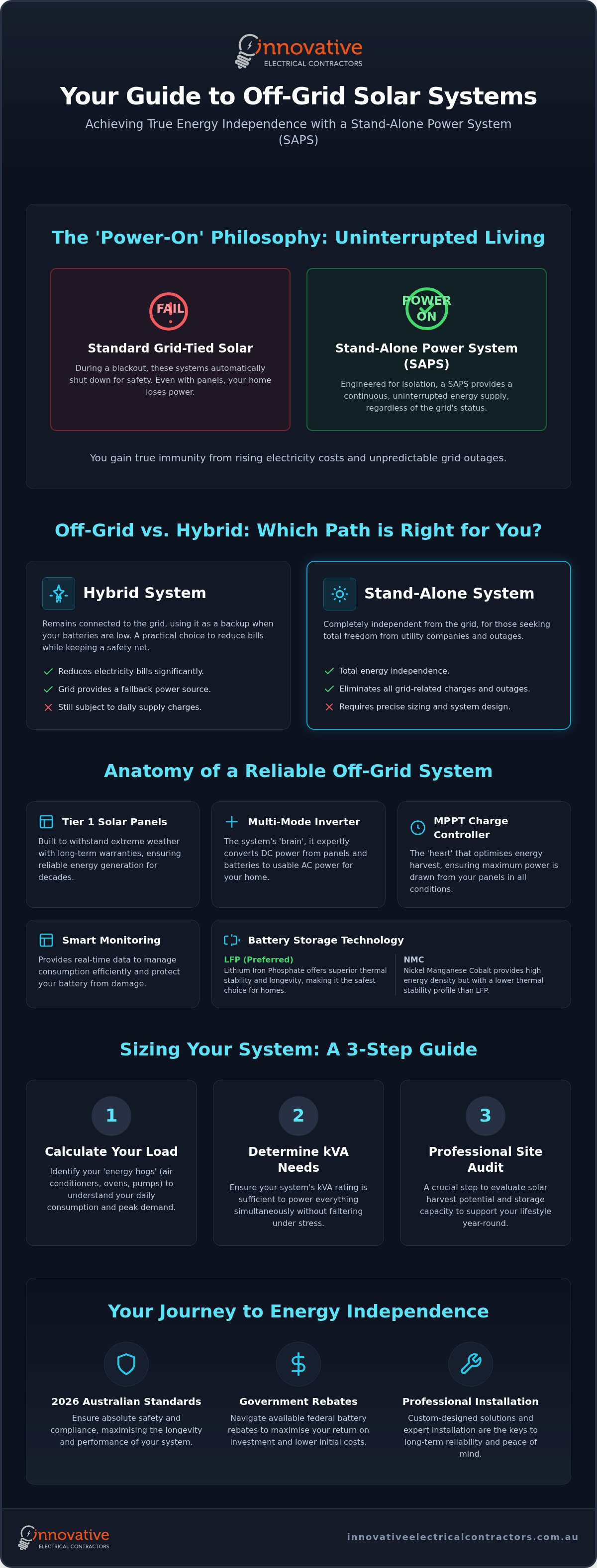
Power-On solar is more than just a technical term; it's a philosophy of living without compromise. While most residential solar setups are designed to supplement grid power, they often fail exactly when you need them most. During a blackout, standard grid-connected systems automatically shut down for safety. In contrast, a true Stand-alone power system (SAPS) is engineered to operate in total isolation. It provides a continuous, uninterrupted energy supply regardless of what's happening with the external network. For homeowners considering off grid solar systems melbourne wide, this distinction is the difference between sitting in the dark and maintaining a fully functional household.
The primary driver for this shift is a desire for genuine energy independence. When you own your power generation and storage, you're no longer a spectator to rising utility prices or aging infrastructure. There's a significant psychological advantage to this autonomy. Knowing that your home will remain a safe, powered sanctuary during extreme weather events provides a level of reassurance that traditional connections cannot provide. It's about taking the "luck" out of your home's energy security and replacing it with engineered certainty.
The Shift Towards Energy Autonomy in 2026
As we move through 2026, the landscape of Australian energy has changed significantly. Rising network charges and service fees have pushed many property owners to reconsider their relationship with big retailers. Modern off-grid solutions now feature advanced energy management software that monitors consumption in real-time. This technology ensures that your stored power is used with maximum efficiency, automatically balancing loads to preserve battery life. This level of reliability is critical for properties that require constant uptime, such as those housing sensitive medical equipment or integrated security networks. By prioritising "power-on" reliability, you ensure that your essential services never skip a beat.
Off-Grid vs. Hybrid: Which Path is Right for You?
Deciding between a completely stand-alone system and a hybrid model is a pivotal step in your journey. A hybrid system remains connected to the grid, using it as a secondary backup when your batteries run low. This can be a practical choice for those who want to reduce bills while keeping a safety net. However, for those seeking total freedom, a stand-alone system eliminates daily supply charges and grid-related outages entirely. To make the right choice, it's best to engage professional electrical services for a comprehensive site audit. This assessment will evaluate your energy profile and determine if off grid solar systems melbourne property conditions allow for the necessary solar harvest and battery storage capacity to support your lifestyle year-round.
The Anatomy of a Reliable Off-Grid Solar System
Building a dependable stand-alone setup requires more than just buying the biggest battery on the market. It's about selecting components that work in harmony to handle the variable conditions of the Australian environment. For high-performance off grid solar systems melbourne properties require Tier 1 solar panels. These panels aren't just about efficiency; they're built to withstand extreme weather and offer long-term warranties backed by financially stable manufacturers. In a stand-alone environment, you cannot afford a hardware failure during a prolonged storm.
The multi-mode inverter and MPPT charge controllers act as the system's brain and heart. The controller optimises the energy coming from your roof, while the inverter manages the complex task of converting DC power to AC for your home. In 2026, smart monitoring is essential. These systems provide real-time data to prevent deep discharge, which can cause permanent damage to your storage bank. If you're unsure which configuration fits your property, you can reach out to our team for a detailed technical breakdown.
Battery Storage: More Than Just a Backup
Modern systems almost exclusively use lithium technology. While NMC (Nickel Manganese Cobalt) offers high density, LFP (Lithium Iron Phosphate) has become the preferred choice for its superior thermal stability and longevity. To get the most out of your setup, consistent solar battery maintenance is vital. Cycle life refers to the total number of full charge and discharge cycles a battery can complete before its capacity drops below a specific percentage of its original rating. This metric is the most accurate way to measure your long-term return on investment.
Integrating Backup Generators for 100% Reliability
Even the most robust solar array can struggle during a week of heavy cloud cover. This is where a backup generator becomes non-negotiable. It provides "black start" capability, allowing the system to reboot if the batteries ever reach a critical shutdown level. Most modern setups include an Automatic Transfer Switch (ATS). This functionality ensures a seamless transition to generator power without you having to lift a finger. Whether you choose a diesel, petrol, or gas unit, having this safety net is what guarantees true "power-on" reliability for off grid solar systems melbourne wide.
Calculating Your Load: How to Size Your System
Sizing your system correctly is the difference between a seamless lifestyle and a constant battle with your circuit breakers. It isn't about guessing; it's about conducting a detailed energy audit. This process involves identifying 'energy hogs' like electric ovens, older refrigerators, or large pool pumps that can drain your reserves faster than you realise. For high-performance off grid solar systems melbourne installations require a design that accounts for your peak load, not just your total daily consumption.
Understanding kVA ratings is vital for long-term reliability. While kilowatt-hours (kWh) tell you how much energy you have in the tank, the kVA rating determines how much power you can draw at any single moment. If your peak load exceeds your inverter's capacity, the system will trip to protect itself. This is why we always design for the shortest day of the year. If your system can handle the Australian winter solstice, it will breeze through the summer months. Under-sizing leads to more than just inconvenience; it puts unnecessary stress on your batteries and can cause permanent system failure.
Sizing Guide: kVA Ratings for Common Australian Properties
The right capacity depends entirely on your specific equipment and usage patterns. We typically categorise systems into three main tiers:
Small cabin or weekend getaway: 3kVA to 5kVA requirements. This setup comfortably handles LED lighting, a high-efficiency fridge, and laptop charging.
Standard family home: 10kVA to 15kVA solutions. These systems are designed to support air conditioning, modern kitchen appliances, and laundry needs without compromise.
Commercial or agricultural sites: These often require a move to three phase power to support heavy machinery, large-scale pumping, or workshop equipment.
Managing High-Draw Appliances
Running high-draw appliances on solar power is entirely possible with the right management strategy. Air conditioning units and water pumps have high 'start-up' currents that can spike your load. We recommend installing soft-starters to protect your inverter from these sudden surge loads. Additionally, scheduling heavy tasks like dishwashing or pool filtration during peak solar production hours ensures you're using energy straight from the roof rather than cycling your batteries. This intelligent approach to energy use is a hallmark of the most reliable off grid solar systems melbourne property owners can invest in.
Installation, Compliance, and Australian Rebates
Choosing a Clean Energy Council (CEC) accredited installer is the most critical decision in your off-grid journey. This accreditation guarantees that your technician has undergone rigorous training and adheres to the highest safety standards in the industry. When installing off grid solar systems melbourne property owners must ensure strict compliance with AS/NZS 5033 for solar arrays and AS/NZS 4777 for inverter requirements. These standards are not just red tape; they are essential frameworks that protect your home from electrical faults and ensure your insurance remains valid.
The transition to a stand-alone system involves a specific paperwork trail that can feel overwhelming without professional guidance. This includes grid-disconnect notices, Certificate of Electrical Safety (CES) filings, and detailed system documentation. Maintaining a clear record of these documents is vital for future maintenance and proof of compliance. Our team handles the heavy lifting on the administrative side, providing you with a complete handover pack that outlines every technical detail of your new energy infrastructure. This methodical approach ensures that your off grid solar systems melbourne project meets every regulatory hurdle with ease.
Navigating the 2026 Rebate Landscape
Financial incentives play a significant role in reducing the upfront cost of your investment. Small-scale Technology Certificates (STCs) remain a primary driver, providing an upfront discount of approximately $1,400 for a 6.6kW system in 2026. You may also be eligible for the latest solar battery rebate, which offers an upfront saving of between $300 and $336 per kWh of usable battery capacity. Rebates are calculated based on the system's expected energy generation over its lifetime and the efficiency of the chosen components.
Professional Site Assessment: The First Step
A physical site visit is non-negotiable for a reliable off-grid design. While remote quotes using satellite imagery are common, they often miss critical details like micro-shading from nearby trees or the structural integrity of your roof. During an assessment, we evaluate roof orientation to maximise rooftop solar for homes and identify the best location for your battery enclosure. We also plan for future expansion by using a modular system design, allowing you to add more capacity as your needs grow. To get started with a precise, on-site evaluation, you can book a consultation with Innovative Electrical Contractors today.
Why Choose Innovative Electrical for Your Off-Grid Journey?
Innovative Electrical Contractors isn't just another installation company; we're your dedicated energy partner. When designing off grid solar systems melbourne residents can trust, we prioritise safety and precision in every wire we pull. Our methodical approach ensures that every connection is secure and every component is optimised for the unique Australian climate. We take pride in our craftsmanship, applying a can-do attitude to every project, regardless of size or complexity. Our identity as a reliable local expert means we don't just finish a job; we ensure the right solution is applied to your specific situation.
We don't believe in one-size-fits-all kits. Every property has a unique energy profile, and our solutions are tailored to match. By conducting thorough site assessments, we ensure your system is perfectly sized for your specific needs, preventing common pitfalls like under-sizing or over-spending. Beyond the initial installation, we provide comprehensive fault-finding and maintenance. This ongoing support ensures your investment continues to perform at its peak for decades. Our expertise in off grid solar systems melbourne wide allows us to provide the technical mastery required for true energy independence.
Beyond Solar: A Holistic Approach to Electrical Safety
A truly independent property requires more than just power. We offer a holistic suite of services to ensure your site is secure and future-proof. This includes integrating specialised CCTV and access control systems that operate seamlessly on your off-grid network. We also handle critical switchboard upgrades and fault finding to ensure your entire electrical system meets current Australian standards. Having a single, trusted partner for all your electrical needs provides the ultimate peace of mind and ensures your infrastructure is as reliable as your energy supply.
Start Your Energy Independence Journey Today
Moving off the grid is a significant step, but you don't have to navigate it alone. To prepare for your initial discussion, it's helpful to have your last few power bills or a list of your major appliances ready. This data helps us build an accurate picture of your consumption patterns and load requirements. We'll walk you through the technical requirements and rebate eligibility, acting as your trusted advisor from start to finish. If you're ready to secure your energy future, you can contact Innovative Electrical Contractors to organise your off-grid assessment. Our team is ready to help you implement a reliable stand-alone power system that ensures you never lose power again.
Secure Your Energy Future with Confidence
Achieving total energy autonomy in 2026 is a practical reality for those who prioritise quality engineering over quick fixes. By focusing on accurate kVA load calculations and integrating high-efficiency battery storage, you can protect your property from rising utility costs and grid instability. True reliability comes from a system designed to handle the shortest day of the year, ensuring your essential services never skip a beat. When planning off grid solar systems melbourne property owners must look beyond the hardware to find a partner who understands the local climate and regulatory landscape.
As CEC Accredited Installers specialising in remote and complex off-grid systems, we provide comprehensive electrical and security integration to ensure your home remains a safe, powered sanctuary. We're here to help you navigate the technical requirements and maximise available rebates for a seamless transition. Request a custom off-grid solar quote from our expert team to take the first step toward a self-sufficient future. You've got the vision; we've got the technical mastery to make it happen.
Frequently Asked Questions
Can an off-grid solar system really run my whole house, including air conditioning?
Absolutely. Modern stand-alone systems are engineered to support full-scale residential loads. The success of this setup relies on a precise kVA design that handles the simultaneous draw of high-power appliances. While standard systems might struggle, a custom-configured solution ensures your climate control and kitchen appliances operate without interruption. This level of reliability is why many people are now investing in off grid solar systems melbourne for their primary residences.
How long do solar batteries typically last in the Australian climate?
Most modern lithium iron phosphate (LFP) batteries are designed to last between 10 and 15 years in Australian conditions. While our climate can be harsh, installing batteries in a shaded, well-ventilated enclosure helps maintain their efficiency. The lifespan is primarily measured in cycle life, which refers to how many times the battery can be charged and discharged. High-quality systems include thermal management to protect the cells during extreme summer heatwaves.
Do I still need a backup generator if I have a large battery bank?
Even with a substantial battery bank, a backup generator is a critical component for 100% reliability. It serves as a safety net during extended periods of low solar harvest or unexpected system faults. A generator provides "black start" capability, allowing you to reboot the system if the batteries reach a critical shutdown level. Most of our installations include an automatic transfer switch for a seamless transition when needed.
What happens to my power supply during three or four days of heavy rain?
Your energy security remains intact through a combination of battery autonomy and backup generation. Most reliable systems are designed with enough storage to cover multiple days of minimal solar harvest. If the overcast weather persists, your backup generator will automatically engage to protect the battery bank from deep discharge. This ensures a continuous "power-on" experience regardless of the local weather patterns or seasonal changes across the country.
Is it legal to disconnect from the main electricity grid in Australia?
It's completely legal to disconnect from the electricity grid in Australia. Homeowners have the right to choose energy self-sufficiency, provided the new installation meets all relevant Australian Standards, such as AS/NZS 5033. You'll need a licensed electrician to perform the physical disconnection and provide a Certificate of Electrical Safety (CES). While you'll stop receiving utility bills, you'll also be responsible for the total management and maintenance of your own power infrastructure.
How much maintenance does an off-grid solar system actually require?
Modern off-grid systems are designed for low maintenance, but they aren't completely "set and forget." You should organise a professional inspection once a year to check electrical connections, inverter performance, and battery health. Keeping your solar panels free of dust, bird droppings, and debris is also vital to maintain maximum harvest efficiency. Fortunately, most systems now feature remote monitoring apps that allow you to track performance and catch potential faults before they cause a shutdown.
What is the typical ROI for a 'power-on' off-grid installation?
The return on investment is often immediate when compared to the substantial fees associated with new grid connections. For many properties, avoiding these upfront infrastructure costs, combined with the total elimination of quarterly electricity bills, results in a payback period of four to seven years. Beyond the financial figures, the long-term ROI is found in the absolute protection against future energy price hikes and grid instability. This makes off grid solar systems melbourne a savvy choice for long-term property value.
Can I add more panels or batteries to my system later on?
Yes, you can add more panels or battery modules later if your system is designed with future expansion in mind. We use modular inverters and charge controllers that allow for easy scaling as your energy needs grow. This is particularly useful for growing families or properties adding new infrastructure like workshops or electric vehicle chargers. It's best to mention your potential future plans during the initial design phase so we can select the right base components for seamless upgrades.


Comments