
Commercial Electrician: The 2026 Reference Guide for Australian Businesses

What if a single overlooked circuit breaker or an outdated compliance certificate cost your business more in one afternoon than your entire annual energy bill? It's a stressful reality for many Australian business owners who are juggling operational costs while trying to keep up with evolving safety standards. You likely want a workplace that runs like clockwork, without the constant worry of electrical faults or skyrocketing overheads. Finding a reliable commercial electrician is the first step toward securing that peace of mind and ensuring your site remains productive.
This 2026 reference guide will help you master the essentials of electrical infrastructure, from 3-phase power upgrades to smart security and solar integration. You'll learn how to ensure your business remains fully compliant with the latest Australian standards while reducing your energy overheads through modern technology. We'll walk through the process of selecting a long-term maintenance partner who prioritises safety and precision. By the end of this article, you'll have a clear roadmap to a more efficient, safer, and more profitable commercial property.
Table of Contents
Defining the Scope: What Does a Commercial Electrician Do?
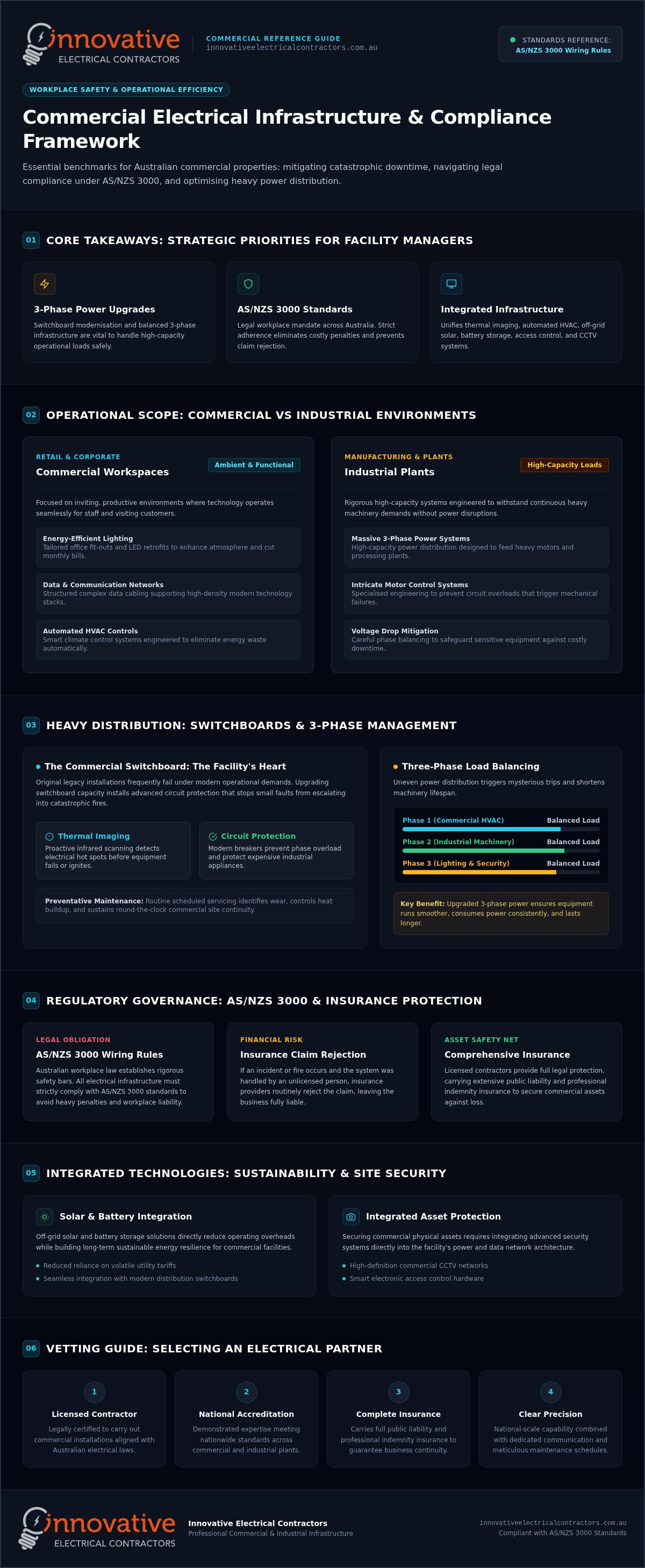
A commercial electrician handles the complex power needs of business environments where the stakes are far higher than a typical home. While residential work focuses on domestic comfort, commercial infrastructure is built for high-capacity loads and constant operation. This scope covers everything from tailored office fit-outs to the heavy-duty maintenance of industrial plants. The primary goal is always risk mitigation. If your electrical system fails, your business stops, making reliability the most valuable asset in your infrastructure.
Qualified commercial electrical contractors manage large-scale systems that include:
High-voltage distribution and 3-phase power systems
Heavy-duty switchboard upgrades and thermal imaging
Energy-efficient lighting and automated HVAC controls
Complex data cabling and integrated security systems
Commercial vs. Industrial Electrical Work
Retail shops and office spaces require a specific set of skills focused on lighting, data, and climate control. These environments need to be functional and inviting for both staff and customers. It's about creating a seamless workspace where technology just works and the lighting enhances the professional atmosphere.
Industrial sites are a different beast altogether. These locations involve heavy machinery, massive 3-phase installations, and intricate motor control systems. A commercial electrician working in this space must understand the unique demands of high-capacity power draw. Specialised knowledge is required to prevent voltage drops or circuit overloads that could damage expensive equipment or cause significant downtime. Precision in these environments is the difference between a productive shift and a costly mechanical failure.
The Importance of a Licensed Electrical Contractor
Australian law sets a high bar for electrical safety in the workplace. Every piece of work must align with the AS/NZS 3000 Wiring Rules to be considered compliant. Hiring a licensed contractor isn't just a best practice; it's a legal necessity that protects your business from liability and ensures the safety of your employees.
If an incident occurs and the work was performed by an unlicensed individual, your insurance provider will likely reject the claim. Professional contractors carry substantial public liability and professional indemnity insurance. This coverage provides a safety net for business owners, ensuring that your assets are protected. Choosing a partner who values precision and clear communication means you get the expertise of a national-scale firm with the dedicated care of a local expert. It's about building a relationship based on trust and dependable results.
Core Services for Modern Australian Commercial Properties
Modern business operations rely on a complex network of power and data that must remain operational around the clock. As your business grows, the demand on your electrical infrastructure increases, often outstripping the capacity of original installations. A professional commercial electrician ensures your site's heart, the main switchboard, is modernised to handle these loads safely. Upgrading your switchboard isn't just about capacity; it's about installing advanced circuit protection that prevents small faults from becoming major fires.
Beyond the basics, commercial services focus on proactive measures to keep your doors open. This includes:
Fault finding and thermal imaging to detect hot spots before they fail
Energy-efficient LED lighting retrofits to slash monthly overheads
Automated control systems for HVAC and lighting to reduce waste
Regular preventative maintenance schedules tailored to your specific industry
Power Load Management and 3-Phase Upgrades
Proper load management is the difference between a stable system and one plagued by mysterious power trips. When a commercial electrician assesses your site, they look at how power is balanced across different phases. If one phase is carrying too much load while others sit idle, you risk equipment damage and inefficient power use. Many modern commercial tools, large-scale air conditioning units, and industrial machines now require the stability of three phase power to operate at peak performance. Three-phase power is the backbone of industrial efficiency. By upgrading, you ensure your machinery runs smoother, lasts longer, and consumes power more consistently.
Integrated Security: CCTV and Access Control
Protecting your physical assets is now a core part of electrical infrastructure. Modern security isn't a standalone system; it's an integrated part of your building's power and data grid. Sophisticated CCTV setups provide high-definition monitoring that can be accessed remotely, while access control systems manage who enters your site and when. By integrating these systems directly into your main power supply, you ensure they remain robust and reliable. This holistic approach simplifies management and provides a higher level of site safety.
All these installations must strictly follow the AS/NZS 3000 Wiring Rules to ensure your business remains compliant and your insurance stays valid. If you're concerned about your site's current capacity or security, a professional assessment from Innovative Electrical Contractors can help you identify and resolve potential risks before they cause downtime.
Compliance and Standards: Navigating AS/NZS 3000
Compliance isn't just a box-ticking exercise; it's the foundation of your business's safety strategy. In Australia, the AS/NZS 3000 Wiring Rules dictate how every wire, socket, and switchboard must be installed and maintained. Following these rules ensures that your site meets the Safe Work Australia electrical safety standards, which are designed to protect workers from preventable hazards. A qualified commercial electrician will ensure your site remains on the right side of the law, providing the necessary documentation to satisfy both government inspectors and insurance auditors.
One of the most critical aspects of compliance is the regular testing of Residual Current Devices (RCDs) and emergency lighting systems. RCDs, or safety switches, must be tripped and timed to ensure they cut power fast enough to prevent a fatal shock. Similarly, exit and emergency lighting must undergo discharge testing every six months to confirm they'll stay illuminated for at least 90 minutes during a power failure. Keeping a detailed electrical logbook of these tests is vital. Without this trail of evidence, your business could face significant legal and financial exposure in the event of an accident.
Mandatory Testing and Tagging
The frequency of testing and tagging depends entirely on your work environment. For a standard office setting, most items require testing every twelve months, whereas equipment used in hostile environments like workshops or factories might need checking every three to six months. As an employer, you have a legal obligation to provide a safe electrical environment for your team. This process involves more than just sticking a tag on a cord; it requires a systematic approach to identifying damaged equipment before it becomes a fire risk. Your compliance records should always be accessible and up to date to prove your commitment to safety during any surprise audit.
Switchboard Safety and Thermal Imaging
Your switchboard is the most likely place for a fire to start, often due to loose connections or overloaded circuits that aren't visible to the naked eye. Modern commercial electrician services now include thermal imaging as part of a standard safety audit. By using infrared cameras, we can detect hotspots where heat is building up due to resistance. This allows us to fix the issue before it leads to a catastrophic failure or a building fire. Upgrading your switchboard to 2026 safety standards ensures you have the latest circuit protection technology. Every major job must be accompanied by a Certificate of Electrical Safety, which serves as your ultimate proof that the work was performed to the highest professional standard.
Vetting Your Contractor: A Buying Guide for Businesses
Choosing the right commercial electrician is a decision that impacts your site's safety and your bottom line for years to come. It's not enough to hire someone who can simply do the job. You need a methodical partner who understands the high stakes of business continuity. Start by verifying their licensing and national accreditation. In Australia, a gold-standard contractor will hold all necessary state-based licences and be able to prove their experience with large-scale projects. This ensures they have the technical mastery to handle your specific infrastructure needs.
Insurance is the next non-negotiable step. Every professional firm must carry comprehensive Public Liability and Professional Indemnity insurance. Public Liability protects your property and the public, while Professional Indemnity covers you against advice-related errors. Without these, your business is exposed to massive financial risk. Beyond the paperwork, evaluate their industry-specific experience. A contractor who specialises in retail fit-outs might not be the best fit for complex industrial plant maintenance. You want a team capable of delivering integrated commercial electrical solutions that grow alongside your company.
Asking the Right Questions Before Signing
Before you sign a contract, you need to dig deeper into their operational processes. A reliable expert will be happy to explain how they manage complex tasks. Use these questions to gauge their suitability for your specific project:
Do you provide a comprehensive energy audit to identify potential cost savings?
How do you handle project management for large-scale new home builds or industrial sites to ensure deadlines are met?
Can you seamlessly integrate solar and battery systems with our existing power infrastructure?
These inquiries reveal whether the contractor is a forward-thinking advisor or just a reactive service provider. A partner who can answer these confidently shows they value clear communication and long-term results.
The Value of Transparent Quoting
A detailed, itemised quote is your best defence against hidden extras that can blow out a project budget. Professionalism starts with transparency. Ensure the quote clearly distinguishes between the initial project costs and any ongoing maintenance requirements. While it's tempting to choose the lowest price, the cheapest quote is rarely the most cost-effective in the long run. Low-cost bids often hide poor-quality materials or a lack of attention to detail that leads to future faults. Investing in precision and high standards from the start saves you from the expense of repeated repairs. If you're ready to partner with a team that values honesty and craftsmanship, you can book a professional site assessment to get a clear, reliable quote for your next project.
Future-Proofing with Innovative Electrical Solutions
As we approach 2026, the role of a commercial electrician has evolved from a simple service provider to a strategic energy partner. Modern businesses are no longer just looking for repairs; they're looking for energy independence and operational resilience. Future-proofing your property involves a shift toward integrated systems that manage power more intelligently. By adopting smart building automation, you can gain granular control over your climate and lighting systems, ensuring energy is only used where and when it's needed. These systems use occupancy sensors and programmed schedules to eliminate waste, directly impacting your bottom line.
Reliability is equally critical for businesses operating in remote areas. Off-grid power solutions, incorporating a mix of solar, battery storage, and backup generators, provide a robust safety net for industrial sites where grid stability is a concern. This level of infrastructure requires a contractor with national-scale expertise and a disciplined approach to maintenance. Partnering with an expert who understands these complex synergies ensures your site remains operational regardless of external grid pressures.
Commercial Solar and Battery Integration
Rooftop solar is now a standard requirement for businesses aiming to slash operational costs. By generating your own power during daylight hours, you can significantly reduce your reliance on the grid and protect your business from rising energy prices. Integrating battery storage takes this a step further, allowing you to capture excess energy and deploy it during peak demand periods when electricity costs are highest. Regular solar battery maintenance protects your long-term ROI by ensuring your energy storage systems operate at peak efficiency and safety levels throughout their entire lifespan. This proactive approach prevents capacity loss and ensures your investment continues to pay dividends for years.
Choosing Innovative Electrical Contractors
Our team at Innovative Electrical Contractors is built on a foundation of no-nonsense, professional authority. We don't just perform tasks; we provide comprehensive solutions across electrical, air conditioning, and security systems. Whether you're managing a large-scale industrial plant or a new home build, our disciplined craftsmanship ensures every circuit and sensor is installed to the highest Australian standards. We take pride in being the reliable local expert you can trust for clear communication and methodical project management. We understand that your business infrastructure is the heart of your operation, and we treat every project with the precision it deserves.
Ready to secure your business infrastructure? Contact Innovative Electrical Contractors today to discuss how we can help you build a safer, more efficient future.
Securing Your Business Infrastructure for 2026 and Beyond
Managing a successful Australian business means staying ahead of technical challenges before they impact your bottom line. We've highlighted the importance of strict AS/NZS 3000 compliance and the strategic value of modernising your power systems to maintain safety. Investing in 3-phase power and integrated security isn't just a safety measure; it's a commitment to long-term operational resilience. A qualified commercial electrician acts as a trusted advisor, helping you navigate these complexities with precision and care.
Innovative Electrical Contractors provides the expert reliability you need for national-scale projects. We are specialists in 3-phase power and industrial maintenance, offering comprehensive solar and battery integration to lower your overheads. Whether you're coordinating a new build or upgrading an industrial site, our team delivers the high standards your business deserves. Don't leave your electrical safety to chance when you can partner with a reliable local expert who understands your unique needs.
Get a Professional Quote for Your Commercial Project and ensure your site is ready for the future. Take the first step toward a more reliable and energy-efficient workplace today.
Frequently Asked Questions
What is the difference between a residential and a commercial electrician?
The primary difference lies in the scale and complexity of the electrical systems. Residential electricians focus on domestic needs like home lighting and power points. A commercial electrician manages high-voltage infrastructure, 3-phase power, and large-scale data cabling for office fit-outs or industrial plants. These environments require a deeper understanding of the AS/NZS 3000 standards to ensure business continuity and workplace safety under heavy electrical loads.
How often should my commercial property undergo an electrical safety audit?
Your audit frequency depends on the specific risks of your industry. Generally, a full safety audit is recommended every 12 to 24 months to maintain compliance. However, mandatory tasks like RCD testing and emergency light discharge tests must occur every six months according to Australian standards. Keeping your safety logs up to date ensures you remain protected during insurance audits and government inspections.
Does my business really need 3-phase power for standard office equipment?
While basic laptops don't require it, most modern offices benefit from 3-phase power for their infrastructure. It is essential for running large-scale air conditioning units, commercial printers, and server rooms efficiently. This system provides a more stable power supply and allows for better load balancing across your property. It prevents unexpected circuit trips and protects your expensive equipment from the stress of voltage fluctuations.
Can a commercial electrician help reduce my company’s energy bills?
Yes, a skilled commercial electrician can identify major cost savings through a detailed energy audit. We often recommend upgrading to high-efficiency LED lighting and installing automated sensor controls for HVAC systems. Integrating solar and battery storage is another highly effective way to reduce your reliance on the grid. These improvements pay for themselves by slashing your monthly overheads and reducing energy waste across your entire operation.
Is it mandatory for commercial buildings to have emergency lighting?
Emergency lighting is mandatory for most commercial buildings under the Building Code of Australia. These systems ensure that occupants can find their way to safety during a power failure or fire. You are legally required to perform discharge tests every six months to confirm the batteries can stay illuminated for at least 90 minutes. A professional contractor will help you maintain these systems to ensure full compliance.
What qualifications should I check when hiring an electrical contractor for an industrial site?
You should verify that the contractor holds a valid state-based electrical licence and has extensive experience with industrial machinery. Look for national accreditation and comprehensive insurance, including Public Liability and Professional Indemnity. It's also important to check for specialised skills in 3-phase power and motor control systems. A disciplined professional will always be transparent about their qualifications and provide references for similar large-scale projects.
How does solar battery storage benefit a commercial property in Australia?
Solar battery storage allows your business to capture excess energy generated during the day for use when grid prices are highest. This significantly reduces your peak demand charges and lowers your total energy overheads. For many Australian sites, it also provides a critical backup power source. This ensures that your security systems and data servers remain operational during a local grid outage, providing essential peace of mind.
What happens if my business fails an electrical compliance inspection?
Failing an inspection means your site is non-compliant, which can result in legal penalties or a forced closure of your facility. It also puts your business insurance at risk, as many policies are void if the electrical work doesn't meet Australian standards. A professional commercial electrician will provide a clear rectification plan to fix any faults immediately. This ensures your workplace remains safe and your compliance documentation is fully restored.


Comments