
How to Choose the Right Electrical Contractor for Your Australian Property

Hiring the wrong person to wire your home isn't just a budget risk; it's a fundamental threat to your family's safety and your property's insurance compliance. When you're looking for an electrical contractor, the stakes are higher than just fixing a flickering light or a faulty power point. You need a partner who understands the latest AS/NZS 3000:2018 wiring rules and can integrate complex systems like off-grid solar, battery storage, or CCTV security.
It's completely normal to feel a sense of anxiety about hidden costs or dodgy work that might leave you in the dark. Peace of mind shouldn't be a luxury. You want a safe, compliant installation and a professional who communicates clearly from the first quote to the final inspection. Our comprehensive guide will help you master the hiring process by showing you exactly how to evaluate contractors for their technical mastery and reliability. We'll preview the essential licence checks, explain the difference between a standard sparky and a contractor, and provide a framework for a stress-free project.
Table of Contents
Understanding the Role of a Professional Electrical Contractor
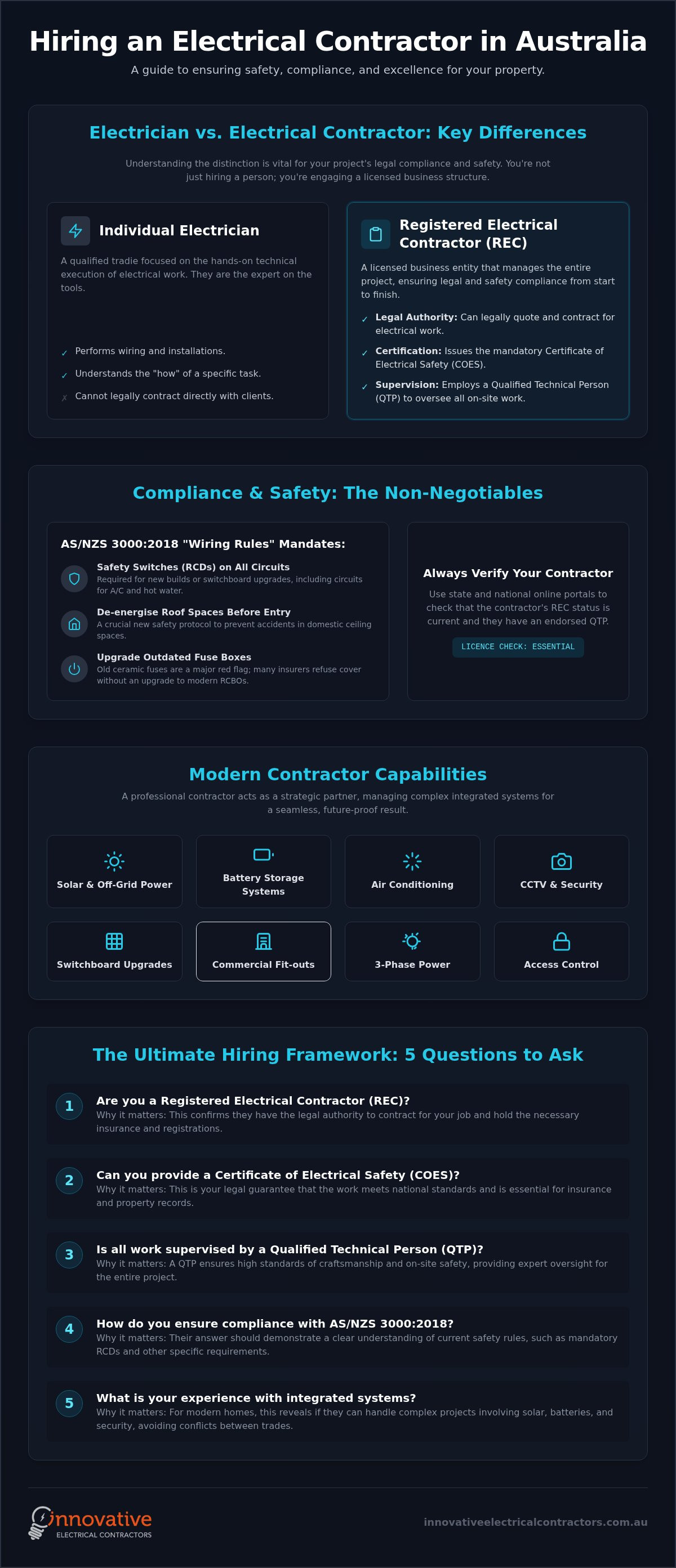
Many property owners use the terms "electrician" and "contractor" interchangeably, but the legal and practical differences are significant. While an individual electrician has the technical training to perform wiring, an electrical contractor is a business entity that holds the necessary registrations and insurance to take on full project responsibility. In Australia, this distinction is vital for your protection. Only a Registered Electrical Contractor (REC) can legally enter into a contract to perform work for a client and provide the required safety certifications upon completion.
Electrician vs. Contractor: What is the Difference?
Individual electricians focus on the technical execution of the job. They are the experts on the tools who understand the "how" of a specific installation. A contractor, however, manages the "what" and "when" of the entire project. They handle the business-level delivery, including public liability insurance, workplace health and safety compliance, and project scheduling. If you are planning a major renovation or a commercial fit-out, you aren't just hiring a person; you're hiring a licensed business structure that carries the legal obligation to ensure the work is safe and compliant.
Legal Authority: Only contractors can legally quote and contract for electrical work in Australia.
Certification: A contractor is responsible for issuing a Certificate of Electrical Safety (COES) to guarantee the work meets national standards.
Supervision: They provide Qualified Technical Persons (QTP) to oversee on-site performance and maintain high standards of craftsmanship.
Scope of Works for Modern Contracting Firms
Modern electrical contracting has moved far beyond simple power points and light fittings. Today, a professional electrical contractor acts as a strategic partner who manages complex, integrated systems. For new home builds or commercial projects, this involves coordinating multiple disciplines to ensure a seamless result. You need a partner who can handle high-capacity 3-phase power for industrial sites while simultaneously managing solar and battery storage integration for energy efficiency.
A reputable firm manages the end-to-end project flow. They organise various components like air conditioning, CCTV, and access control systems so they work together without conflict. This holistic approach reduces project friction. Instead of juggling five different trades, you deal with one methodical partner who ensures every system is future-proofed and compliant. Whether it's a switchboard upgrade or a complex off-grid generator setup, the contractor ensures the entire infrastructure is reliable, efficient, and built to last.
Compliance and Safety: The Non-Negotiables of Hiring
Safety is the cornerstone of any electrical project. It isn't just about preventing immediate hazards; it's about ensuring your property remains insurable and legally compliant for years to come. In Australia, this begins with understanding Australia's electrical licensing framework, which ensures that every professional on your site has met rigorous national standards. When you engage an electrical contractor, you are hiring a firm that must adhere to the AS/NZS 3000:2018 "Wiring Rules." These standards now mandate that safety switches (RCDs) are installed on all circuits for new builds or switchboard upgrades, including air conditioning and hot water systems. New safety protocols also require professionals to de-energise domestic roof spaces before entry to prevent accidents. If your property still relies on old ceramic fuses, it's a major red flag. Many insurance providers now refuse to issue policies for homes with these non-compliant components, requiring an upgrade to modern RCBOs instead.
Licensing and REC Status Explained
Verifying an electrical contractor and their REC status is your first line of defence against dodgy work. National and state authorities provide online portals where you can check the current standing of a firm. An expired or restricted licence doesn't just mean a lapse in paperwork; it means the contractor lacks the legal authority to guarantee the safety of your installation. You should also confirm that the firm has an endorsed Qualified Technical Person (QTP) overseeing the work. Under recent 2026 regulations, contractors must notify authorities within 10 business days if their QTP leaves the business, ensuring that expert supervision is never compromised. Digital compliance is also becoming the standard across the country, with many jurisdictions now requiring all Certificates of Compliance to be submitted through electronic portals to ensure a permanent, verifiable record of safety.
Insurance Requirements and Consumer Protection
Never assume a contractor is insured. You must request proof of current public liability and products liability insurance before any work commences on your property. This coverage protects you against accidental damage or injury caused during the project. For residential works, consumer protection insurance provides an extra layer of security, covering you if the contractor is unable to complete the job or fix defects. A Certificate of Electrical Safety is the most important document you'll receive after the job is done. It serves as your legal proof that the work was performed by a licensed professional and meets all Australian standards. Without this certificate, your property insurance could be voided in the event of an electrical fire. If you want to ensure your next project is handled with this level of precision, you can reach out to our expert team for a transparent assessment.
Specialist Capabilities: Why Integration Matters
Choosing a partner who can manage electrical, solar, and climate control under one roof isn't just about convenience. It's about system performance. When separate trades work in isolation, they often miss the bigger picture of how your property's energy is consumed and managed. A multi-disciplinary electrical contractor ensures that your air conditioning doesn't fight with your solar output and that your security system has the necessary backup power during a blackout. This integrated approach eliminates the friction of managing multiple schedules. It also prevents the common problem of trades blaming each other when things don't work as expected. You gain a single point of accountability, which is invaluable for complex new builds or commercial fit-outs.
Solar and Battery Storage Expertise
Clean Energy Council (CEC) accreditation is non-negotiable for any solar project. An expert contractor will always link a solar battery installation directly with your main switchboard capacity to avoid overloading the system. This is particularly vital for off-grid solutions where solar, batteries, and backup generators must function as a single, harmonious unit. By planning these systems together, you ensure your property is future-proofed for the projected growth in the smart home market, which is expected to reach $12.80 billion in Australia by 2034. It also prepares your home for the inevitable shift to electric vehicles, ensuring your charging infrastructure is ready when you are.
Commercial and Industrial Specialisations
Business sites require a higher level of technical mastery. Managing three phase power and high-voltage infrastructure is standard for industrial projects. To maintain business continuity, regular electrical fault finding and preventative maintenance are essential. This proactive care identifies potential failures before they lead to costly downtime. Integrating CCTV and access control into your site's electrical plan provides a comprehensive security solution that is both reliable and easy to manage. A single partner can coordinate the installation of these systems alongside your primary power needs, ensuring that every component is optimised for efficiency and long-term reliability.
The Ultimate Hiring Framework: 5 Questions to Ask
Vetting an electrical contractor requires more than a quick look at a website. You need to be certain that the firm has the capacity to handle the specific complexities of your property without cutting corners. When you're ready to hire, use these five questions to separate the professionals from the pretenders. It protects you. It ensures your project stays on track. It guarantees that the final result meets every Australian safety standard.
Can you provide proof of current REC status and insurance? This is your non-negotiable baseline for any project.
Do you have experience with similar-scale residential or commercial projects? Expertise in a small renovation doesn't always translate to complex industrial fit-outs.
How do you manage project timelines and communication? Clarity on your point of contact prevents the common anxiety of project delays.
Will you provide a Certificate of Electrical Safety upon completion? This is your legal lifeline for property insurance and future sales.
Do you offer integrated services like solar or air conditioning? Hiring a one-stop-shop reduces the friction of managing separate trades.
Evaluating Quotes and Transparency
A low-ball estimate often hides a lack of technical foresight. If a quote seems too good to be true, it probably is. Choosing the cheapest option can lead to expensive electrical switchboard upgrades later if the contractor didn't account for your property's total load requirements. You should look for a detailed scope of works in the initial contract. This document must clearly identify any potential "hidden extras" like cable runs, disposal fees, or specialised equipment hire. A transparent tender is a sign of a methodical partner who values honesty over a quick win.
Checking References and Past Performance
When checking references, look for a portfolio that matches your specific needs. A firm with a strong local reputation provides the accountability you need, even when they operate on a national scale. For businesses, long-term partnerships are far better for commercial property maintenance. The contractor becomes familiar with your site quirks and can respond more efficiently to your needs. If you want a partner who values clear communication and technical excellence, you can get in touch for a transparent quote that covers every detail of your project.
Innovative Electrical Contractors: Your Partner in Excellence
Innovative Electrical Contractors represents the intersection of technical mastery and approachable, local reliability. We aren't just another service firm; we are a dedicated electrical contractor that prioritises the long-term safety, compliance, and energy efficiency of your property. Our team approaches every project with a disciplined "can-do" attitude, ensuring that no technical challenge is too complex. Whether we are designing a large-scale commercial fit-out or a specialised off-grid power system with battery and generator integration, our focus remains on providing peace of mind through precision. We take pride in our craftsmanship and the integrity of our work, grounding our modern solutions in traditional values of hard work and dependability.
Our expertise in renewable energy is particularly vital as Australia transitions toward clean energy targets. With an industry-wide need for an additional 32,000 electricians by 2030 to meet these goals, we are already leading the way in sustainable power solutions. We specialise in complex off-grid setups that require a deep understanding of how solar, battery storage, and backup generators interact to provide a seamless power supply. By choosing a partner with this level of specialist knowledge, you ensure your property is prepared for the energy demands of the future.
A Methodical Approach to Every Project
We believe that a successful project starts with transparency and meticulous planning. From the first quote to the final sign-off, we maintain a clear line of communication so you are never left in the dark. As your "Trusted Advisor," we don't just perform a task; we provide the right solution for your specific situation. This includes modern infrastructure like ev charger installation, where we ensure your system meets all 2026 Australian standards and property load requirements. By managing the technical details and compliance paperwork, we allow you to focus on your property or business with total confidence in your electrical infrastructure.
National Standards, Personal Service
While we deliver projects on a national scale, we never lose sight of our community-focused roots. We operate with the efficiency and discipline of a national firm but maintain the warm, reliable feel of a local expert who is personally invested in your project. Our integrated service model covers everything from commercial electrical and air conditioning to solar and CCTV security setups. This one-stop-shop approach saves you the administrative headache of juggling different trades and ensures that all your systems work in perfect harmony. It's about more than just wiring; it's about building a sustainable and secure future. Contact us today to discuss how we can partner with you on your next electrical or renewable energy project.
Future-Proof Your Property with Confidence
Selecting a professional electrical contractor is the most important decision you'll make for your property's safety and longevity. You now have a practical framework to verify REC status, confirm insurance coverage, and ensure your project adheres to the latest AS/NZS 3000:2018 standards. By choosing a partner who can integrate solar, security, and climate control, you eliminate the friction of managing separate trades and gain a single point of accountability.
Our team at Innovative Electrical Contractors brings a methodical approach to every build. We are accredited solar and battery installers with specialist expertise in off-grid power systems and comprehensive commercial infrastructure. We take pride in our craftsmanship and our commitment to transparent communication. Don't settle for a dodgy tradie when you can have a trusted advisor by your side. Discuss your project with the experts at Innovative Electrical Contractors today to get started. We're ready to help you build a safe and efficient future for your Australian property.
Frequently Asked Questions
Is an electrical contractor different from a regular electrician?
An electrical contractor is a registered business entity, whereas an electrician is a qualified individual who performs the technical work. In Australia, only a contractor can legally enter into a contract to perform work for others. They carry the necessary public liability insurance and are responsible for the overall safety and compliance of the project. While the electrician focuses on the wiring, the contractor manages the legal and business obligations of the job.
How do I check if an electrical contractor is licensed in Australia?
You can verify a licence by using the online public register provided by your state electrical regulator. Each state maintains a database where you can search by the business name or licence number to confirm their current standing. It's vital to ensure the licence is active and not restricted. Hiring a licensed electrical contractor ensures that the work is performed to national safety standards and remains eligible for insurance coverage.
What insurance should a professional electrical contractor have?
A professional contractor must hold current public liability and products liability insurance. These policies protect you against accidental property damage or personal injury that might occur during the project. You should always ask to see a Certificate of Currency before any work begins on your site. For residential projects, additional consumer protection insurance may also be required to cover defects or incomplete work if the business ceases to operate.
Can an electrical contractor install solar panels and batteries?
Yes, many contractors specialise in renewable energy solutions, including solar panels and battery storage. To ensure quality and eligibility for government rebates, you should choose a firm with Clean Energy Council accredited installers. These professionals understand how to integrate solar systems with your existing switchboard and can manage complex off-grid power solutions involving batteries and backup generators to provide a seamless, sustainable energy supply for your property.
Why do I need a Certificate of Electrical Safety (COES)?
A Certificate of Electrical Safety is your legal proof that the work was performed by a licensed professional and complies with the AS/NZS 3000 Wiring Rules. You need this document for property insurance purposes, as insurers may void your policy if a fire is caused by uncertified work. It's also essential when selling or leasing your property, as it demonstrates that the electrical infrastructure meets all mandatory safety requirements and national standards.
What happens if I hire an unlicensed person for electrical work?
Hiring an unlicensed person is illegal and extremely dangerous. If an electrical fault causes a fire or injury, your insurance provider will likely reject your claim, leaving you with massive out-of-pocket costs. Additionally, you may face significant fines from state regulators for allowing unauthorised work on your property. Unlicensed work often bypasses critical safety standards, such as the mandatory installation of RCDs, putting your family or employees at serious risk.
How much does it cost to hire an electrical contractor for a new build?
The cost depends entirely on the size of the property, the complexity of the wiring, and the integration of specialised systems like air conditioning or solar. A comprehensive quote for a new build should include a detailed scope of works, covering everything from the main switchboard to data cabling. It's best to request a transparent tender that outlines all labour and material costs to avoid hidden extras during the construction process.
Do electrical contractors handle air conditioning and security systems?
Many modern contracting firms offer integrated services that include air conditioning and security system installations. This holistic approach ensures that your climate control and CCTV systems are wired correctly into your property power grid. By using one electrical contractor for these diverse needs, you reduce project friction and ensure all components work together efficiently. This is particularly beneficial for smart home setups and commercial sites requiring advanced access control.


Comments