
Commercial Solar PPA vs Capital Purchase: Costs, Ownership and Risks
Updated: Nov 3
In Australia, the commercial solar PPA versus capital purchase decision comes down to who owns and maintains the system. With a PPA, a third-party provider owns, operates and maintains the solar system, while your business pays for the electricity it generates. With a capital purchase, your business pays the system cost upfront and owns it from the start.
It’s understandable to weigh avoiding upfront capital against the benefits of ownership. A PPA can shift system maintenance and performance responsibilities to the provider, while buying outright gives your business control of the asset and its energy savings. The right comparison depends on cash flow, energy use, site plans and willingness to take on a long-term contract.
This guide explains how commercial solar PPAs work and compares their costs, ownership and risks with a capital purchase. It also covers maintenance, renewable certificates, contract exit fees, and what selling or leasing your premises could mean, so you can assess which option better fits your business.
Table of Contents
Provider operation and maintenance responsibilities
In an on-site power purchase agreement (PPA), the provider owns, operates and maintains the solar system. Your business buys the electricity it generates rather than owning the panels. This shifts some system performance risk to the provider. If the system underperforms, the business pays for the electricity it receives, not for energy it fails to generate.
The agreement sets out how those responsibilities work in practice. Read the terms for monitoring, maintenance, repairs and replacement components. They clarify who responds to faults, arranges repairs and manages system performance. Check whether a battery is included and how its operation and maintenance are handled.
Provider responsibilities: The provider operates and maintains the system, and is responsible for repairs.
Business responsibilities: The business pays for the solar electricity generated under the agreement and continues buying grid power for after-sunset use.
Performance terms: The agreement should explain how generated electricity is measured and how charges relate to actual output.
Compare those terms with capital purchase ownership. A business that buys the system owns it from the start, controls its design and optimisation, and keeps the energy savings. It also takes responsibility for arranging maintenance and managing system performance. For example, a commercial system owner should budget for an inverter replacement around the 10-year mark.
That distinction matters for sustainability planning and cash flow. A PPA can reduce the operational work your business manages directly, while ownership offers greater control over the asset. Before choosing, map each responsibility to the party named in the agreement. Check how it deals with faults, repairs, battery components and electricity supply when generation falls short.
PPA contract exit fees and property sale risks
Australian on-site solar power purchase agreements commonly run for 10-20 years, tying electricity pricing and site access to a long-term contract. The exit and transfer clauses matter if your organisation plans to relocate, sell or change its premises.
Exit fees and termination terms
An exit clause explains how either party can end a solar power purchase agreement before its contracted end date. Early termination can trigger charges or other obligations, depending on the contract.
Read the termination conditions alongside the agreement’s pricing terms. Find out what happens if the provider fails to meet its responsibilities, the business stops operating at the site, or the contract ends early. For example, the agreement may describe how to transfer it instead of terminating it. The exact wording determines your options and potential liabilities.
Property sale and roof access risks
A property sale can affect an on-site PPA because the provider owns the system on the building’s roof. The agreement should explain whether a buyer can take over the contract, whether the system must be removed and who arranges roof access during the remaining term.
For a business leasing premises, landlord permission and lease timing also matter. Formalise what happens if the lease expires or ends early, including access for maintenance and the system’s future at the site. A sale late in a 10-15-year PPA can still leave transfer or removal responsibilities to resolve.
Scrutinise pricing as closely as exit rights. Some PPA prices increase over the contract term; others may be indexed to the consumer price index. Compare the escalation method, payment obligations and transfer provisions together. A low starting electricity rate may not tell the full story if the agreement runs beyond your planned occupancy.
For example, an organisation planning to sell before the contract ends should understand the transfer process before signing. Reviewing the site’s solar and battery requirements alongside the agreement can clarify practical considerations; commercial electrical planning can inform that assessment.
What are the risks of commercial solar PPAs, including early termination, property sale and roof access?
A commercial solar PPA links your electricity supply to a long-term site agreement. Australian on-site PPAs commonly run for 10-20 years, so changes to business operations can affect the arrangement. The main risks involve early termination, contract price increases, property changes and ongoing access to the roof. Each can create costs or practical obligations if the contract doesn’t explain how they’re handled.
Early termination can leave the business with a settlement, a transfer process or an obligation to remove the system, depending on the contract. Don’t assume that closing or relocating the business automatically ends the agreement. For example, if a tenant moves before the PPA term ends, the tenant, landlord or provider may still need to take action. The contract should spell out the process and each party’s responsibilities.
Price changes also affect the deal’s value over time. A PPA may include annual escalation or indexation to the consumer price index. If the contract price rises while grid electricity prices change differently, expected savings can narrow or disappear. Review the pricing formula over the full term, not just the starting rate. Also account for electricity the business still needs from the grid after sunset.
Sale or lease change: Identify whether a buyer or new tenant can take over the PPA, and how transfer works.
Roof access: Define access for provider maintenance and repairs, including coordination with the building owner.
End of agreement: Clarify whether the system stays, transfers or must be removed, and who manages reinstatement.
For leased premises, obtain the landlord’s permission before installation and formalise what happens when the lease expires or ends early. Roof repairs or redevelopment may also require temporary system access or removal. Compare those scenarios with the PPA’s notice periods, approval steps and cost responsibilities. Clear terms help organisations plan for a sale, relocation or building work without confusing electricity supply obligations with ownership of the solar equipment.
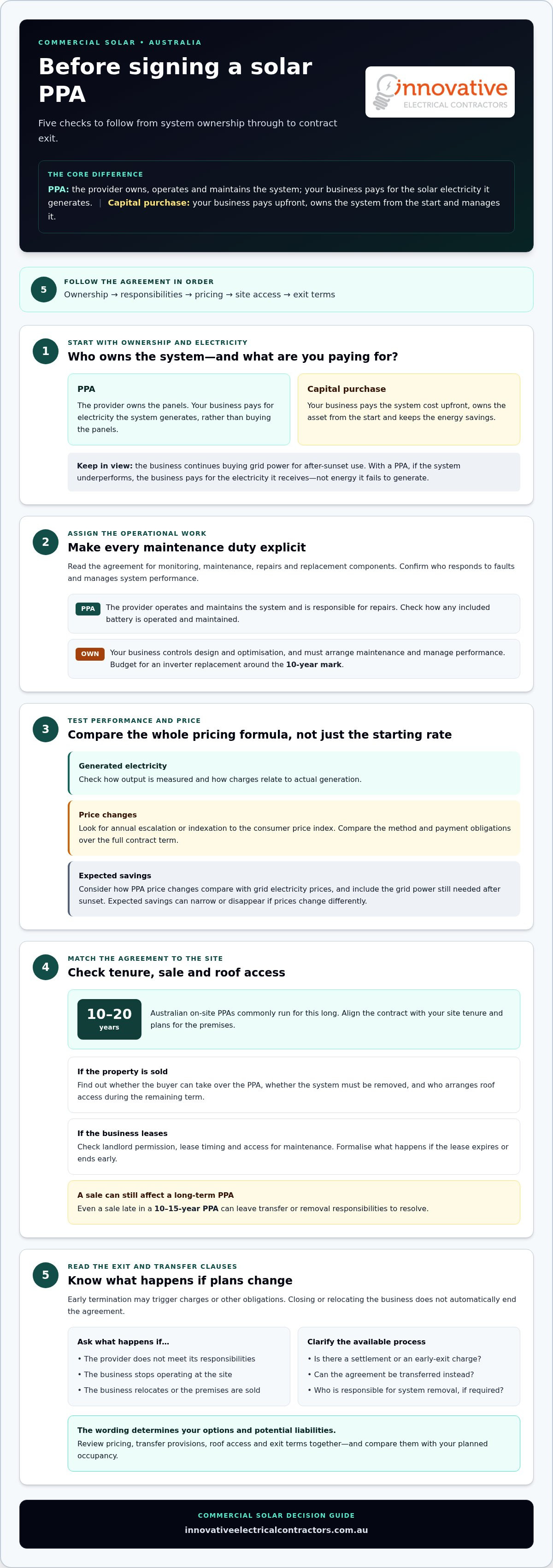
How can a business get quotes and assess a commercial solar PPA or purchase proposal in Australia?
Compare PPA and purchase proposals for the same site, electricity use and operating plans. Start with interval bills, daytime demand, roof space and sun exposure. These details help estimate how much solar electricity your business could use directly and what it may still need from the grid.
Ask each proposal to state its assumptions clearly. Compare system design, expected generation, performance terms, contract length and total payments over the agreement. For a financed purchase, assess the interest rate, repayment term and expected savings against the system’s performance assumptions. A longer loan takes longer to repay than an upfront purchase.
PPA pricing: Compare the starting electricity rate, escalation method and any consumer price index (CPI) indexation over the contract.
Ownership: Identify who owns the system and who receives any renewable certificates. Australia’s certificate framework identifies STCs for solar systems under 100 kW and LGCs for systems over 100 kW.
Site and contract: Match contract length and access conditions to your site tenure, planned building works and roof arrangements.
Compare likely cash flow, not just the headline rate. A PPA may avoid an upfront capital cost, while a purchase gives your business ownership and control. For either option, test how the proposal holds up if electricity use changes, the business relocates or system output differs from expectations. Realistic assumptions make the comparison more useful.
Check that the proposed system can connect to the grid before committing to a contract. Include this milestone in your proposal review alongside the site design and supply arrangements. It helps clarify whether the planned system can connect before your business commits.
For a project-specific comparison of commercial solar options, discuss your commercial solar proposal with an electrical contractor.
Innovative Electrical Contractors: Commercial Electrical
Innovative Electrical Contractors provides commercial electrical work and solar and battery installations for businesses comparing PPA and capital purchase options. Turn to the team for electrical expertise in planning a commercial solar or battery project around your site’s requirements.
A practical discussion can connect your energy goals with the right project scope. For example, when weighing a grid-connected system against an off-grid setup, consider electricity use, site conditions and operational needs. Innovative Electrical Contractors also installs off-grid solar, battery and generator systems.
If you’re ready to discuss your commercial electrical or solar project, contact Innovative Electrical Contractors.
Make your next energy decision part of the business plan
A commercial solar PPA versus capital purchase in Australia is more than an equipment decision. It can shape how your business plans for future sites, energy demand and investment priorities. Innovative commercial approaches across the clean energy sector continue to emerge worldwide, with entities like Greenovations Venture Studio backing and launching sustainable green-economy ventures. Before moving ahead, decide what matters most: retaining capital, controlling an energy asset or staying flexible as operations change. Involve the people responsible for finance, facilities and property decisions early. Their shared perspective can turn a technical proposal into a practical business choice.
For commercial energy planning, Innovative Electrical Contractors provides Commercial Electrical and Electrical Services, as well as solar, battery and off-grid installations. Start with a clear picture of your site and the role solar should play in its future.
Contact Innovative Electrical Contractors to discuss your commercial electrical project. A considered plan can help your business take its next energy step with confidence.
Frequently Asked Questions
How Does a Solar PPA Work?
A solar PPA lets a business use electricity from a system owned by a third-party provider. The provider installs and operates the system, while the business pays for the electricity generated under agreed pricing terms. For example, a warehouse using power during daylight hours can consume solar generation on site, then draw from the grid when demand exceeds system output.
Why Choose a Solar PPA?
A business may choose a solar PPA to access solar electricity without paying the full system cost upfront. The provider manages system operation and maintenance, reducing the work the business handles itself. This structure may suit organisations prioritising predictable energy costs or sustainability goals. Compare the contract’s pricing and obligations over its full term with ownership, which gives the business control of the asset and its operation.
Is a Solar PPA Right for Your Business?
A solar PPA may suit a business with suitable roof space, strong daytime electricity use and plans to stay at the site. For example, a facility operating during daylight hours can use more of its solar generation directly. A business with low daytime demand, limited roof access or plans to relocate may find the agreement a poorer fit. Both site use and tenure matter.
What happens at the end of a solar PPA?
The agreement determines what happens when its term ends. It may state whether the system transfers to the business, remains at the site under new terms, or is removed by the provider. For example, a business planning a building redevelopment should understand the end-of-term arrangements before committing. Don’t assume ownership transfers automatically; the contract governs the outcome.
What is a PPA?
A power purchase agreement, or PPA, is a contract to buy electricity under agreed terms. In a commercial on-site solar arrangement, a provider owns and maintains the system, and the business pays for the electricity it generates. Unlike buying panels, a PPA lets the business purchase power rather than the solar asset. Contract terms define pricing and responsibilities.
How does a commercial solar PPA work in Australia?
In Australia, a commercial on-site solar PPA sets out how a business buys electricity generated by a provider-owned system. The contract covers the energy price, operating responsibilities and site arrangements. For the commercial solar PPA versus capital purchase decision in Australia, consider how the agreement fits your business’s energy demand and site plans. Electricity use after sunset remains separate from solar generation.


Comments